
OEM / ODM · PRODUCT DEVELOPMENT
Custom Power Banks: Private Label or Full Custom Development?
Compare private label power banks with full custom development: tooling costs, testing, material commitments and when a new mold makes business sense.
 Reviewed by Grace WongCo-Founder | Custom Charging Solutions Lead · Updated November 7, 2026 · 14 min read
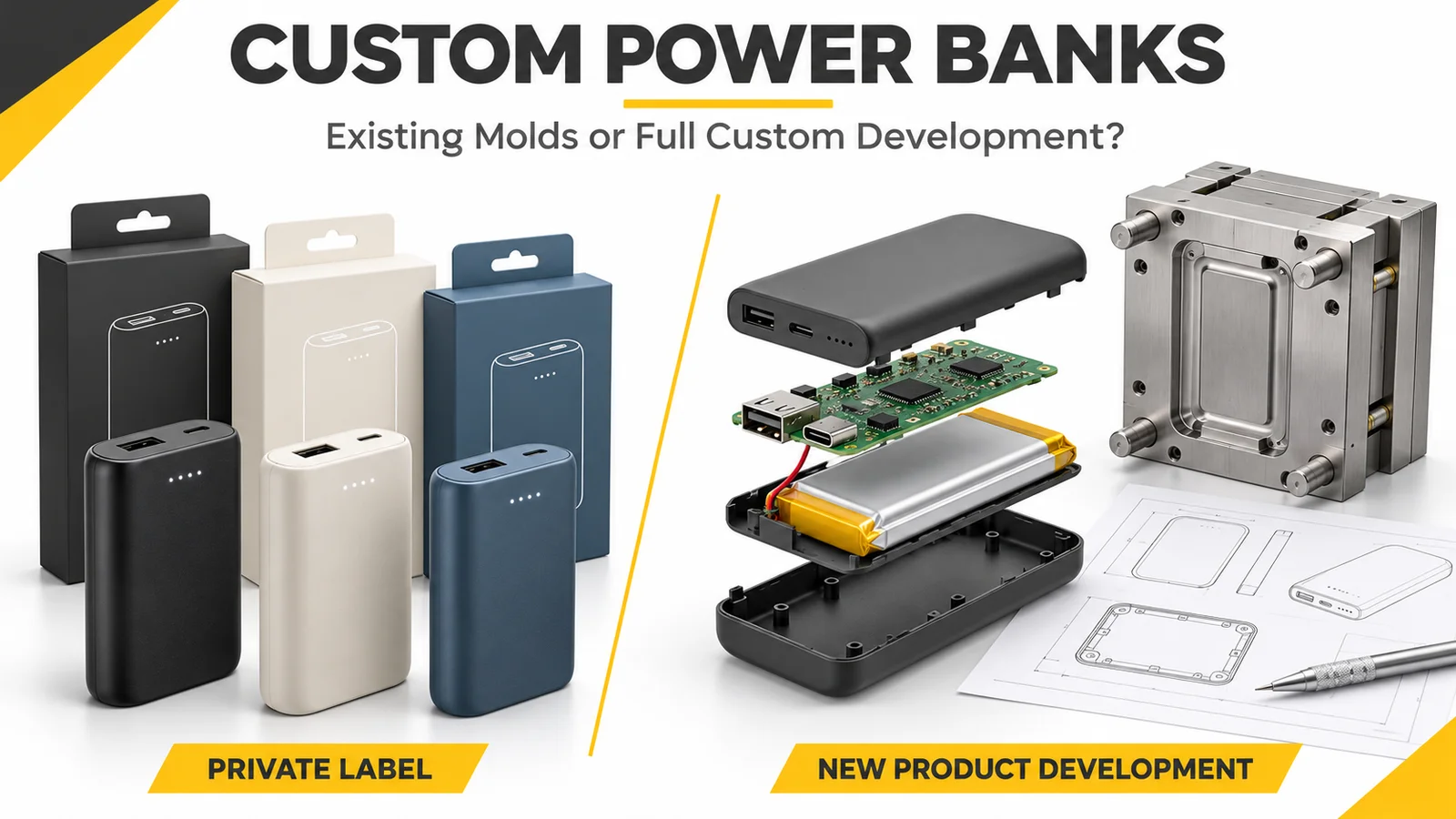
For brands still validating their market, differentiated customization using an existing power bank mold is usually the most economical and practical starting point. Developing a completely new product with dedicated tooling is a higher-investment, higher-risk decision. Validate demand and channel performance before committing to full custom development.
Start with differentiation, not necessarily a new mold
An established product platform can give a new brand room to differentiate through logo placement, packaging, selected colors and finishes, and suitable model selection. Available options and minimum order quantities depend on the model and process.
This approach lets buyers test positioning, price and channel demand before committing to a completely new housing and engineering program. It does not remove the need for quality checks or documentation review: buyers must still confirm that reports cover the actual product configuration they order.
Choose a product that fits the customer first. Then use consistent branding, packaging and a clear market position to make it your own.
OEM, ODM and private tooling are different decisions
OEM generally describes manufacturing to a customer's requirements or design. ODM involves a manufacturer participating in product design as well as manufacturing. Suppliers use these terms differently, so a purchase agreement should define the actual work and responsibilities.
Neither term, by itself, tells you whether a new mold is necessary. A customer-designed product made under an OEM arrangement may require new tooling. A supplier-developed ODM platform may already have a usable mold.
For practical sourcing decisions, compare these three routes:
| Route | Typical scope | Best starting situation |
|---|---|---|
| Existing-model private label | Logo, packaging, selected colors and finishes | First orders, market testing and a relatively fast launch |
| Adaptation of a proven platform | Feasible changes to selected features, housing details or configuration | Validated demand and a clearly defined improvement |
| Full custom development | Coordinated industrial, mechanical and electronic design, dedicated tooling and validation | A funded project with a credible channel and sustained sales plan |
Why a new power bank is an engineering project
A successful new power bank needs more than an attractive rendering. Industrial design helps make the product desirable; mechanical engineering helps make it manufacturable; electronic engineering helps make its performance safe, consistent and reliable. These disciplines must be coordinated throughout development, rather than approved in isolation.
Industrial design: will the appearance attract your customer?
Industrial design shapes the first impression: proportions, color, finish, grip, controls and the way a product communicates its brand positioning. It asks whether the design appeals to the intended customer and offers a meaningful reason to choose it. A striking image is a useful starting point, but it does not establish that the internal components fit or that the housing can be manufactured.
Mechanical engineering: can it be produced efficiently with a high first-pass yield?
Mechanical design turns the visual concept into a repeatable physical product. Component clearances, tolerances, housing joints, fastening methods, port alignment and tooling details influence how easily workers can assemble each unit and how consistently parts fit across a production batch.
A practical structure supports both first-pass yield—the proportion of units that pass the defined production checks without rework—and production throughput. Awkward assembly steps, difficult cable routing or inconsistent fits can increase cycle time, rework and scrap. Serviceability also matters: where safe and appropriate, the design should allow fault diagnosis and controlled repair without unnecessarily damaging other parts. Battery safety and the intended construction must guide that decision.
Neither yield nor output can be established from a rendering alone. Prototypes, tooling trials and pilot builds are needed to measure assembly time, identify recurring defects and confirm the process before a larger material commitment.
Electronic engineering: will quality remain stable in real use?
Electronic engineering addresses charging functions, circuit integration, battery compatibility, component selection, protection behavior and thermal performance. The objective is consistent operation across representative devices and operating conditions, rather than a sample that works once on a demonstration bench.
Circuit design contributes to product reliability, but stable quality also depends on battery and component consistency, mechanical integration, manufacturing controls and verification. Functional checks, thermal evaluation, protection testing and aging tests help reveal weaknesses before shipment. A reliable product is the result of the complete system and production process.
AI can help visualize a concept; it cannot replace hands-on development responsibility
AI-assisted tools can help teams explore appearance concepts, colors and visual directions quickly. However, an AI-generated product image is not evidence of a production-ready structure, an achievable first-pass yield, an efficient assembly process, serviceability or stable electronic performance.
These questions still require an experienced product lead who understands actual products and can coordinate industrial, mechanical and electronic engineering with the factory. The team must review feasible trade-offs, build and inspect samples, observe assembly, analyze failures and approve changes using measured evidence. AI can assist parts of this work; it does not replace physical validation or the people accountable for engineering and production decisions.
For this reason, a factory partner with practical product-development and manufacturing experience is essential for a full custom project. Buyers should ask how the factory handles design-for-manufacture reviews, tooling trials, pilot production, yield tracking, rework and reliability verification—not simply whether it can reproduce a concept image.
A thinner housing, for example, can affect battery space, structural strength, assembly access and heat management at the same time. Before paying for tooling, agree on specifications, engineering deliverables, approval stages, pilot-build acceptance criteria, the modification process and responsibility for design files and tooling.
Development cost and time: plan beyond the mold
Based on TOPTAI's project experience, a new power bank development program can require an initial development and tooling budget of approximately US$5,000–12,000 and at least 3–4 months for the design and engineering work. These are planning estimates for suitable projects, not fixed quotations or a guaranteed order-to-shipment schedule.
A project quotation must specify whether industrial design, mechanical design, electronic development, prototypes, mold modifications and trial production are included. Testing, compliance documentation, production materials, packaging, freight and other costs must be confirmed separately.
Sample changes, failed tests, component availability and approval delays can extend the schedule. Do not promise a retail launch based only on the initial tooling timeline.
Which customization route fits your brand?
Share your first order, expected annual sales, target market, required features and launch date. We will recommend a practical route.
Request catalog & quotation →Budget separately for testing and compliance documentation
A new product also needs a market-specific testing and documentation plan. For some project scopes, TOPTAI's indicative budget for a package involving UL 2056 safety testing, RoHS testing, EMC testing supporting CE conformity assessment, an SDS/MSDS and UN 38.3 testing/documentation is approximately US$1,500–2,000, with an indicative laboratory/documentation lead time of 15–45 days.
For projects requiring a named laboratory such as SGS or Bureau Veritas, TOPTAI has seen budgets of approximately US$3,000–4,000 and schedules of 2–3 months. These are TOPTAI planning estimates, not published laboratory tariffs or guaranteed service times. Obtain a written quotation for the exact model, test scope, reporting requirements and laboratory.
The two budget ranges are not automatically equivalent packages. Compare the deliverables before comparing prices.
| Item | Why these tests and documents matter |
|---|---|
| UL 2056 safety testing | Evaluates power bank safety under the applicable test conditions and provides evidence for buyer and channel safety reviews. |
| RoHS | Checks restricted substances in relevant materials and components, supporting applicable market requirements and customer purchasing standards. |
| EMC / CE | EMC testing evaluates electromagnetic emissions and immunity. It supports the applicable EU conformity assessment, technical documentation and declaration of conformity. |
| SDS / MSDS | Communicates material hazards, handling, storage and emergency information for logistics and supply-chain review when requested. |
| UN 38.3 | Evaluates the relevant lithium battery type against transport test requirements. The test summary supports battery transport checks by logistics providers. |
Why must testing and certification costs be considered before development?
Product testing and certification are separate from the initial design and development work, but the applicable tests and compliance documents are necessary preparations for entering the target market. Completing a design and opening a mold does not mean the product is ready to sell.
These costs must therefore be included before deciding whether to develop a new product—not added to the budget after tooling is complete. Buyers should evaluate development/tooling costs, the required testing and certification costs, and the production commitment together. If the project cannot absorb these upfront costs at its planned sales volume, customizing an existing model is the more practical starting point.
How much do development, tooling and testing add to each unit?
The table below combines the US$5,000–12,000 development/tooling estimate with two alternative testing/documentation allowances. The basic allowance gives a combined upfront budget of US$6,500–14,000; the named-laboratory allowance gives US$8,000–16,000. The alternatives are not added together. These illustrations assume the quoted scopes apply and do not overlap.
| Cumulative units sold | Basic testing allowance: US$6,500–14,000 total | Named-laboratory allowance: US$8,000–16,000 total |
|---|---|---|
| 200 pcs | US$32.50–70.00 / unit | US$40.00–80.00 / unit |
| 500 pcs | US$13.00–28.00 / unit | US$16.00–32.00 / unit |
| 1,000 pcs | US$6.50–14.00 / unit | US$8.00–16.00 / unit |
| 3,000 pcs | US$2.17–4.67 / unit | US$2.67–5.33 / unit |
| 10,000 pcs | US$0.65–1.40 / unit | US$0.80–1.60 / unit |
At only 200 units, upfront development and testing alone can add US$32.50–80.00 to every unit before purchasing the product or acquiring a customer. Even at 3,000 units, the illustrated allocation is US$2.17–5.33 per unit. At 10,000 units, it falls to US$0.65–1.60. This is why a small initial order and an unproven sales channel can make a completely new product commercially difficult.
For the full custom projects described here, TOPTAI recommends planning for at least 10,000 cumulative unit sales to spread upfront investment across a meaningful volume. This is a commercial planning benchmark, not a claim that 10,000 units guarantees profit or that the first shipment must contain 10,000 units. The separate first-batch material requirement remains at least 3,000 sets. Buyers should assess margin, sell-through and repeat orders before approving tooling.
The first material commitment can be larger than the first order
For the full custom projects described here, TOPTAI's planning requirement is at least 3,000 sets of first-batch materials. This is a project procurement requirement, not an industry-wide minimum for every power bank.
If a buyer wants only 200 or 500 finished units initially, the remaining material commitment still needs to be funded and managed. Confirm what constitutes one set, which components are dedicated to the project, payment terms, storage arrangements and responsibility for unused materials.
Tooling is only one part of the exposure. A buyer may also be committing to project-specific housings, components, packaging and inventory before customer demand is proven.
When does full custom development make sense?
Full custom development is more appropriate when a buyer can demonstrate:
- Repeatable sales through an established channel.
- A specific customer problem that existing models cannot adequately solve.
- A documented specification and a person responsible for project decisions.
- Funding for engineering, tooling, testing, materials, revisions and launch inventory.
- A credible sales forecast and tolerance for development delays.
TOPTAI generally prioritizes these projects for established brands, often with three or more years of operating history and evidence of sustained demand. As a commercial screening reference, 8,000–10,000 units per year in the relevant product range corresponds to approximately 670–830 units per month on average. A sustained 500 units per month is useful evidence, but equals about 6,000 per year and should not be presented as the same threshold.
These figures are TOPTAI screening references, not guarantees of success or universal rules. A credible funded project can be assessed on its merits. Conversely, brand age alone does not establish readiness.
For an unvalidated brand without stable channels, we generally do not recommend starting with full custom tooling. Validate the commercial proposition with a proven platform first.
A practical path for a growing brand
- Select a proven model that suits your users and channel.
- Build differentiation through suitable branding, packaging and available customization.
- Use early orders to validate sell-through, returns, customer feedback and repeat demand.
- Identify a measurable gap that a product modification would solve.
- Evaluate platform adaptation before committing to a fully new design.
- Invest in private tooling when the forecast, funding and product requirements justify it.
A smaller first order can be a sensible way to build a brand. It simply calls for a customization route that matches the current stage of the business.
Frequently asked questions
Can I develop a new power bank for an order of 500 units?
No. For TOPTAI full custom projects, the development and launch preparation costs allocated to just 500 units are prohibitively high. A small order must absorb the same upfront mold development and testing investment across far fewer products.
Using the development/tooling budget of US$5,000–12,000 plus the basic testing/documentation allowance of US$1,500–2,000 gives US$6,500–14,000 in combined upfront costs. With the alternative named-laboratory allowance of US$3,000–4,000, the combined budget is US$8,000–16,000. These alternatives are calculated separately; the figures below are planning estimates for the scopes described above.
| Project quantity | Development/tooling + basic testing: US$6,500–14,000 | Development/tooling + named-laboratory testing: US$8,000–16,000 |
|---|---|---|
| 500 pcs | US$13.00–28.00 per product | US$16.00–32.00 per product |
| 1,000 pcs | US$6.50–14.00 per product | US$8.00–16.00 per product |
| 3,000 pcs | US$2.17–4.67 per product | US$2.67–5.33 per product |
| 10,000 pcs | US$0.65–1.40 per product | US$0.80–1.60 per product |
The product unit price is NOT included.
These allocations cover only development/tooling and the stated testing/documentation scope, not every launch expense. Advertising, promotion, packaging, freight and other operating costs are additional. Figures are rounded to two decimals.
Conclusion: developing a new mold is not suitable for TOPTAI projects below 10,000 units. For smaller projects, choose differentiated customization based on an existing mold. The 10,000-unit benchmark concerns the planned total project volume; the separate first-batch material requirement remains at least 3,000 sets.
Can a new brand still have a differentiated product without a private mold?
Yes. Model selection, branding, packaging and available colors or finishes can create a distinct offer. Exact options and MOQs depend on the selected product. Differentiation also depends on positioning and customer experience, not only housing shape.
Does an existing model eliminate testing costs?
No. Existing documentation must be reviewed against the actual model, battery, configuration, destination and buyer requirements. Changes may require additional assessment or testing.
Does ODM always mean opening a new mold?
No. ODM describes design/manufacturing responsibilities. It can use an existing supplier-developed platform or involve a new design. Specify the actual work rather than relying on the acronym.
Are the quoted fees a guarantee of certification?
No. They are indicative TOPTAI project estimates. Testing outcomes, formal certification scope and permission to use any mark must be confirmed with the relevant laboratory or certification body.
Get a customization recommendation
Tell TOPTAI your target market, first-order quantity, expected annual sales, required features, budget and launch date. We will help assess whether an existing model, an adapted platform or a new development program is the practical next step.
Explore customization options · Compare power bank models · Discuss your project
Sources and editorial note
Commercial budgets, timelines, first-material commitments and screening references are TOPTAI project experience estimates, not laboratory tariffs or universal minimums. Confirm the exact scope and destination requirements before committing. Cover illustration is conceptual, not a photograph of a completed TOPTAI project.

ABOUT THE REVIEWER