
OEM SOURCING · MOQ PLANNING
Custom Power Bank MOQ: How Many Units Should You Order for Your First Order?
A practical framework for choosing a custom power bank first-order quantity based on brand stage, sales channels, customization scope, cash flow and reorder timing.
 Reviewed by Grace WongCo-Founder | Custom Charging Solutions Lead · Updated August 26, 2026 · 16 min read
Treat MOQ as a production constraint, not an automatic order recommendation. Use 10–50 units for product validation, 100–200 for a new brand with one main channel, 200–500 for a mature brand entering a new category, and consider 1,000 or more for an established multi-channel brand. Adjust the quantity for customization depth, cash flow and replenishment lead time.
How to plan your first custom power bank order
When starting a private-label power bank project, one of the first questions buyers ask is:
What is the MOQ for a custom power bank?
A low MOQ is attractive. It allows you to start with less inventory, reduce upfront investment and test your product before committing to a larger order.
However, the lowest possible MOQ is not always the best quantity for your first order.
If you order too few units, the data sample may be too small to show whether the product, price and packaging are suitable for your market. If you order too many, you may tie up cash in inventory before demand has been properly validated.
The right first-order quantity depends on your brand stage, sales channels, existing customer base and purpose of the order.
For example:
- A new brand testing one product through one channel may start with 100–200 pieces.
- A mature brand entering a new product category may start with 200–500 pieces.
- A brand operating for more than five years across multiple categories and channels may need at least 1,000 pieces.
- A brand that is still validating the product may begin with 10–50 samples before placing a formal order.
These are practical planning recommendations, not universal rules for every buyer or product.
What Does Custom Power Bank MOQ Mean?
MOQ means Minimum Order Quantity.
For a custom power bank project, MOQ is the minimum number of units a supplier requires for a specific customization program.
However, custom power bank MOQ is not always one fixed number. It may change according to:
- The selected power bank model
- Battery capacity
- Charging power and functions
- Logo method
- Product color
- Retail packaging
- Cable configuration
- Custom structure or housing
- New tooling or mold development
- Required testing and certification
- Production and component requirements
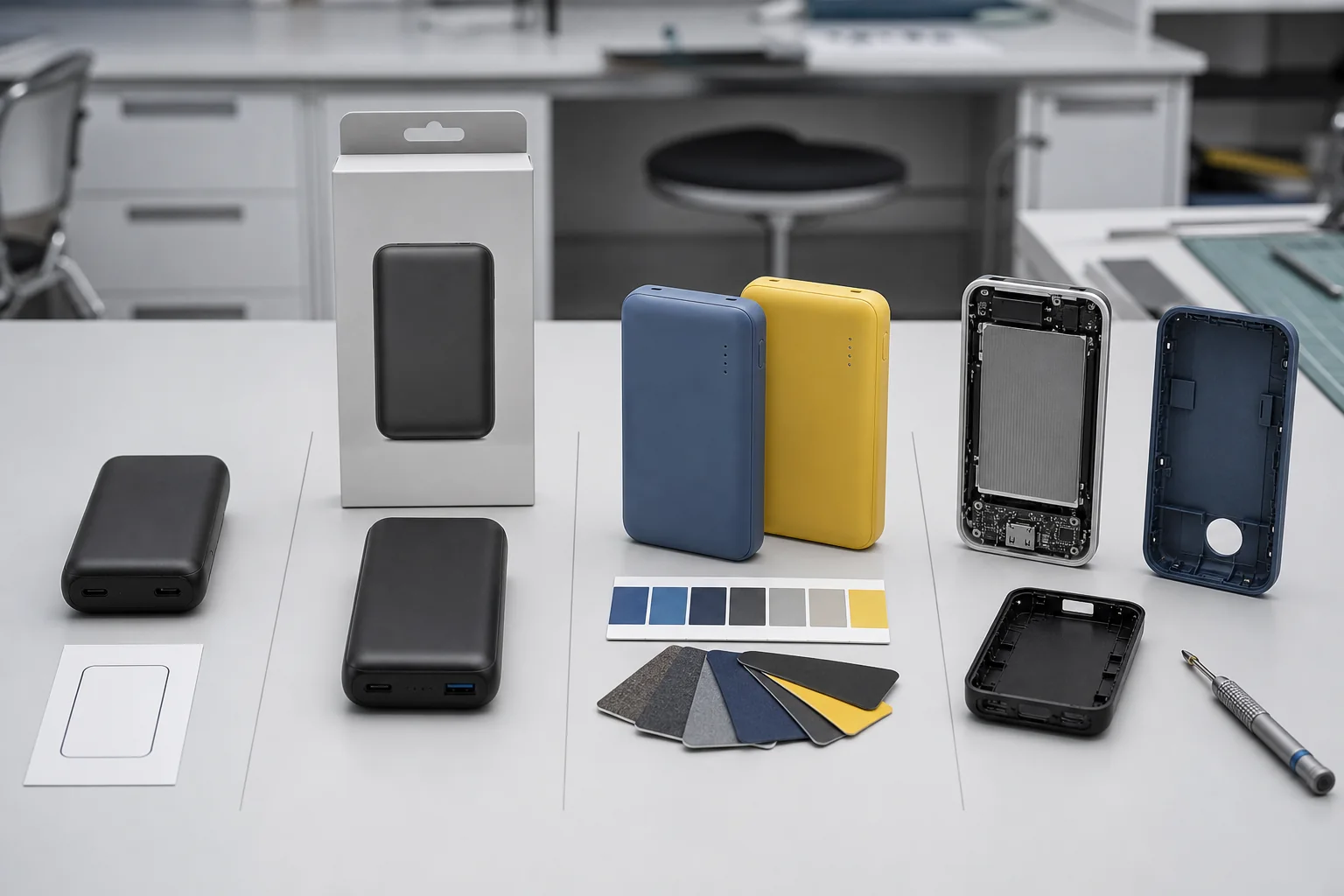
For example, adding a logo to an existing model may require a lower MOQ than developing a new housing, custom color or new electronic function.
Some selected standard models may support logo customization from 100 pieces. However, an available low MOQ should be viewed as a starting option, not automatically as the best purchasing quantity for every business.
Is a Lower MOQ Always Better for Buyers?
A lower MOQ can provide important benefits, especially for new brands and buyers testing a new product category.
Advantages of a lower MOQ
A smaller first order can help you:
- Reduce initial inventory investment
- Test customer interest
- Validate packaging and product positioning
- Compare different sales channels
- Identify product or quality issues earlier
- Avoid committing to a product before market feedback
- Preserve cash for marketing and future orders
These advantages are particularly important for e-commerce sellers, new brands, importers and companies entering the power bank market for the first time.
Limitations of ordering too few units
A very small order may not provide enough information for a confident business decision.
For example, if you order only a small number of units and sell them through one campaign or to a limited customer group, you may not know whether the result reflects:
- Actual product demand
- The sales channel
- The product price
- The advertising quality
- The timing of the campaign
- The packaging presentation
- A temporary customer response
A small order may also result in:
- Higher unit cost
- Higher packaging cost per unit
- Less efficient shipping
- Limited availability for different sales channels
- Insufficient stock for repeat customers
- Difficulty comparing regional or customer feedback
The goal of a first order is not simply to purchase the smallest possible quantity. It is to order enough units to obtain useful commercial feedback without creating unnecessary inventory risk.
Can a Supplier’s Logo MOQ Tell You How Established a Product Is?
A supplier’s logo MOQ can provide useful clues about its production model and product maturity. However, it should not be treated as conclusive proof of sales performance or customer loyalty.
A lower logo MOQ may indicate that the supplier already has common components, housings or production materials planned for the model. This can make it easier to support smaller customized orders.
However, a higher MOQ does not automatically mean that the product sells poorly.
The MOQ may also be influenced by:
- Printing or engraving processes
- Packaging production requirements
- Custom color materials
- Material purchasing quantities
- The supplier’s inventory policy
- Whether the product is made to order
- Whether the buyer requires special packaging or functions
- Minimum quantities set by another production partner
For this reason, buyers should ask why the MOQ is set at a particular level.
Questions buyers should ask
If a supplier offers a low logo MOQ, ask:
- Does the supplier keep common components or housings in stock?
- Is the product already in regular production?
- Is the MOQ different for standard and custom colors?
- Is the MOQ set by the factory or by the printing supplier?
- Is the same MOQ available for repeat orders?
- Can the supplier maintain the same product specification later?
If a supplier requires 1,000–3,000 pieces for basic logo customization, ask:
- Is this a standard model or a newly developed product?
- Does the MOQ include custom packaging or custom color?
- Is the MOQ caused by the printing or packaging process?
- Does the supplier operate on a made-to-order basis?
- Does the model have existing repeat-order customers?
- Can the MOQ be reduced for a standard version?
If a supplier has been active in a product category for more than five years but still requires a high MOQ for basic logo customization, buyers should investigate further before drawing a conclusion.
The product may be new, the supplier may use a made-to-order production model, or the MOQ may be determined by the customization process rather than product demand.
MOQ is a useful signal, but it is not proof by itself.
Need help choosing a practical starting quantity?
Share your market, brand stage, sales channels, preferred model and customization scope. TOPTAI can review the sample route, MOQ drivers and a realistic first-order plan.
Request catalog & quotation →How Many Custom Power Banks Should You Order for Your First Order?
The right first-order quantity depends on your brand stage, sales structure and purchasing purpose.
The following framework is based on practical B2B experience.
| Buyer stage | Recommended starting quantity | Main purpose |
|---|---|---|
| Brand operating for more than 5 years, selling multiple categories through multiple channels | At least 1,000 pieces | Support existing channel demand and obtain broader sales data |
| Mature brand operating for more than 3 years and expanding into a new category | 200–500 pieces | Test the new category while controlling inventory risk |
| New brand operating for less than 1 year with one main sales channel | 100–200 pieces | Run a focused market test with a manageable inventory commitment |
| Brand at the very beginning of development | 10–50 samples | Validate the product, quality, packaging and customer response |
These quantities are planning recommendations, not universal supplier rules.
The final order quantity should also reflect the selected power bank model, customization scope, sales forecast, available cash flow and expected reorder time.

First, Distinguish Samples from a Formal First Order
An order of 10–50 pieces should normally be treated as a sample or pilot quantity, not as a formal market launch.
These units can be used to:
- Check product appearance and quality
- Test charging performance and capacity
- Review the logo and packaging
- Create product photos and marketing materials
- Present the product to potential customers
- Collect initial feedback
- Identify technical or packaging issues
However, 10–50 units are usually not enough to produce reliable sales data.
The result may be affected by:
- A small audience
- One particular marketing campaign
- Limited product exposure
- Personal opinions rather than broad customer feedback
- Temporary market conditions
After the sample stage, the buyer can decide whether to move to a formal first order of 100–200, 200–500 or 1,000+ pieces, depending on the brand’s business stage and sales structure.
1. Established Brands with Multiple Categories and Channels: At Least 1,000 Pieces
For a brand that has operated for more than five years and already sells multiple product categories through multiple channels, a first custom power bank order of at least 1,000 pieces is often more appropriate.
This type of buyer usually has:
- An existing customer base
- More than one sales channel
- Established marketing resources
- Experience managing product inventory
- A higher ability to generate sales
- Existing demand data from related products
For these buyers, ordering only a few hundred units may not provide enough stock to test different channels, regions or customer groups.
A larger first order can help the buyer:
- Launch through multiple channels
- Support existing distributors or retailers
- Collect broader sales feedback
- Reduce the risk of running out of stock
- Improve production and packaging efficiency
- Prepare for repeat orders more smoothly
This does not mean that every established brand must order exactly 1,000 pieces.
The quantity should still be adjusted according to:
- Product type
- Sales forecast
- Customization scope
- Expected launch schedule
- Reorder lead time
- Available inventory budget
However, for a mature, multi-category and multi-channel brand, a very small first order may not match the company’s actual sales capacity.
2. Mature Brands Expanding into a New Category: 200–500 Pieces
A brand operating for more than three years may already have customer trust, traffic and sales experience.
However, entering a new product category still involves uncertainty.
For example, a brand may already sell consumer electronics, travel accessories or lifestyle products but have no previous experience selling power banks.
In this situation, 200–500 custom power banks can provide a practical starting point.
This quantity may allow the brand to:
- Introduce the new category to existing customers
- Test product-market fit
- Evaluate the selling price
- Compare customer interest with other categories
- Test packaging and brand presentation
- Measure inquiry and reorder rates
- Control the risk of unsold inventory
The brand already has some commercial advantages, but the new product category has not yet been fully validated.
A 200–500-piece order can therefore provide a more useful market sample than a very small pilot while keeping the financial commitment under control.
3. New Brands with One Main Sales Channel: 100–200 Pieces
For a brand that has operated for less than one year and relies mainly on one sales channel, 100–200 custom power banks may be a more suitable formal first order.
A new brand usually needs to validate several factors at the same time:
- Whether customers understand the product
- Whether the price is acceptable
- Whether the product can generate sufficient conversion
- Whether the packaging communicates the brand correctly
- Whether the chosen sales channel is suitable
- Whether the product can generate repeat demand
Because the brand has limited historical sales data, ordering too many units can create unnecessary inventory pressure.
At the same time, ordering only a few dozen units may not provide enough stock to support a proper product launch. It may also make the unit cost and packaging cost relatively high.
A 100–200-piece order can offer enough inventory for a focused launch while keeping the first financial commitment manageable.
4. Brands at the Very Beginning: 10–50 Samples
If you are only beginning to build a brand, start with 10–50 samples or pilot units rather than placing a large formal order.
At this stage, the main objective is not to maximize sales. It is to determine whether the product is suitable for further investment.
Use the samples to confirm:
- Product appearance and finish
- Battery capacity and charging performance
- Cable and connector quality
- Heat and protection performance
- Logo placement
- Packaging design
- Product compatibility
- Customer and distributor feedback
These units may also be used for:
- Internal review
- Photography and video
- Influencer or key-customer evaluation
- Distributor presentations
- Small-scale pre-orders
- Initial product demonstrations
After the sample stage, review the results before deciding on the formal first order.
If the product is accepted and the sales channel is ready, move to a quantity that matches your business stage. If the product or packaging needs improvement, revise the project before committing to mass production.
Different Customization Levels Have Different MOQs
Existing model with logo customization
This is usually the simplest way to start a private-label power bank project.
The product structure remains unchanged, while the buyer customizes:
- Logo
- Logo position
- Printing or laser engraving
- User manual
- Product label
- Basic packaging
This option usually allows a lower entry quantity than deeper customization.
It can be suitable for buyers who want to test their brand without investing in a new mold or major product development.
Custom packaging
Custom packaging can include:
- Retail boxes
- Gift boxes
- Promotional packaging
- Product inserts
- Manuals
- Barcode labels
- Shipping-carton information
Packaging may require a higher MOQ because of printing setup, material purchasing and production arrangements.
If you are testing a new product category, it may be more practical to customize the retail presentation while keeping the product structure unchanged.
Custom color
Custom colors can help a product match your brand identity, but they may create additional production requirements.
The MOQ may depend on:
- Pantone color selection
- Housing material
- Minimum material purchasing quantity
- Production batch size
- Color consistency requirements
- Whether the color is used for one model or several models
Custom color is more suitable when you already have a clear brand direction and expect to reorder the same product.
Functional or structural customization
Functional customization may include:
- Different output power
- Built-in cables
- LCD display
- Wireless charging
- Special protection functions
- Changed connector configuration
- New housing structure
- New battery configuration
These projects require a technical feasibility review.
They may also involve:
- New samples
- Engineering work
- Testing
- Tooling
- Additional certification
- A different production schedule
For this reason, the MOQ and development schedule are usually different from a basic private-label program.
What Should You Consider Before Choosing Your First-Order Quantity?
1. Your sales channels
Your first-order quantity should reflect where you plan to sell.
An e-commerce brand may need enough inventory for online testing and advertising.
A wholesaler may need stock for several customers.
A promotional supplier may already have a confirmed event or corporate project.
2. Your expected sales
Estimate your realistic first three-month sales rather than using an optimistic annual target.
Consider:
- Expected monthly orders
- Sales conversion rate
- Customer acquisition cost
- Reorder timing
- Seasonal demand
- Sales channel capacity
A first order should support testing without leaving excessive stock if the product sells more slowly than expected.
3. Your product positioning
A premium magnetic power bank, a fast-charging power bank and a promotional gift power bank may require different purchasing strategies.
The more specialized the product, the more important it is to validate:
- Customer expectations
- Price acceptance
- Product performance
- Packaging quality
- Compatibility
- Competitive positioning
4. Your available cash flow
Inventory is not the only cost.
Your budget may also need to cover:
- Product samples
- Packaging design
- Logo setup
- Freight
- Import duties
- Testing
- Marketing
- Product photography
- After-sales replacements
A larger MOQ may reduce the unit price but use cash that could otherwise support market testing and promotion.
5. Your reorder lead time
If the supplier needs several weeks to produce a repeat order, you may need more initial stock.
Ask the supplier:
- What is the production lead time?
- How long does packaging production take?
- Are components readily available?
- Can the same specification be repeated?
- How quickly can the supplier respond to a new order?
The ideal first-order quantity is influenced by both demand and replenishment speed.
Questions to Ask a Custom Power Bank Supplier
Before confirming your first order, ask:
- What is the MOQ for the standard model?
- What is the MOQ for logo customization?
- What is the MOQ for custom packaging?
- Is custom color available at my planned quantity?
- Will my customization require new tooling?
- How long will the sample take?
- Can I approve a sample before mass production?
- Will the final product match the approved sample?
- Which certifications and documents apply to this model?
- What is the production lead time?
- Can the supplier support repeat orders with the same specification?
- What happens if I want to increase the quantity later?
- Does the MOQ change for repeat orders?
- Does the supplier keep common components or materials available?
A professional supplier should explain not only the minimum quantity, but also the effect of quantity on unit price, customization, production and delivery.
A Practical First-Order Process
For many custom power bank projects, the following process can reduce risk.
Step 1: Confirm the product direction
Select the product type, capacity, charging functions, target price and target customer.
Step 2: Review the customization scope
Decide whether you need:
- Logo only
- Logo and packaging
- Custom color
- Functional changes
- Structural development
- A complete OEM/ODM project
Step 3: Evaluate samples
Check:
- Appearance
- Charging performance
- Capacity
- Cable quality
- Heat
- Product dimensions
- Packaging
- Labeling
- Compatibility with target devices
Step 4: Choose the starting quantity based on your business stage
Use 10–50 pieces for initial product validation.
Use 100–200 pieces for a new brand with one main sales channel.
Use 200–500 pieces for a mature brand entering a new product category.
Consider at least 1,000 pieces for a brand operating for more than five years across multiple categories and sales channels.
Step 5: Review the results
After the first sales cycle, evaluate:
- Sales speed
- Customer feedback
- Return rate
- Product reviews
- Advertising performance
- Reorder requests
- Channel acceptance
- Actual gross margin
Step 6: Scale based on evidence
If the product performs well, adjust the next order according to actual sales data rather than assumptions.
If the product performs poorly, determine whether the problem comes from the product, price, packaging, positioning or sales channel before placing another large order.
Final Thoughts
The lowest custom power bank MOQ can reduce your initial commitment, but it does not automatically create a successful product launch.
Ordering too few units may leave you with limited data and a higher unit cost.
Ordering too many may tie up cash in inventory before your market has been validated.
For practical planning:
- Use 10–50 pieces for initial product and brand validation.
- Use 100–200 pieces for a new brand with one main sales channel.
- Use 200–500 pieces for a mature brand entering a new product category.
- Consider at least 1,000 pieces for a brand operating for more than five years across multiple categories and sales channels.
A supplier’s logo MOQ can also provide clues about its production model, material planning and product maturity. However, buyers should always ask additional questions before drawing conclusions from the number alone.
The right first-order quantity depends on your brand stage, product category, sales channels, customization scope, cash flow and reorder plan.
If you are planning a custom power bank project, share your target market, product type, estimated sales quantity, branding requirements and expected launch schedule. TOPTAI can help you review the appropriate customization path, sample process and starting order quantity for your project.
Sources and editorial note
This guide combines current primary-source guidance with TOPTAI’s experience supporting OEM/ODM power bank evaluation. Requirements can change by model, market, carrier and date; confirm the exact product and destination before ordering or traveling.

ABOUT THE REVIEWER