POWER BANK CUSTOMIZATION · B2B BUYER GUIDE
How to Choose the Right Custom Logo Solution for Power Banks
Choose a custom power bank logo solution by housing material, visual effect, branding purpose, durability, MOQ and production requirements—not by printing method alone.
 Reviewed by Grace WongCo-Founder | Custom Charging Solutions Lead · Updated September 13, 2026 · 14 min read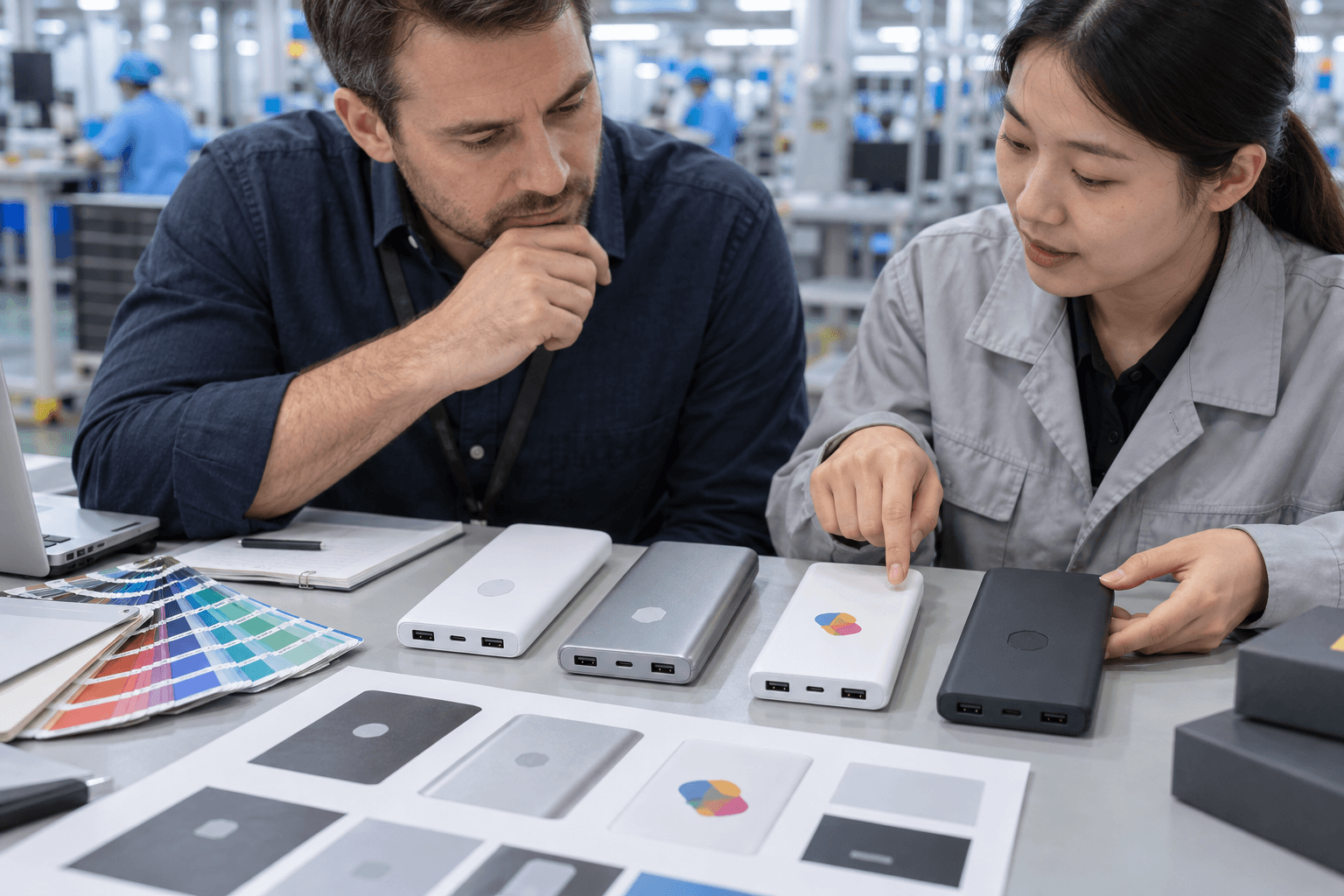
There is no single best logo method for every custom power bank. Start with the branding purpose, then match the desired appearance and durability to the exact housing material and surface finish. Screen printing is often practical for simple campaign branding, UV printing supports full-color graphics, laser engraving creates a permanent understated mark on suitable materials, and embossed or debossed branding works best when the logo should become part of the housing itself. Confirm the method on a production-representative sample before mass production.
Do not begin by asking which printing method is best
A buyer searching for the best logo printing method may be starting with the wrong question. A process that looks excellent on anodized aluminum may not produce the same result on textured ABS, rubber coating, silicone or a curved wireless-charging surface.
The more useful question is: Which logo solution best supports this product, this audience and this project? The answer should combine three decisions: the purpose of customization, the product material and finish, and the brand effect the buyer wants to create.
For B2B projects, the logo also interacts with MOQ, sample lead time, artwork preparation, packaging, inspection criteria and repeat-order consistency. Treat it as one part of the complete private-label product rather than a final decoration added after the product is selected.
Start with the commercial purpose of the customization
Promotional gifts, events and short campaigns
Campaign products usually need clear brand recognition, controlled cost and a fixed delivery date. A simple one- or two-color logo on a mature standard product is often more useful than a complex premium process.
- Prioritize visibility at normal viewing distance.
- Keep small text and fine lines to a minimum.
- Choose an existing housing color that supports sufficient contrast.
- Confirm the logo sample and production schedule before approving campaign materials.
Retail and private-label products
For a retail brand, the logo is part of the product design. It must work in listing photography, packaging, shelf presentation and long-term use. The buyer may need a full-color graphic, a permanent understated mark or branding integrated into the housing.
Corporate and premium gifts
Premium gifts should be evaluated as a complete presentation. The power bank material, logo finish, product color, cable set and gift box need to feel intentional together. A subtle laser mark or debossed logo may communicate quality better than a large printed mark, while a precise brand-color print may be more important for a campaign with strict visual guidelines.
Outdoor, industrial and repeated-use programs
A logo used outdoors or handled every day needs stronger durability evidence. Buyers should review abrasion, chemicals, surface coatings, temperature exposure and contact points. A permanent-looking method is only valuable if the exact substrate and finished sample support it.
Match the logo solution to the power bank material
ABS, PC and other rigid plastics
Rigid plastic housings can support screen printing or UV printing, but adhesion varies with resin, texture, paint and protective coating. A smooth flat panel is easier to control than a heavily textured or sharply curved surface. Surface treatment or ink selection may be required.
Soft-touch paint and rubber-coated surfaces
Soft-touch finishes can feel premium but may create adhesion and wear challenges. The factory should test the exact coating rather than assume a process that works on uncoated ABS will work after rubber paint is applied.
Aluminum and other metal surfaces
Laser engraving is commonly considered for anodized aluminum because it can remove or change the surface layer to create a durable mark. Actual contrast depends on alloy, anodizing, color and laser settings. Printing may be preferable when the brand requires an exact color rather than a metal-toned mark.
Silicone, fabric, leather and special finishes
Flexible or textured materials may require a process designed for the substrate, such as embossing, debossing, a badge, transfer method or a separate branded component. Production consistency and bonding should be validated on the final material.
Transparent or light-transmitting structures
A light-up logo is a structural and electronic customization, not only a printing choice. It may affect the housing, light guide, PCB space, power consumption, assembly and tooling. Start with a feasibility review rather than treating it as an artwork change.
Compare the main logo solutions by effect and project fit
| Logo solution | Typical material fit | Visual effect | Project fit | Main point to verify |
|---|---|---|---|---|
| Screen printing | Flat plastic or metal surfaces with compatible finish | Crisp solid colors | Promotions, corporate gifts, straightforward private label | Ink adhesion, color, edge quality and wear |
| UV digital printing | Smooth plastic or coated metal | Full color, gradients and fine artwork | Retail branding, artwork-led designs, smaller design variations | Color proof, white ink, adhesion and scratch resistance |
| Laser engraving | Anodized or coated metal and selected suitable materials | Permanent, subtle, premium | Executive gifts, professional products, understated retail branding | Contrast, depth, discoloration and position |
| Embossed or debossed logo | Molded plastic, silicone, leather-like or soft-touch components | Integrated, tactile and same-color | Long-term brand programs and premium housings | Tooling, minimum quantity, depth and release from the mold |
| Metal badge or separate plate | Housings that can accept a bonded or fixed component | Dimensional and decorative | Premium gifts and distinctive retail designs | Bonding, corrosion, edge safety and assembly consistency |
| Light-up logo | Purpose-designed light-transmitting housing | High-impact illuminated branding | Technology campaigns and differentiated premium products | Light uniformity, power use, structure, tooling and reliability |
This comparison is a shortlist, not a universal specification. The factory should review the actual artwork, housing drawing, surface finish, quantity and intended use before confirming feasibility.
Need a logo method matched to your product and project?
Send your logo artwork, selected power bank, target market, quantity, packaging requirement and launch date. TOPTAI can review the surface, recommend a practical branding route and prepare a sample plan.
Request catalog & quotation →What a screen-printed logo is good at
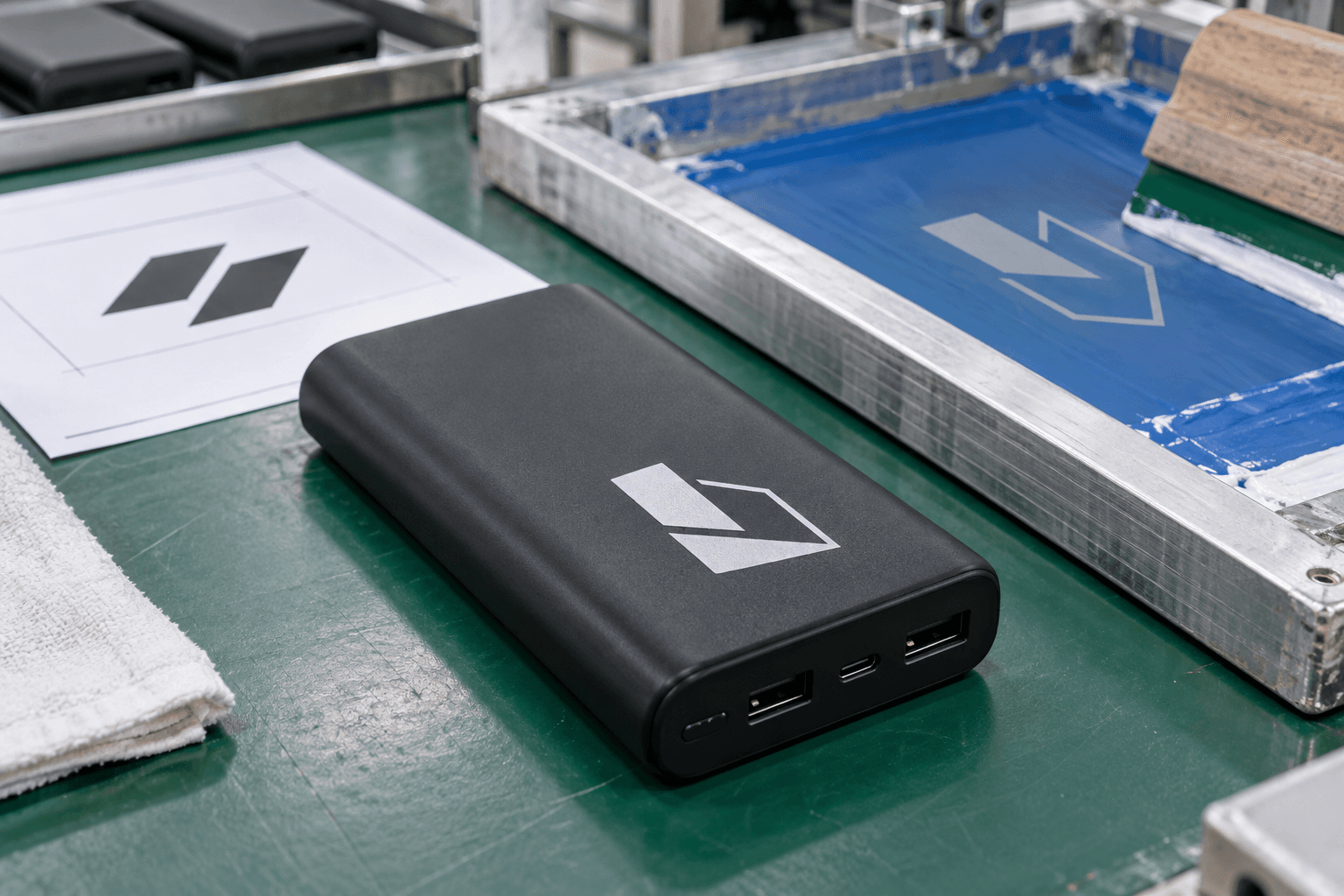
Screen printing is usually strongest when the artwork uses a limited number of solid colors and the printing area is reasonably flat. It can be practical for promotional orders, corporate programs and standard-model private labeling.
- Good for simple logos, text and solid brand colors.
- Often easier to control commercially than a highly complex decoration route.
- Each color may require separate setup and alignment.
- Very small text, fine lines, gradients and photographic artwork are not its natural strengths.
Buyers should approve the real ink color on the selected housing. The same Pantone reference can appear different on white, black, metallic or colored substrates, especially when an underbase is needed.
When laser engraving is the better branding decision
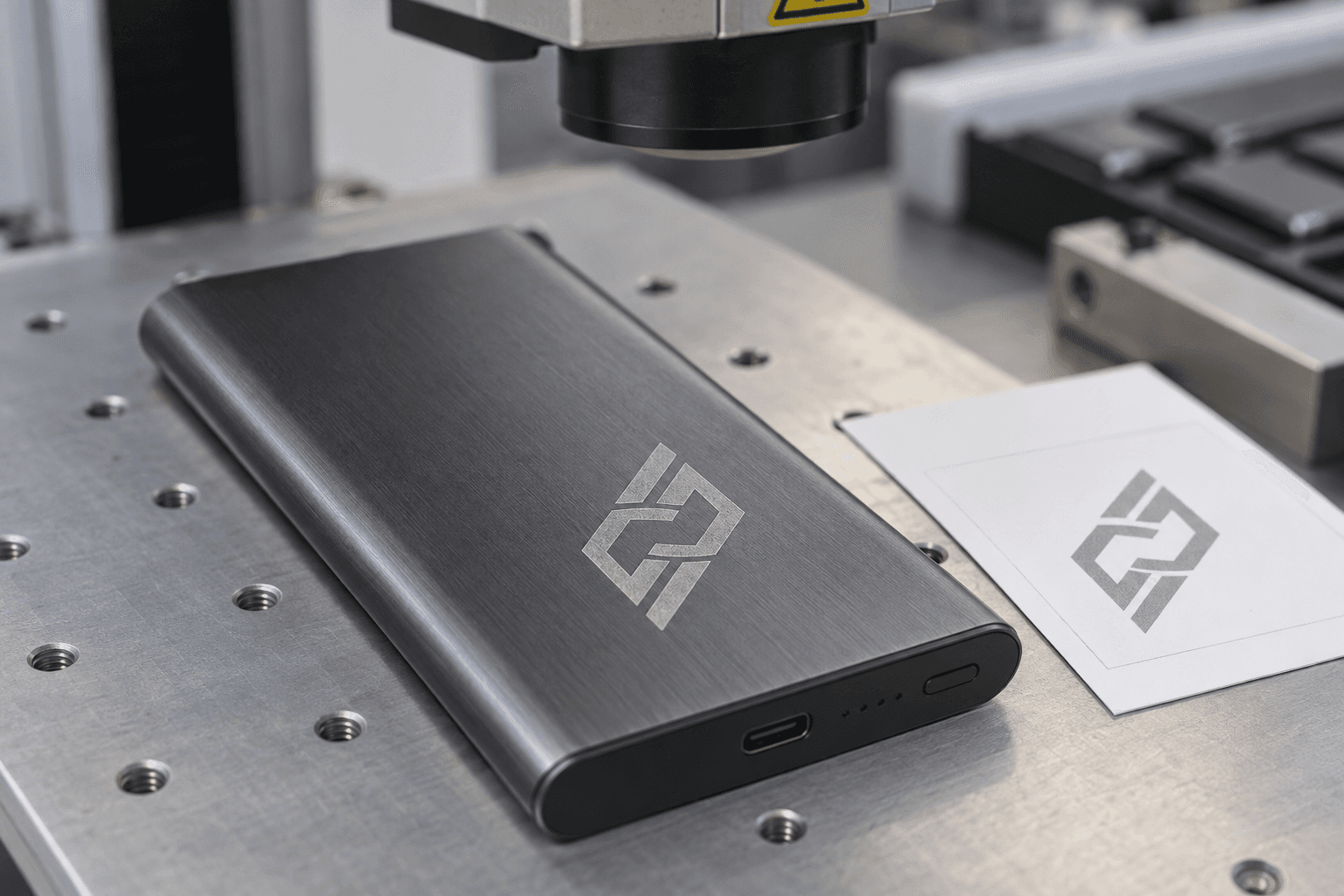
Laser engraving is attractive for buyers who want the brand mark to feel permanent and integrated rather than printed on top. It is particularly relevant to suitable metal housings and executive gift projects.
- No ink color is added, so an exact Pantone brand color is normally not the objective.
- The final shade can change with the anodized finish, coating and laser parameters.
- Thin housings, curved surfaces and heat-sensitive materials require careful process control.
- A sample should confirm legibility, position, contrast and surface appearance.
Laser engraving is not automatically more premium in every situation. If the target audience expects a bright brand color or full-color artwork, a well-executed print may communicate the brand more effectively.
Use UV printing when artwork and color carry the brand
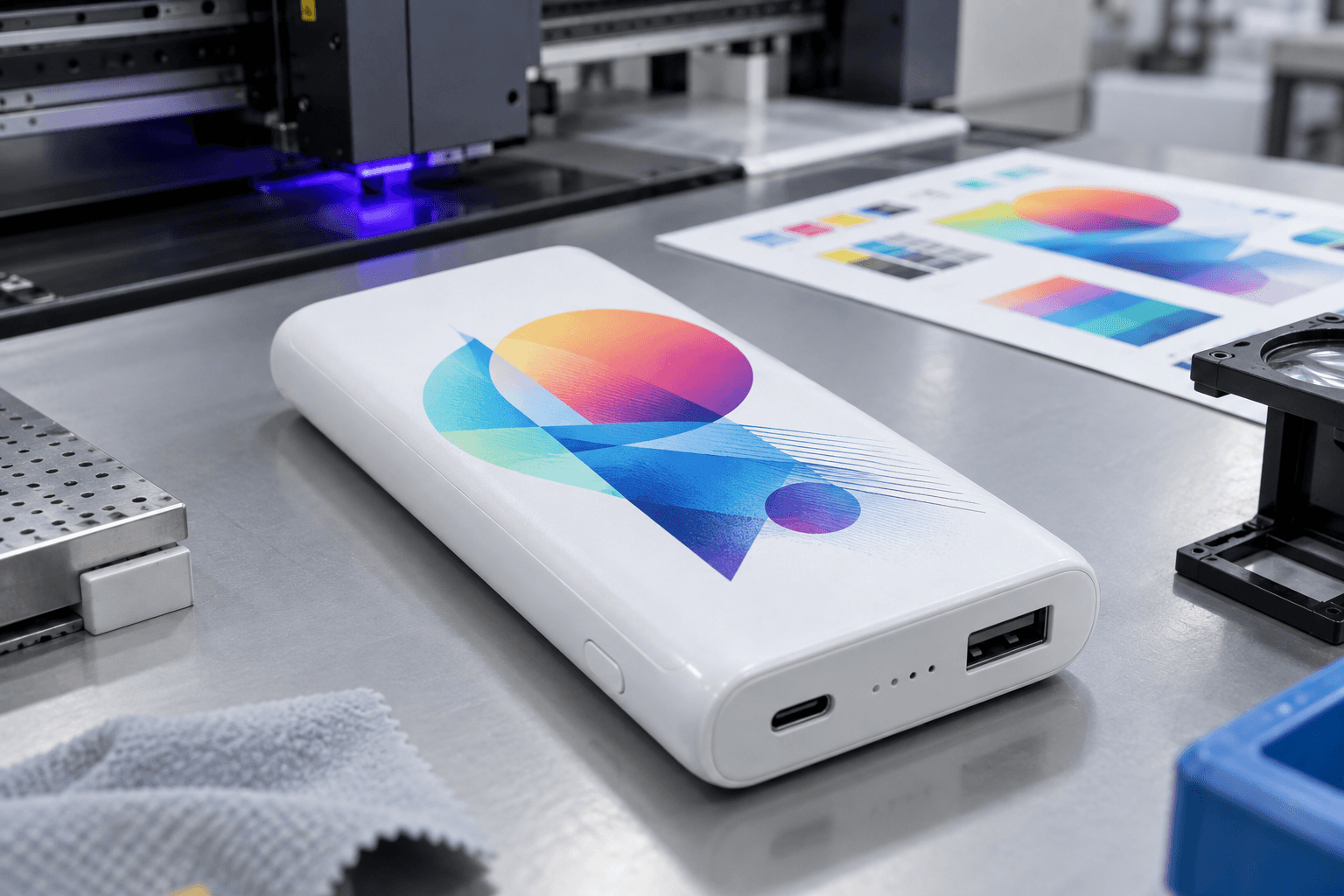
UV digital printing can support multiple colors, gradients, fine graphics and artwork variations without reproducing the design as a series of simple solid-color screens. It can be useful for retail designs, licensed-style artwork programs and brand campaigns requiring more visual detail.
- Confirm whether white ink or a base layer is required on dark housings.
- Review color against a physical proof, not only a monitor.
- Check adhesion on the exact coating and after normal handling.
- Avoid placing critical artwork across seams, strongly curved areas, buttons or wireless-charging alignment zones.
More color is not always more valuable. A detailed print should support the brand and sales channel; it should not make the product look busy or reduce recognition at thumbnail size.
Embossing and debossing make the logo part of the housing
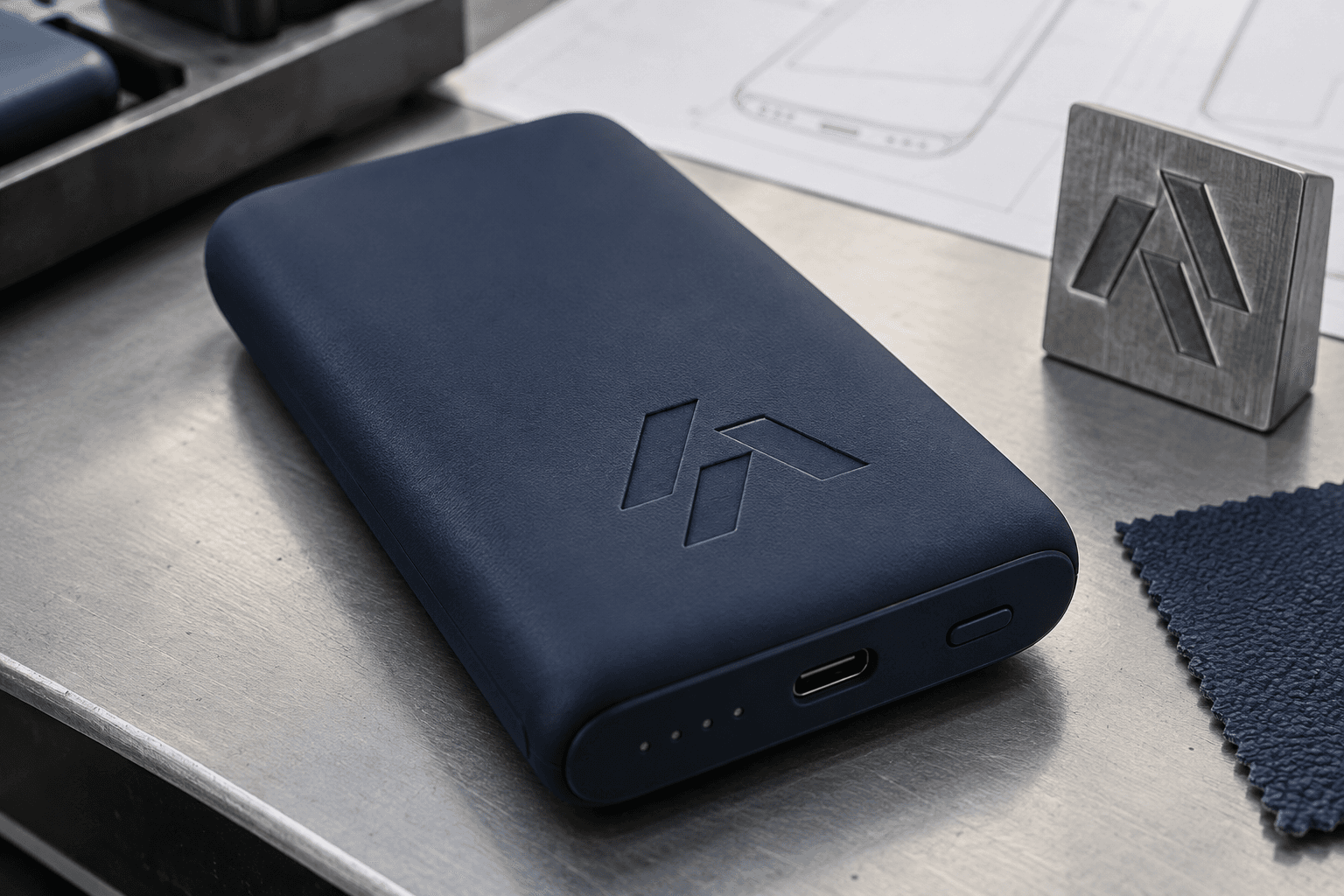
An embossed logo rises above the surrounding surface; a debossed logo is recessed into it. Both approaches can create an integrated, tactile appearance on suitable molded or pressed materials.
- Best suited to brands planning a stable design and repeat orders.
- May require a modified mold insert, tooling or a dedicated branded component.
- Logo depth, draft angle, corner radius and placement affect manufacturability.
- Very fine details may not reproduce consistently in molding or pressing.
This route can be excessive for a small one-time promotional order. It becomes more commercially reasonable when the product is expected to remain in the range and the same housing will support repeat production.
Why the same logo file can look different in production
Artwork shown on a screen is emitted light; a logo on a product is reflected light interacting with ink, coating, texture and substrate color. That is why an approved PDF or digital mockup cannot replace a physical sample.
- A dark housing can reduce color brightness or require a white underbase.
- Matte and glossy finishes change perceived color and contrast.
- Curved surfaces can distort artwork and move the visual center.
- Texture can interrupt fine edges or make small text less legible.
- Production tolerances can change placement relative to seams, displays, coils and ports.
- Coating lots, anodizing lots and ink batches can create acceptable but visible variation.
The buyer and supplier should define what will be inspected: artwork version, size, location tolerance, color reference, adhesion, abrasion, appearance under normal lighting and comparison with the approved sample.
What buyers should provide before requesting a logo sample
- Vector artwork in AI, EPS, SVG or production-ready PDF format.
- Pantone or other agreed physical color reference where color matching is required.
- Preferred logo size and position, plus any clear-space rules.
- Selected power bank model, housing color, material and surface finish.
- Target market, sales channel and customization purpose.
- Estimated quantity and repeat-order expectation.
- Packaging style, manual language and product-label requirements.
- Target sample approval date and required delivery date.
If the product has not been selected, provide the target user, charging functions, budget position and quantity first. Choosing a housing only because it has a large printable area can create a product that displays the logo well but does not fit the market.
Approve a production-representative sample, not only a rendering
A digital mockup is useful for confirming the intended location and proportions, but it does not prove color, adhesion, engraving contrast or tactile depth. The approved reference should be made using the selected housing, finish and production process whenever practical.
Visual checks
- Logo size, position and orientation.
- Color, opacity, contrast and surface gloss.
- Fine lines, text edges, gradient transitions and registration.
- Scratches, overspray, heat marks, deformation or contamination.
Durability checks
- Adhesion and abrasion appropriate to the process and end use.
- Handling at common contact points and around ports or buttons.
- Compatibility with cleaning, packaging inserts and protective films.
- Environmental checks appropriate to the target application.
Lock the approved artwork revision, product color, surface finish, logo method and location into the order specification. A change to any one of these can change the final result.
Choose the correct customization level before discussing tooling
| Buyer requirement | Practical route | Typical project implication |
|---|---|---|
| Add logo to an existing product | Standard model private label | Lowest development risk and usually the fastest sample route |
| Add logo, manual and retail or gift packaging | Brand-ready OEM package | Coordinates the complete presentation without changing the electronics |
| Add a custom housing color or special finish | Material and color customization | May increase material MOQ and color-control requirements |
| Create embossed branding or a light-up logo | Structural customization | May require tooling, engineering review and a higher commitment |
| Change product shape, internal layout or functions | ODM or new-tooling project | Requires feasibility, engineering, testing and a separate schedule |
Many buyers can reach a distinctive result by combining a mature standard power bank with the right logo, color, packaging and accessories. New tooling should solve a genuine product or brand requirement—not be the default response to every customization request.
A practical logo-solution selection checklist
- Define the buyer, channel and reason for customization.
- Select a power bank that fits the user before optimizing the printable area.
- Confirm the exact housing material, color, texture and coating.
- Choose the visual effect: bold, full-color, permanent, tactile, subtle or illuminated.
- Compare the method against quantity, budget, lead time and repeat-order plan.
- Simplify artwork that is too fine or complex for stable production.
- Approve a physical sample on the correct housing and finish.
- Document color, position, appearance and durability criteria before production.
- Inspect the batch against the approved reference and locked specification.
Frequently asked buyer questions
Which logo method is cheapest for a custom power bank?
For simple limited-color artwork on a compatible standard housing, screen printing is often a practical low-complexity route. The actual quotation depends on colors, positions, setup, quantity, product finish and inspection requirements.
Is laser engraving always more durable than printing?
Laser engraving can create a permanent mark on suitable materials, but the result depends on the substrate and finish. A buyer should still inspect contrast, surface effect and the exact sample rather than relying on the process name.
Can a full-color logo be printed on a black power bank?
Often yes, but the process may need white ink or an underbase to keep colors bright. Confirm opacity, color and adhesion on the exact black housing.
Does embossing require a new mold?
It may require a new or modified mold insert, a dedicated branded component or another tooling route. The factory should review the housing construction, logo geometry, planned volume and repeat-order value.
What is the best route for a first private-label order?
Start with a mature standard product and customize the logo and packaging. Move to custom colors, structural branding or new tooling only when the market and order plan justify the additional commitment.
Turn the logo request into a complete product brief
The strongest custom power bank projects do not begin with a process list. They begin with the target customer, channel, product role and brand objective. Material and desired effect then narrow the available logo solutions, while quantity, schedule and testing determine which route is commercially realistic.
Send TOPTAI your logo, target market, selected model or required functions, order quantity, packaging plan and launch date. The project team can recommend a suitable standard-product branding route, sample plan and production path without introducing unnecessary tooling.
Sources and editorial note
This guide combines current primary-source guidance with TOPTAI’s experience supporting OEM/ODM power bank evaluation. Requirements can change by model, market, carrier and date; confirm the exact product and destination before ordering or traveling.

ABOUT THE REVIEWER