
APPLICATIONS & CHANNELS · WEARABLE POWER
How to Choose a Power Bank for Heated Clothing, Cooling Wear and Wearable Devices
A B2B guide to matching power banks with heated clothing, cooling workwear and wearable devices by voltage, current, connector, polarity, runtime and testing.
 Reviewed by Grace WongCo-Founder | Custom Charging Solutions Lead · Updated September 10, 2026 · 14 min read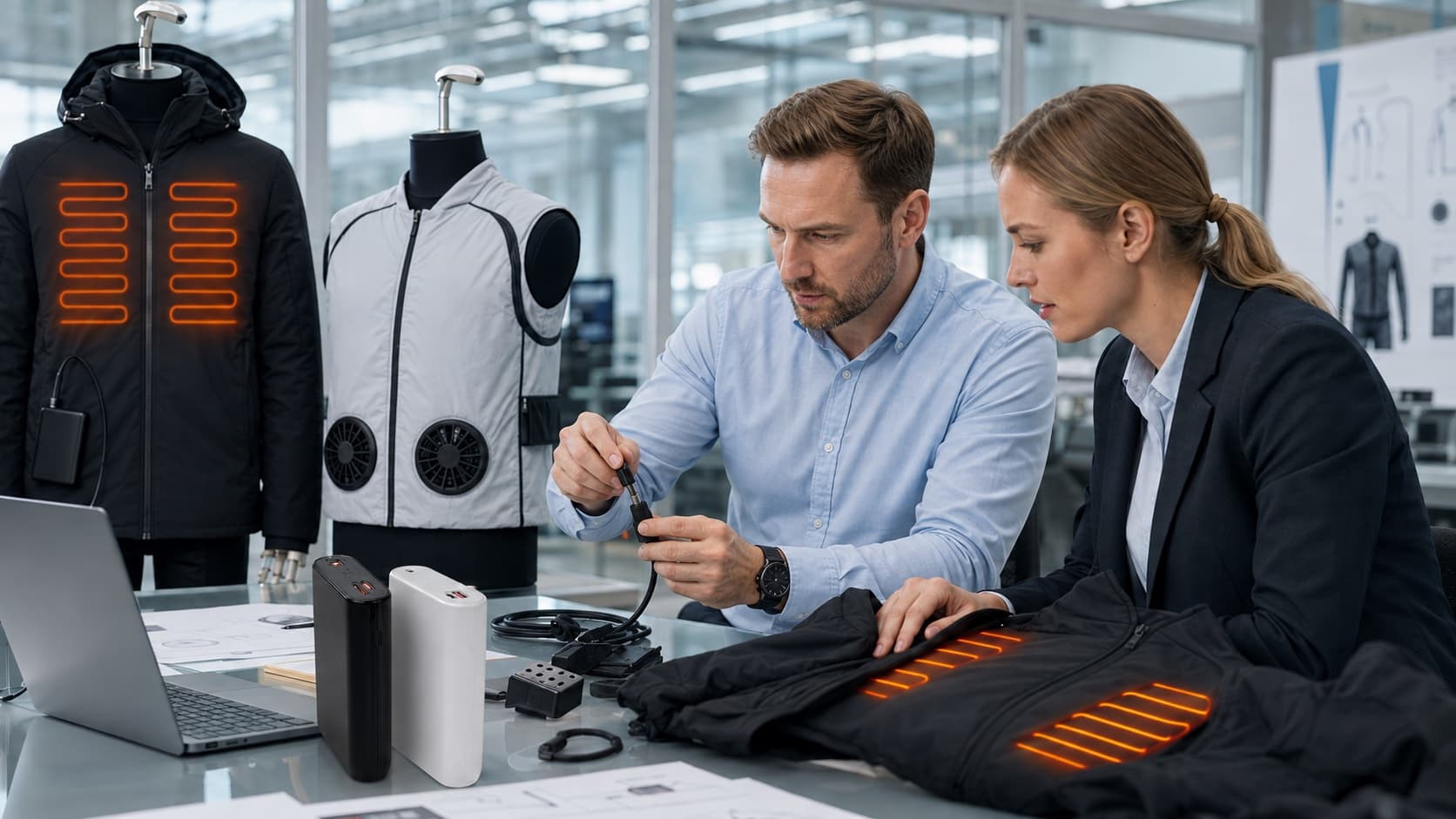
Choose a power bank for heated clothing, cooling wear or another wearable device by matching the exact operating voltage, normal and peak current, power, connector, polarity and required runtime. Confirm continuous-output and low-load behavior, then test the power bank with the real device at different operating modes and battery levels. Capacity alone cannot prove compatibility or guarantee runtime.
Choose by the Device's Power Profile
A power bank for a phone and a power bank for heated clothing may look similar, but they do not perform the same job. A phone controls its own charging process. A heated jacket, cooling vest or wearable device may depend on the battery pack for stable, continuous power during operation.
For B2B buyers, the first question should therefore not be “How many milliampere-hours do we need?” It should be “What electrical and operating conditions must the power source match?”
Voltage, current, peak load, connector size, polarity, automatic shutoff behavior, runtime, temperature and mechanical fit can all determine whether a standard power bank works with the target device. A mismatch can cause a garment to heat weakly, a fan to stop, a controller to restart or a low-power wearable to trigger automatic shutdown.
The most efficient sourcing route is usually to begin with the device specification, identify the closest proven power platform and validate the combination with a production-representative sample. New tooling should be considered only when the application cannot be supported by an existing housing, output configuration or connector solution.
Why a Standard Phone Power Bank May Not Work
Most consumer USB power banks are designed to charge phones and other devices that negotiate or draw power in familiar patterns. Wearable equipment can behave differently.
A heated vest may require a fixed DC voltage and continuous current for heating elements. Fan-cooled workwear may draw a higher current when the fans start and a different load at each speed. A small wearable controller may consume so little power that a conventional power bank decides no device is connected and shuts down.
Common causes of incompatibility include:
- Output voltage does not match the device requirement
- Peak or start-up current exceeds the power source capability
- The load falls below the power bank's automatic shutoff threshold
- The required charging or output protocol is not supported
- Connector dimensions or polarity are incorrect
- Cable resistance causes excessive voltage drop
- Protection logic interprets normal device behavior as a fault
- Cold, heat or restricted airflow changes battery and converter performance
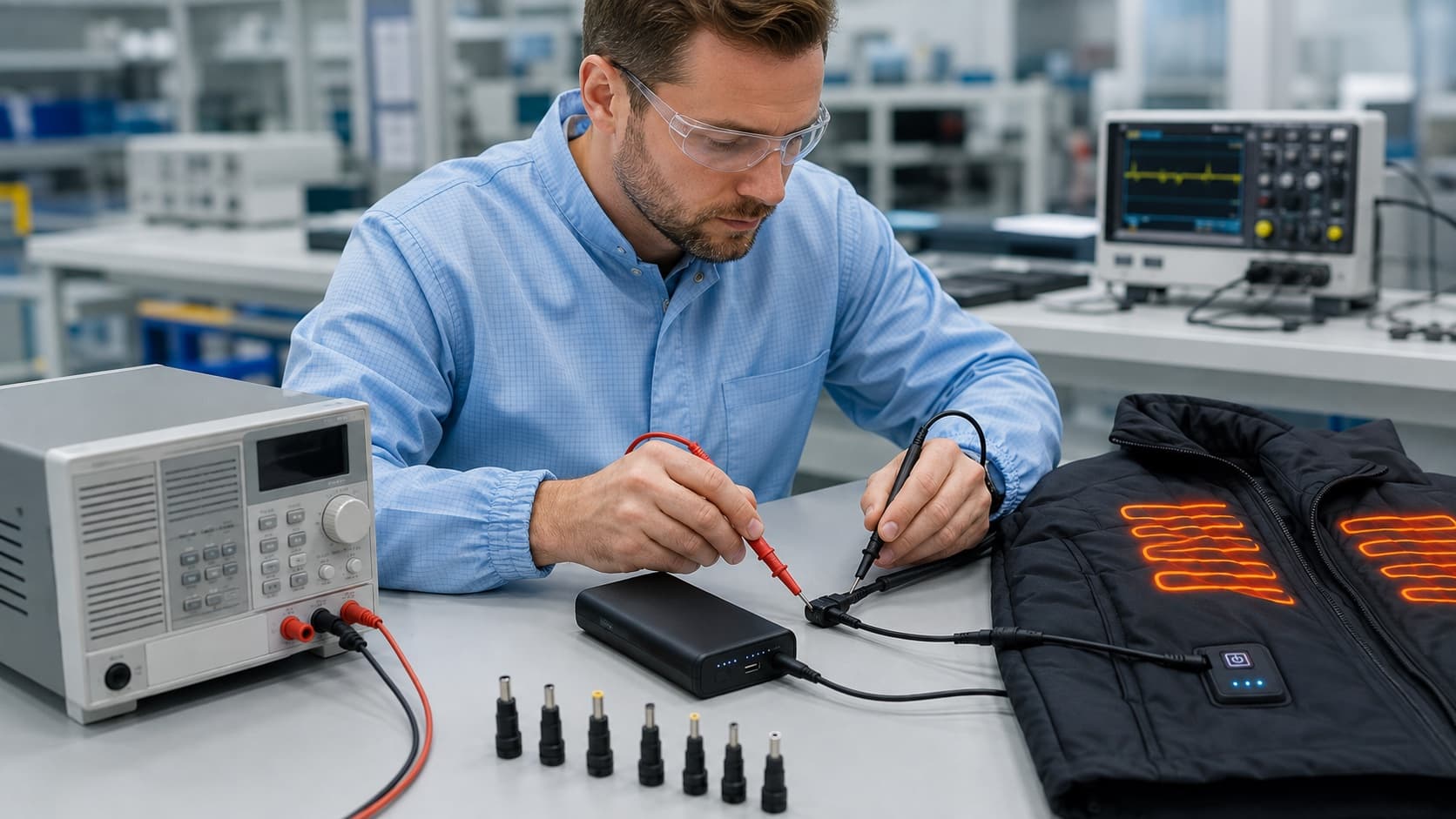
A device can sometimes turn on during a short demonstration and still fail during extended use. Compatibility testing should cover start-up, every operating level, mode switching, low battery state and realistic ambient conditions.
Five Specifications Buyers Must Confirm First
Before requesting a quotation, create a simple device power profile.
| Requirement | Information to provide | Why it matters |
|---|---|---|
| Operating voltage | 3.7V, 5V, 7.4V, 9V, 12V or another defined range | Incorrect voltage can prevent operation or damage the device |
| Normal and peak current | Measured or specified current at start-up and each mode | The power bank must support both continuous and transient demand |
| Connector and polarity | Connector dimensions, drawing, photo and center-positive/negative definition | Similar-looking DC plugs are not automatically interchangeable |
| Required runtime | Target operating hours at each mode | Determines the useful energy requirement, not only nominal capacity |
| Operating environment | Indoor, outdoor, low temperature, high temperature, moisture or close-to-body use | Affects cell performance, enclosure, protection and validation |
Add the device control method, cable length, available mounting or pocket space and total weight target. If USB-C Power Delivery is involved, state the voltage profile the device requests rather than using “Type-C” as the complete electrical requirement.
Match the Power Requirement to the Application
Heated clothing
Heated jackets, vests, scarves and other garments use resistive heating elements controlled through one or more power levels. The power source must support the required voltage and current continuously without unstable mode switching.
Buyers should confirm:
- Voltage and current at every heat level
- Peak demand when the garment starts or changes mode
- Connector and polarity
- Target runtime on low, medium and high settings
- Position of the battery pocket and acceptable product dimensions
- Cable strain when the wearer sits, bends or walks
- Performance at the lowest intended ambient temperature
A high-capacity battery can still be unsuitable if the output voltage, connector or protection logic does not match the garment.
Cooling wear and fan jackets
Cooling workwear commonly uses one or more fans. Motors create a dynamic load: start-up demand, speed changes and mechanical resistance can affect current. A power supply that appears stable at one fan speed may restart or shut down when both fans start together.
The sample test should include fan start-up, each speed, repeated switching, blocked or partially restricted airflow where appropriate, cable movement and operation as the power bank approaches a low state of charge.
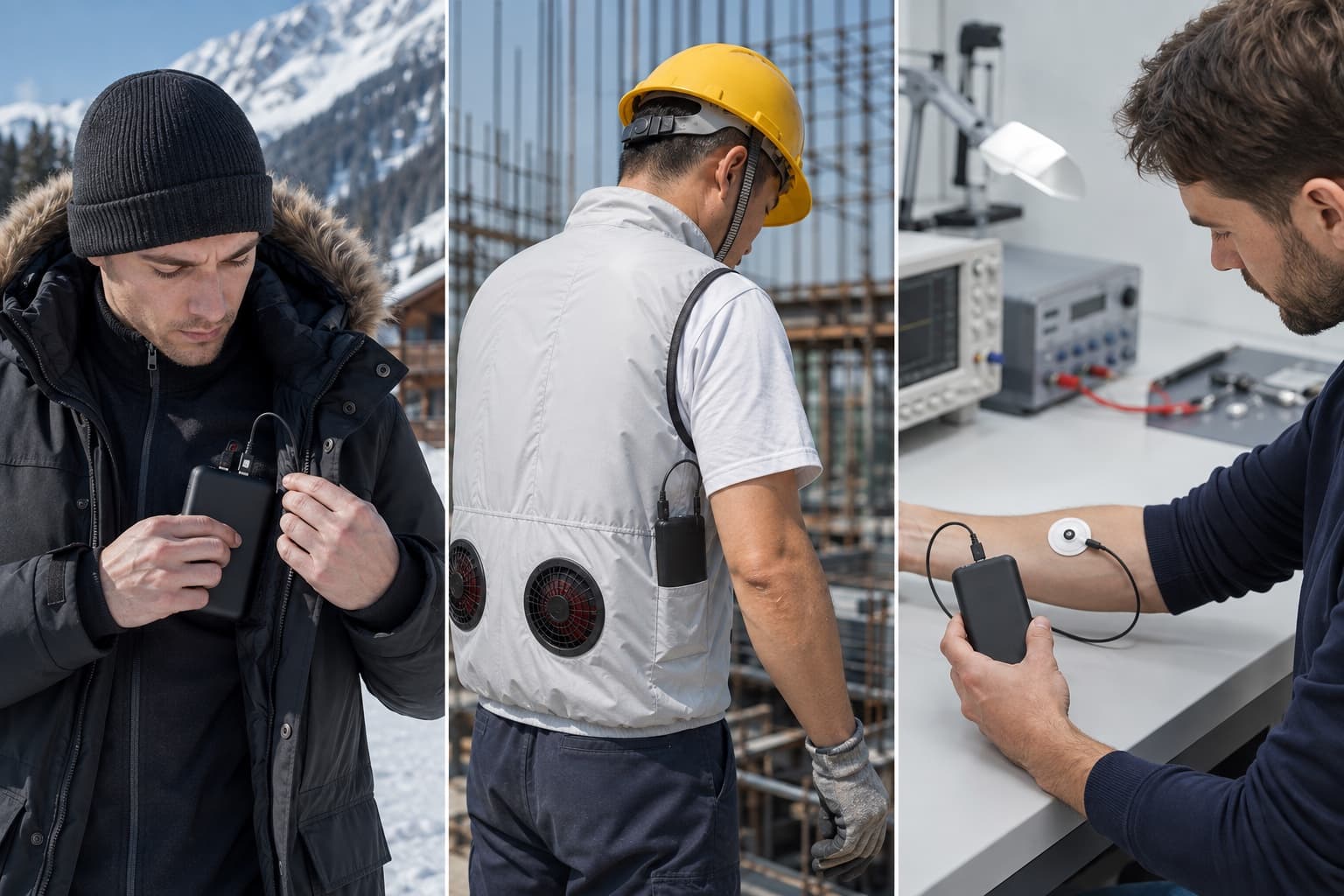
Wearable and portable devices
Sensors, controllers, therapeutic accessories and other portable devices may have lower or more variable loads. Here, automatic shutoff behavior can be as important as maximum output.
Confirm whether the application needs:
- A low-current or always-on output mode
- Fixed-voltage DC rather than standard USB output
- A locking, recessed or right-angle connector
- A compact enclosure or defined mounting direction
- An accessible power button or battery indicator
- Cable and connector retention under movement
The device manufacturer should define any medical, protective or functional requirements beyond ordinary consumer charging. Do not infer suitability for a safety-critical or medical application from voltage alone.
Need a device-to-power-bank compatibility review?
Send the device voltage, current, connector, polarity, target runtime, quantity and market. TOPTAI can shortlist a suitable dedicated power platform and define the sample test.
Request catalog & quotation →Voltage, Current and Power: Do Not Treat Them as Interchangeable
Electrical power is calculated as:
Power (W) = Voltage (V) × Current (A)
A device specified at 7.4V and 2A can require approximately 14.8W during that operating condition. However, a nameplate value may represent a maximum rather than an average. Buyers should obtain measured demand across start-up and all modes where possible.
The power bank output must match the acceptable voltage range of the device and provide sufficient current capacity. A supply with a higher available current rating does not necessarily force extra current into a correctly designed device; the load normally draws what it requires. An incorrect voltage or polarity, however, can create immediate risk.
For adjustable-output models, confirm how the voltage is selected, whether the setting can change accidentally, what happens after shutdown and whether the output remains stable as the internal battery discharges.
Estimate Runtime Using Energy, Then Validate It
Nominal battery capacity in mAh is not a guaranteed operating time. Runtime depends on stored energy, conversion efficiency, device power, cable losses, temperature, output mode and the power bank's cutoff behavior.
A first estimate can use watt-hours:
Battery energy (Wh) = Capacity (Ah) × Nominal battery voltage (V)
Estimated runtime (hours) = Usable output energy (Wh) ÷ Device power (W)
For example, a 10,000mAh battery based on a 3.7V nominal internal pack contains approximately 37Wh before conversion losses. It does not provide 10Ah at a 7.4V or 12V output. The converter, protection limits and device load reduce usable output energy.
Do not publish a runtime claim based only on this calculation. Test the actual garment or device at defined settings and ambient temperature. Record:
- Initial power bank state of charge
- Device operating mode
- Measured voltage and current
- Ambient temperature
- Cable and connector used
- Time until shutdown or defined performance limit
- Power bank and device surface temperature
The result should be stated for that tested combination, not generalized to every garment or battery pack.
When Can an Existing Dedicated Power Bank Be Used?
An existing platform may be the best commercial starting point when:
- Its voltage range already matches the device
- Current and peak-load capability are sufficient
- A supported connector and polarity can be used
- The enclosure fits the garment pocket or mounting space
- The required runtime can be achieved with an available capacity
- Branding, labels and packaging provide enough differentiation
TOPTAI's current dedicated power bank range includes 3.7V and 5V models and selectable 7.4–12V formats. Available references include DC35135, DC38135 and DC5521 connector options, with capacities from 3,000mAh to 20,000mAh. These are platform references only; the selected product must still be matched and sample-tested with the target device.
| Application direction | Relevant platform examples | Selection question |
|---|---|---|
| Compact 5V wearable | Q201, Q401 or Q501 | Is 5V output and the available connector suitable? |
| Adjustable low-voltage device | Q123 | Does the device operate within the supported adjustable range? |
| Heated clothing or cooling workwear | Q1001, Q1601, YQ6, YQ9 or YQ15 | Which 7.4–12V setting, current and connector are required? |
| Longer-runtime program | YQ8 or YQ11 | Does the added capacity justify the size and weight? |
When Is ODM Development or New Tooling Justified?
A new structure or deeper engineering change may be justified when no current platform meets a critical requirement, such as:
- A unique enclosure size or wearable attachment
- A nonstandard voltage or power profile
- A sealed or specially protected connector arrangement
- A dedicated user interface or status display
- A specialized control or communication requirement
- A volume program that can support development and validation cost
Before opening a mold, separate must-have requirements from preferences. A connector, cable, label, housing color or packaging change may be achievable without a new enclosure. Starting from the closest validated platform can shorten the sample cycle and reduce both technical and commercial risk.
Customization Options for Wearable-Device Brands
Customization can support both device compatibility and brand presentation:
- Output voltage and current configuration review
- Connector, polarity and cable-length selection
- Straight, right-angle or application-specific cable evaluation
- Housing color where available
- Printed, laser-marked or other suitable logo process
- Product label and operating instructions
- Retail box, kit packaging or device-and-battery set
- Battery indicator or selected control behavior
- Accessory and adapter combination
Any electrical change should be distinguished from a visual change. Logo and packaging may leave the core performance unchanged, while a different cell, PCB, voltage setting, cable or connector can require renewed testing and document review.
Sample Testing Should Use the Real Device
A useful compatibility sample is a system test, not just a power bank inspection.
Recommended approval process:
- Record the target device specification and use conditions.
- Select the closest existing power platform.
- Confirm voltage, current, connector and polarity before connection.
- Test start-up and every operating mode.
- Run the system through the required operating period.
- Check mode switching, low-load behavior and low battery state.
- Record temperature at the device, cable, connector and power bank.
- Approve the electrical sample before final branding and packaging.
- Use the approved sample and specification as the production reference.
If the buyer cannot send the actual device, provide a detailed drawing, electrical specification, controller information and representative load. The limitation should be recorded, and final verification should still be completed on the real product before mass production.
What Quality Evidence Should B2B Buyers Request?
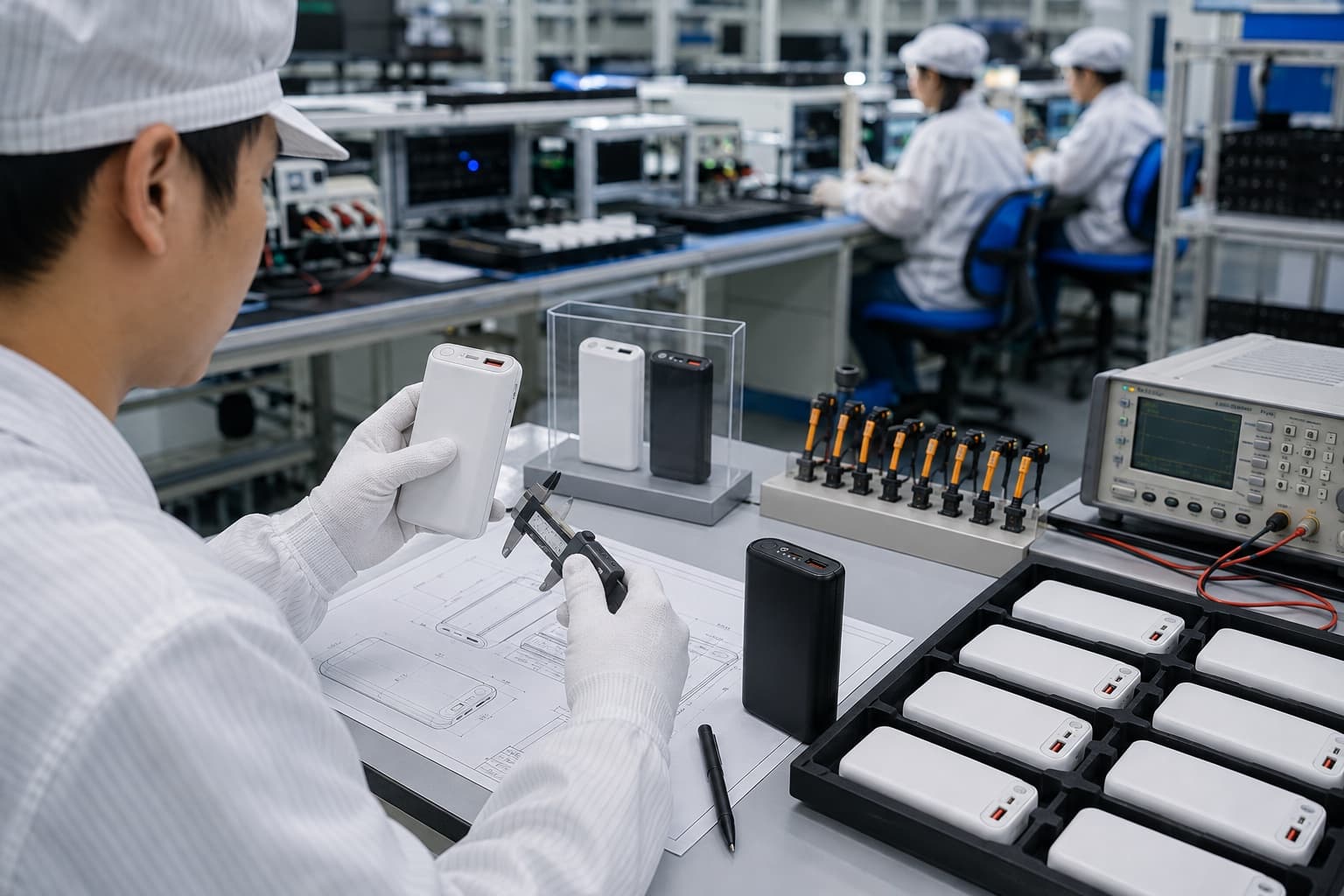
Quality evidence should connect the approved design to repeat production.
Ask the supplier how it controls:
- Battery cell model and lot traceability
- Protection circuit and critical component changes
- Output voltage and current tolerance
- Connector dimensions, polarity and cable assembly
- Charging, discharging and abnormal-condition protection
- Device start-up and continuous operation
- Temperature during the defined load test
- Enclosure, button, display and label appearance
- Packaging contents and artwork revision
- Final sampling and shipment release
Depending on the product and destination, buyers may also need cell, battery, transport, EMC, chemical or market-specific documentation. A report for a related model is not evidence for every configuration. Confirm the exact model, cell, PCB, output, connector and intended market before printing compliance claims.
Information Needed for a Reliable Recommendation
Send this information with the inquiry:
- Device type and intended user
- Target market and operating environment
- Input voltage range
- Normal and peak current or power
- Connector dimensions and polarity
- Cable length and routing
- Device operating modes
- Required runtime at each important mode
- Battery size and weight limits
- Expected order quantity
- Logo, color, label and packaging requirements
- Required launch or delivery date
- Available device sample, specification or test data
An inquiry that says only “10,000mAh power bank for a heated jacket” is not enough to confirm compatibility. Voltage, current, connector, polarity and real operating conditions must come first.
Frequently Asked Questions
Can I use a normal USB power bank for heated clothing?
Only if the garment is designed for that USB voltage and current and the combination passes device testing. Many heated garments require a specific DC output, connector or continuous-load behavior that a standard phone power bank may not provide.
Is a larger mAh rating always better?
No. More capacity can increase runtime, but it also increases size and weight. The power bank must first match voltage, current, connector, protection and operating behavior. Runtime then needs to be verified with the actual device.
Why does a power bank shut down while a wearable device is still connected?
The load may fall below the automatic shutoff threshold, fluctuate between modes or trigger protection logic. Test the device's lowest-power mode and any standby cycle, and select a platform designed for continuous or low-current operation when required.
What is the MOQ for a dedicated wearable-device power bank?
TOPTAI's current dedicated range generally starts from 200 pieces per model, while Q201 is listed from 500 pieces. Final MOQ depends on the selected model, electrical changes, connector, cable, branding and packaging.
How long does a sample take?
Standard sample preparation is normally about three days after the electrical specification is confirmed. A custom cable, connector, output configuration, housing or packaging may require a separate schedule.
Start With the Device, Not the Battery Catalog
The correct power bank for heated clothing, cooling workwear or a wearable device is the one that operates safely and consistently with that specific system. Capacity and price matter, but they come after voltage, current, connector, polarity, continuous-output behavior, environment and mechanical fit.
For many B2B projects, the fastest lower-risk route is to adapt a proven dedicated power platform through connector, cable, logo, label and packaging changes. New tooling becomes relevant only when a critical electrical or mechanical requirement cannot be met by the existing range.
Send the real device specification and target runtime before requesting a final quotation. That allows the supplier to recommend a model, identify missing information and define a sample test that can become the reference for mass production.
Sources and editorial note
This guide combines current primary-source guidance with TOPTAI’s experience supporting OEM/ODM power bank evaluation. Requirements can change by model, market, carrier and date; confirm the exact product and destination before ordering or traveling.

ABOUT THE REVIEWER