
APPLICATIONS & CHANNELS · NETWORK POWER
How to Choose a Backup Power Bank for Wi-Fi Routers, 4G/5G CPE and Outdoor Network Devices
A B2B guide to selecting backup power banks for Wi-Fi routers, 4G/5G CPE and outdoor network devices by voltage, current, connector, runtime and load testing.
 Reviewed by Grace WongCo-Founder | Custom Charging Solutions Lead · Updated September 11, 2026 · 13 min read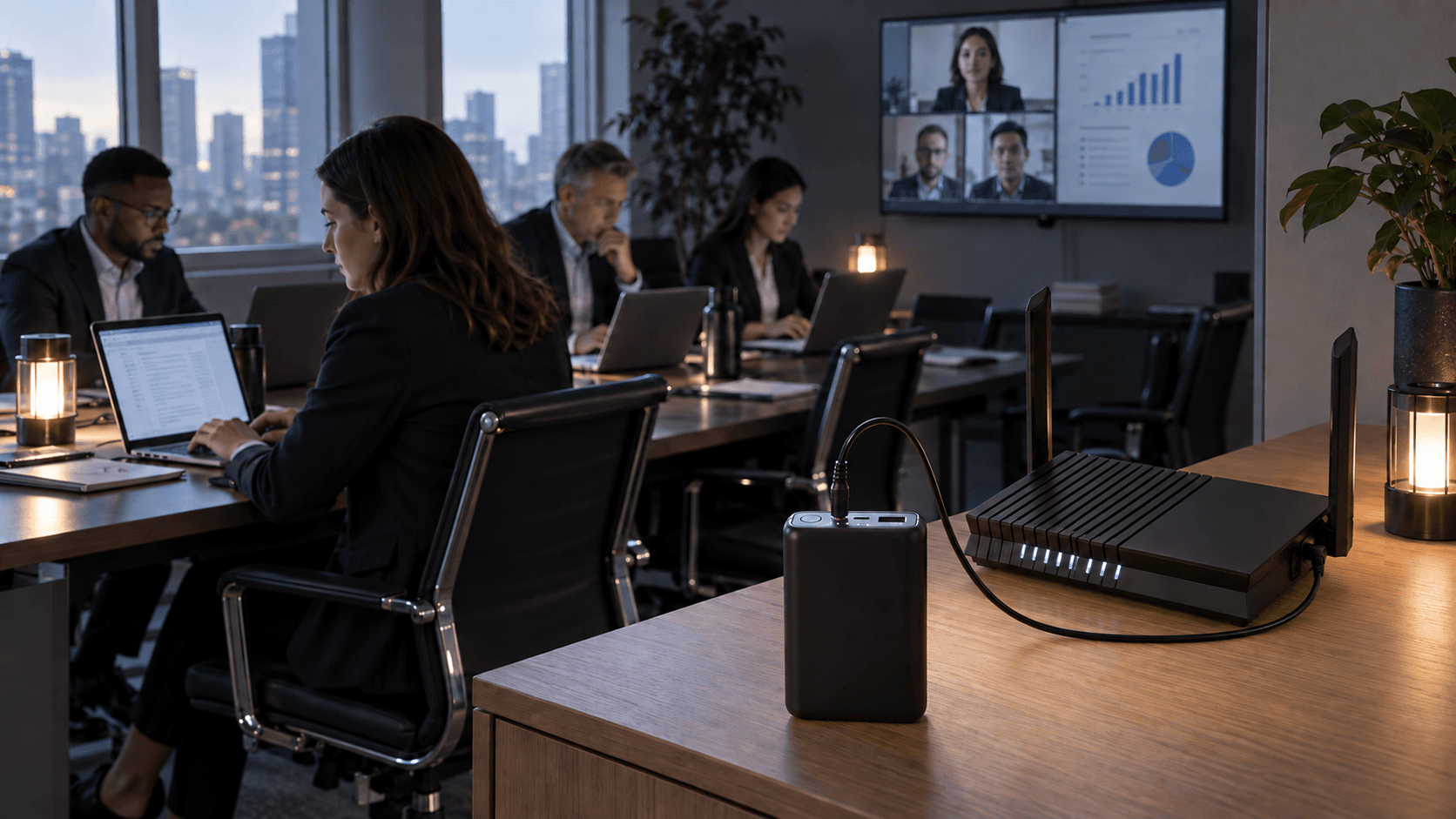
Start with the router or CPE nameplate and power-adapter specification. Match voltage exactly, provide enough current for start-up and peak radio activity, confirm connector size and polarity, and test the battery, cable and network device together. TOPTAI's 20,000mAh dedicated DC power bank can provide approximately 4–10 hours of emergency router backup, depending on the router's power consumption and test conditions. It does not support charging and discharging at the same time, so it is connected as an emergency source after mains power fails—not used as an always-connected UPS.
Choose Around the Network Device, Not Capacity Alone
When a router or cellular gateway loses power, the cost is rarely limited to the device itself. A retail terminal may stop reporting, a temporary site may lose connectivity, a camera may go offline, or a field team may lose access to a remote network.
For a B2B buyer, the right backup power bank is therefore not simply the model with the largest capacity. It must match the network device's input voltage, continuous and peak current, connector, polarity, required runtime and operating environment. A dedicated DC power bank is especially useful when a business needs emergency network power after the mains supply has failed—for example, to keep an important client meeting, retail operation, temporary project office or field team working while charged laptops remain available.
Why Network Devices Need a Device-Specific Power Check
Wi-Fi routers, 4G/5G CPE, industrial gateways and outdoor network equipment do not share one universal power input. Consumer routers may use a fixed barrel connector. Industrial cellular routers may accept a wider DC input range, use a terminal connector or support passive PoE. A USB-C socket also does not prove that any USB-C power bank will provide the voltage the device expects.
For example, the official Teltonika RUTX11 datasheet specifies a 4-pin industrial DC socket and a 9–50V DC input range. That is very different from a fixed-voltage router using a small barrel plug. The device datasheet—not the device category—must control the selection.
The supplier should receive the following information before recommending a model. Buyers planning connector, cable, voltage, branding or packaging changes can also review TOPTAI's OEM/ODM customization process before sampling:
- Device brand and model
- Input voltage or accepted voltage range
- Rated current and measured peak demand
- Connector dimensions and polarity
- Original adapter output specification
- Required operating time
- Indoor or outdoor environment
- Whether zero-interruption switchover is required
- Quantity, target market and certification requirements
Dedicated DC Power Bank vs. Mini UPS
These terms are often mixed together, but the operating requirement is different.
| Requirement | Dedicated DC power bank | Mini UPS |
|---|---|---|
| Main purpose | Provide efficient emergency DC power after mains power fails | Remain connected between a DC adapter and the router for automatic backup |
| Normal power source | Charged in advance, then connected to the router during an outage | Still requires an external DC input during normal operation |
| Switchover | Manual connection or restart should be expected | Designed for automatic switchover; verify the exact model's transfer behavior |
| Charge and discharge at the same time | Not supported | Common to the category, but verify the exact model and limits |
| Runtime consideration | Stored energy is reserved for emergency device power | Always-on conversion and system consumption can reduce the energy available during an outage |
| Key validation | Voltage, current, connector, runtime and temperature | Input adapter, transfer behavior, charging load, internal consumption and backup runtime |
Do not describe a dedicated DC power bank as a UPS based only on its DC output. The TOPTAI dedicated DC range does not support charging and discharging at the same time. Its role is to be charged in advance and connected as an emergency router power source when the mains supply is unavailable. A mini UPS can offer automatic transfer, but it still relies on a DC input during normal operation, and its own conversion and standby consumption can shorten actual battery runtime during an outage. Buyers should compare the required continuity, usable runtime and operating method—not only the capacity label.
Six Specifications to Match Before Selecting Capacity
1. Output voltage
The output must remain within the device's accepted input range throughout the useful discharge period. A router labeled 12V should not be connected to a randomly selected adjustable output without confirming the actual permitted range and setting method.
For USB-C Power Delivery applications, confirm the requested PD profile. USB-IF describes USB Power Delivery as a negotiated, flexible power system; a Type-C connector alone does not guarantee that the required voltage will be available.
2. Continuous and peak current
The original adapter rating is a useful starting point, but real demand can vary. A 5G CPE may draw more power during start-up, high data traffic, weak-signal transmission or when Wi-Fi and attached devices are active. The battery system must support both continuous load and short peaks without voltage collapse, shutdown or repeated rebooting.
3. Connector and polarity
Two barrel plugs can look similar but differ in outer diameter, inner diameter, insertion length or polarity. Confirm the connector by drawing or measurement and record whether the center pin is positive or negative. Also define cable length, wire gauge, locking needs and whether a right-angle plug is required.
4. Required runtime
State the business target: two hours through a short outage, an eight-hour shift, overnight monitoring or a full day at a remote site. Test at the network device's realistic load, not only its idle state.
5. Emergency connection and restart behavior
Because the dedicated DC power bank does not operate in pass-through mode, plan how staff will disconnect the failed mains adapter and connect the charged backup pack. Some routers take several minutes to restart and reconnect to the mobile network. If the application cannot tolerate any interruption, a separately verified automatic-backup architecture is required.
6. Environment and installation
Outdoor cabinets, solar installations, vehicles and temporary sites introduce heat, cold, moisture, vibration and limited airflow. Confirm the power bank's permitted operating and charging conditions. A consumer enclosure should not be assumed suitable for direct weather exposure; an external protected cabinet may be required.
Need a compatibility review? Send the router/CPE model, voltage, current, connector, polarity, target runtime and order quantity.
Need a router or CPE compatibility review?
Send the device model, voltage, current, connector, polarity, target runtime, quantity and market for a practical emergency-backup platform and sample recommendation.
Request catalog & quotation →Calculate Runtime in Watt-Hours, Not mAh Alone
A 10,000mAh label does not mean the power bank can deliver 10Ah at 9V or 12V. Capacity is normally stated at the internal cell's nominal voltage. Conversion to a higher DC output consumes energy and creates losses.
Use these first-pass calculations:
Nominal battery energy (Wh) = capacity (Ah) × nominal pack voltage (V)
Estimated runtime (hours) = usable output energy (Wh) ÷ average device power (W)
If a device averages 8W and the tested battery system can deliver 32Wh of usable output under the selected voltage and load, the first estimate is about four hours. This is only a planning figure. Cable loss, converter efficiency, signal conditions, temperature, battery cutoff and device activity can shorten the result.
For a compatible router, TOPTAI's 20,000mAh dedicated DC power bank is positioned for approximately 4–10 hours of emergency operation. A lower-power router may operate toward the upper end of that range; a higher-power router or CPE will operate for less time. The range must be verified with the buyer's real device, output voltage, cable and network load.
For purchasing approval, record runtime while the actual router or CPE is operating under a defined network load. Include start state of charge, output voltage, current, cable, ambient temperature, signal condition and shutdown criterion.
Q1001 Temperature and Voltage Curve for Low-Power Routers
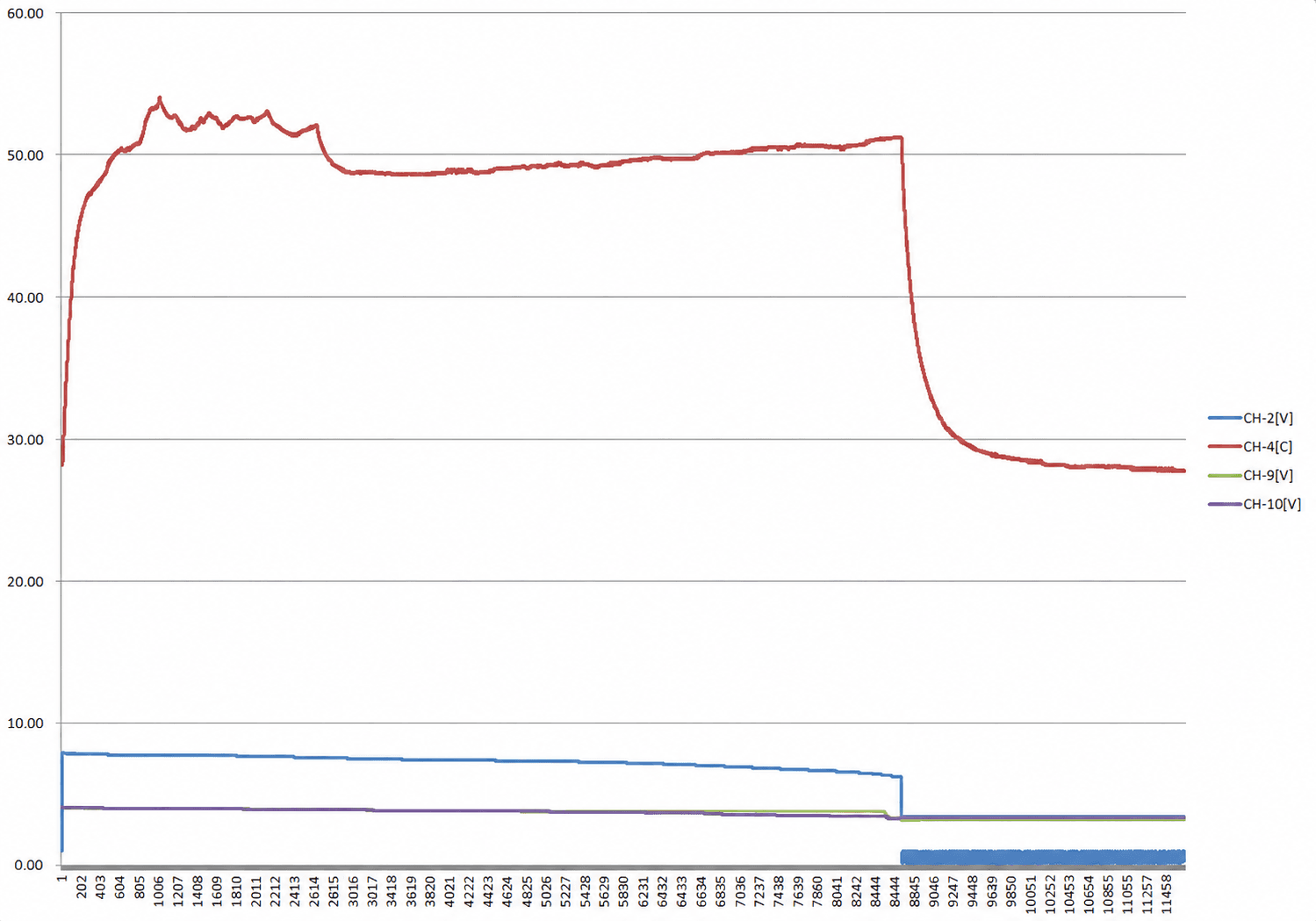
The available Q1001DC-D test record uses two 5000mAh lithium-ion cells and a 2A DC-port load. The chart records:
- Total discharge time of approximately 2 hours 25 minutes, or 8,864 seconds
- DC output near 7.97V at the beginning of the recorded discharge
- DC output near 6.1V close to cutoff
- Battery voltage moving from approximately 4.15V to 3.0V, followed by recovery to approximately 3.4V after load removal
- Recorded DC-port temperature points of approximately 54°C and 51.2°C
The curve chart supports two practical conclusions that explain the main advantages of a dedicated DC power bank for a compatible low-power router:
- Relatively stable voltage during the main output period. The output changes gradually rather than showing repeated abrupt fluctuations through most of the discharge process, helping a matched router operate more consistently until the battery approaches cutoff.
- Relatively stable temperature during the main working period. After the initial temperature rise, the measured temperature remains within a comparatively narrow band through most of the test instead of continuing to climb sharply.
Together, stable matched DC output and controlled thermal behavior are the defining advantages of a dedicated power bank in this application. They matter more to router reliability than capacity alone.
It is not a universal router-runtime promise. The result applies to the tested Q1001DC-D configuration and stated 2A load. Before publication as a formal performance claim, the test record should also identify ambient temperature, measurement location, test equipment, output setting tolerance, sample version and cutoff definition. A buyer's router or CPE should then be tested as the real load.
Choose a Capacity and Platform Around the Device
TOPTAI's dedicated power bank range includes selectable 7.4–12V references and DC38135 or DC5521 connector options. Relevant starting points for network-device projects include Q1001 at 10,000mAh, Q1601 at 16,000mAh, YQ8 and YQ11 at 20,000mAh, plus other 10,000–16,000mAh platforms.
These are platform references, not automatic compatibility approvals. The final model depends on:
- Accepted device voltage
- Continuous and peak load
- Required connector and polarity
- Runtime target
- Size and installation limits
- Need for USB or USB-C output alongside DC
- Manual emergency connection and restart requirement
- Target market documentation
Current dedicated models generally start at 200 pieces per model, while Q201 starts at 500 pieces. Standard sample preparation is normally about three days after specifications are confirmed. Electrical compatibility and lead time remain subject to the final approved configuration.
Special Checks for Wi-Fi Routers, 4G/5G CPE and Outdoor Devices
Wi-Fi routers
Test boot-up, Wi-Fi radio operation, wired ports and high traffic. If the router powers USB accessories, include them in the load. Confirm that the device does not restart as the battery approaches cutoff.
4G/5G CPE and cellular gateways
Test under weak and strong signal conditions, because radio transmission demand can change. Include SIM registration, network reconnection and high-throughput operation. Industrial gateways may have a much wider input range or special connector, but the battery output still needs to remain within that range.
Outdoor network devices
Define the weather-protected enclosure, thermal environment, cable routing and strain relief. If the system also uses solar charging, specify panel, controller and charging logic as a complete system. Do not assume a standard power bank can be charged safely in direct sun or inside a sealed hot cabinet.
Cameras, access points and PoE equipment
PoE requirements must be reviewed separately. Passive PoE and IEEE 802.3af/at/bt are not interchangeable. A DC barrel output cannot directly replace a PoE power source without the correct power architecture and verified injector or converter.
OEM/ODM Options for Network-Device Projects
When an existing electrical platform matches the device, buyers can focus power bank customization on the parts that improve installation, branding and channel readiness:
- DC connector and polarity
- Cable length, wire specification and plug direction
- Output-voltage configuration and labeling
- Housing color, logo and product label
- Battery indicator and operating instructions
- Device-specific kit packaging
- Adapter, cable and accessory set
- Barcode, manual and target-market packaging
Deeper ODM work may be justified for a unique enclosure, higher protection level, mounting features, a nonstandard connector or system communication. Automatic backup switching would be a different power architecture from the current dedicated DC power bank and requires a separate engineering review and validation plan.
A Practical Sample-Approval Test Plan
- Freeze the target device model, firmware and accessories.
- Record voltage range, normal current, start-up peak, connector and polarity.
- Select the closest battery platform and cable.
- Verify the output setting before connecting the device.
- Test cold start, reboot and repeated power cycles.
- Run idle, typical traffic and peak-load conditions.
- Check voltage at the device end of the cable, not only at the battery port.
- Record runtime and temperatures at defined intervals.
- Test low-battery behavior and network recovery.
- Simulate mains failure and confirm the manual connection, router restart and network reconnection procedure.
- Approve a signed sample and specification as the production reference.
Factory and quality-control evidence should link the approved configuration to incoming cell control, PCB and connector inspection, output testing, aging or load testing, final inspection and lot traceability.
Questions to Ask a Backup Power Bank Manufacturer
- Can you match our exact voltage, current, connector and polarity?
- What is the verified continuous output at our selected voltage?
- How does the output behave near low battery cutoff?
- Can you provide a load-test record with voltage, time and temperature?
- Does the product support simultaneous charging and discharging? For this dedicated DC range, the answer is no.
- Which battery cell, PCB and cable are covered by the approved sample?
- What customization can be completed without new tooling?
- What are the MOQ, sample time and mass-production lead time?
- Which power bank transport and shipping documents apply to the exact configuration?
- How are production changes and lot traceability controlled?
Send These Details for a Faster, More Accurate Proposal
To receive a useful recommendation instead of a generic quotation, send:
- Company and country
- Network-device brand, model and application
- Datasheet or original adapter label photo
- Input voltage and current
- Connector dimensions and polarity
- Target runtime and use environment
- Planned manual backup procedure and acceptable restart time
- Logo, housing, cable and packaging requirements
- Quantity and forecast
- Target market, certification needs and requested delivery date
Buyers sourcing batteries for another device-specific application can also review the power bank guide for heated clothing, cooling wear and wearable devices. It uses the same device-first approach to voltage, current, connector, runtime and sample approval.
Frequently Asked Questions
Can any 12V power bank run a 12V router?
No. Confirm the router's accepted voltage tolerance, continuous and peak current, connector, polarity and cable voltage drop. Then test the exact combination through start-up, network load and low battery state.
Is a USB-C power bank suitable for a router or 5G CPE?
Only if the power source, cable or trigger method and device support the required power profile. “USB-C” describes the connector, not a guaranteed voltage or power level.
How large should a router backup battery be?
Calculate from the device's measured wattage and target hours, allow for conversion and cable losses, then verify runtime with the real device. Do not size it from mAh alone.
Does a dedicated DC power bank provide uninterrupted backup?
No. The TOPTAI dedicated DC power bank does not support charging and discharging at the same time. Charge it in advance and connect it to the compatible router as an emergency source after mains power fails.
What should be tested before mass production?
Test voltage stability, peak current, connector and polarity, cable drop, device boot, traffic load, runtime, temperature, low-battery behavior and—if required—mains failure and recovery. The approved sample and specification should become the production reference.
Sources and editorial note
This guide combines current primary-source guidance with TOPTAI’s experience supporting OEM/ODM power bank evaluation. Requirements can change by model, market, carrier and date; confirm the exact product and destination before ordering or traveling.

ABOUT THE REVIEWER