
COMPLIANCE & SHIPPING · B2B GUIDE
Power Bank Shipping Documents: UN38.3, MSDS, IEC 62133 and Sea/Air Freight Requirements
Understand UN38.3, SDS/MSDS, IEC 62133-2 and the air- and sea-freight documents buyers should verify before shipping power banks internationally.
 Reviewed by Grace WongCo-Founder | Custom Charging Solutions Lead · Updated September 2, 2026 · 24 min read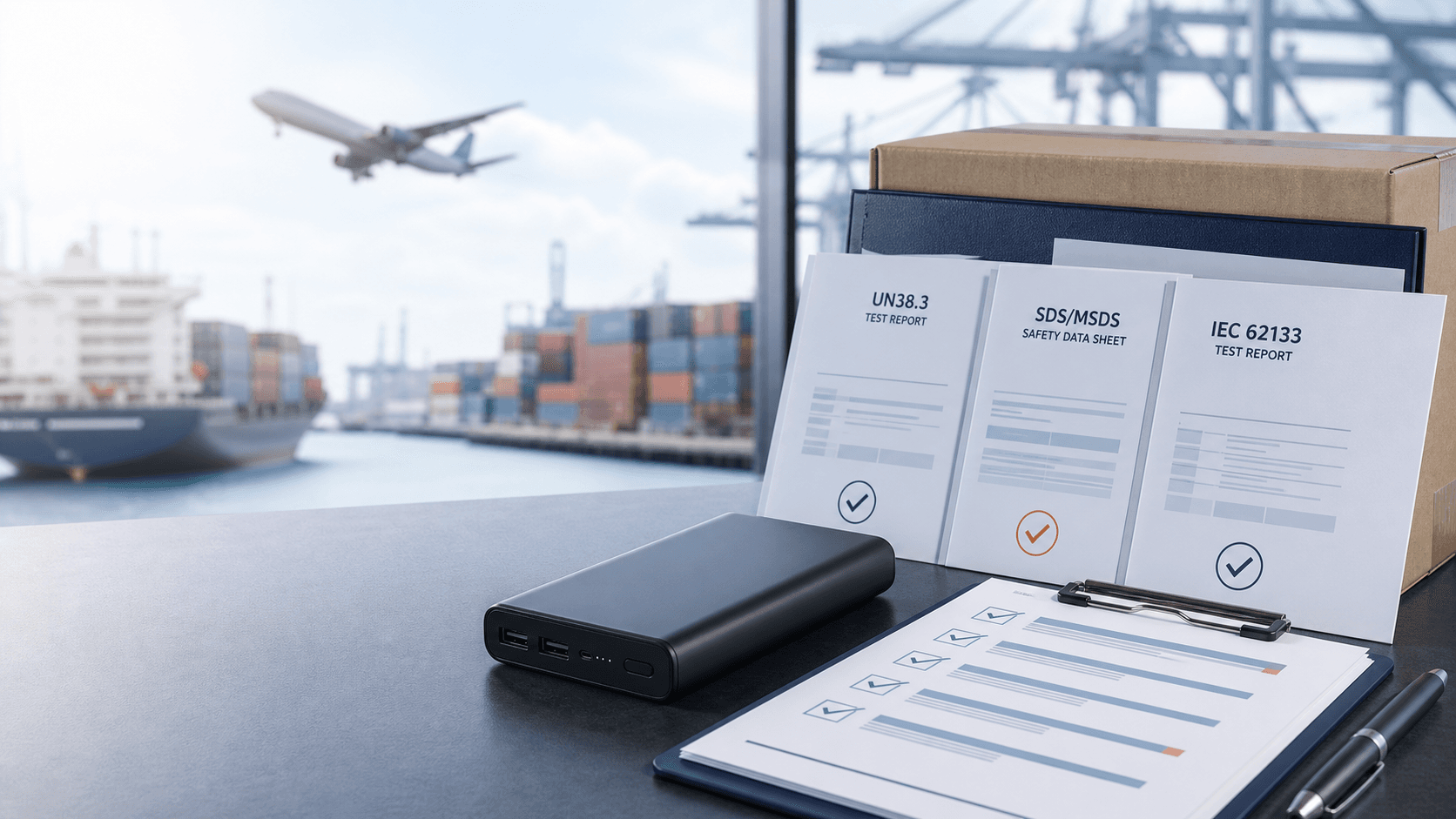
A power bank shipping package commonly includes a matching UN38.3 report and test summary, a current SDS/MSDS, transport classification evidence requested by the forwarder, commercial documents, and the correct package marks and labels. IEC 62133-2 may support product or market safety requirements but does not replace UN38.3. The exact package must be confirmed for the model, route, carrier and shipment year.
Quick Answer: What Documents Are Commonly Needed to Ship Power Banks?
The exact document package depends on the product, battery configuration, rated energy, transport mode, country, carrier and freight forwarder.
For a conventional rechargeable lithium-ion power bank shipped as standalone cargo, buyers commonly need to verify the following:
| Document or item | Main purpose | Commonly relevant to air freight | Commonly relevant to sea freight |
|---|---|---|---|
| UN38.3 test report | Shows the battery type passed the applicable UN transport tests | Yes | Yes |
| UN38.3 test summary | Provides the standardized summary required to be made available | Yes | Yes |
| SDS/MSDS | Communicates composition, hazards and handling information | Often requested | Often requested |
| Transport conditions or classification report | Helps the carrier or forwarder classify the shipment | Frequently requested in practice | Frequently requested in practice |
| Dangerous goods declaration | Declares regulated dangerous goods when required | Depends on applicable packing instruction | Depends on classification and shipment |
| Commercial invoice | Customs and commercial information | Yes | Yes |
| Packing list | Shipment quantity, weight and packaging details | Yes | Yes |
| Package marks and labels | Communicates lithium-battery and transport hazards | Yes | Yes |
| IEC 62133-2 report or certificate | Product battery safety evidence, not a transport document | Market/customer dependent | Market/customer dependent |
| Market compliance documents | Supports sale in the destination market | Market dependent | Market dependent |
This table is a planning guide rather than a universal shipping checklist. A freight forwarder or dangerous-goods specialist must confirm the final requirements against the current regulations and carrier rules.
1. What Is UN38.3?
UN38.3 refers to subsection 38.3 of Part III of the United Nations Manual of Tests and Criteria.
It establishes transport-related tests for lithium metal and lithium-ion cells and batteries. The objective is to verify that the battery type can withstand conditions that may occur during transport.
The test series covers:
- Altitude simulation
- Thermal testing
- Vibration
- Shock
- External short circuit
- Impact or crush, as applicable
- Overcharge for rechargeable batteries
- Forced discharge for cells
The applicable tests depend on whether the item is a cell or a battery and whether it is rechargeable.
The UN Manual provides the test methods and criteria used for the classification of dangerous goods. The current official materials are published by the United Nations Economic Commission for Europe.
What does a UN38.3 report prove?
A valid report provides evidence that the tested cell or battery type passed the applicable UN38.3 tests.
It does not automatically prove that:
- Every production unit has the same quality.
- The product complies with all electrical safety requirements.
- The power bank can legally be sold in every destination market.
- The shipment has been correctly packed and labeled.
- Every airline, shipping line or forwarder must accept the cargo.
UN38.3 is an essential part of lithium-battery transport compliance, but it is not the entire compliance package.
Does changing the power bank require a new UN38.3 test?
Possibly.
A report should match the battery type used in the production model. Buyers should check whether the following information is consistent with the actual goods:
- Manufacturer
- Model number
- Cell model
- Battery configuration
- Rated voltage
- Rated capacity
- Watt-hour rating
- Physical construction
- Protection system
- Report issue date and laboratory information
Changes to the cell, battery assembly, capacity, protection circuit or other safety-relevant construction may affect whether the existing report remains applicable.
A supplier should not simply provide a report from a different model because both products have the same advertised capacity.
2. What Is a UN38.3 Test Summary?
The test summary is different from the full UN38.3 test report.
Manufacturers and subsequent distributors of lithium cells and batteries must make available a standardized test summary showing that the cell or battery type has met the applicable UN38.3 requirements.
A test summary normally includes information such as:
- Cell or battery manufacturer
- Manufacturer contact details
- Test laboratory details
- Test report identification number
- Test report date
- Description of the cell or battery
- Applicable test results
- Reference to the relevant UN Manual edition
- Signature and identification of the signatory
The full laboratory report may contain detailed test procedures, measurements and results. The test summary provides a standardized compliance overview for parties in the supply chain.
What should an importer check?
Before shipment, the buyer should confirm that:
- The model and electrical specifications match the ordered goods.
- The stated manufacturer and factory relationship are clear.
- The test report number can be traced.
- The summary covers the finished battery configuration—not only an unrelated cell.
- The information is consistent across the report, label, invoice and packing list.
A mismatch between these documents can delay carrier review or cause the shipment to be rejected.
3. What Is an MSDS or SDS?
MSDS means Material Safety Data Sheet. The more current term is SDS, or Safety Data Sheet.
An SDS communicates information about a chemical product or material, including:
- Product and supplier identification
- Hazard identification
- Composition
- First-aid measures
- Firefighting measures
- Accidental-release measures
- Handling and storage
- Exposure controls
- Physical and chemical properties
- Stability and reactivity
- Toxicological and ecological information
- Disposal considerations
- Transport information
- Regulatory information
For power bank shipments, freight forwarders and carriers often request an SDS as part of their internal review.
Is an SDS proof that a power bank passed UN38.3?
No.
An SDS describes hazards and handling information. It does not replace:
- A UN38.3 test report
- A UN38.3 test summary
- A transport classification report
- A dangerous goods declaration
- Product safety certification
The transport section of an SDS may state a UN number, hazard class or shipping description, but the document alone does not prove that the battery completed the required UN tests.
Is an SDS always a legal shipping document?
Not in exactly the same way for every route.
An SDS is frequently requested by freight forwarders, carriers, warehouses and customs-service providers. However, the legally prescribed dangerous-goods documents depend on the applicable transport regulation and shipment classification.
Buyers should therefore treat the SDS as part of the supporting document package—not as a universal substitute for transport documentation.
Need a model-specific shipping document review?
Share the target country, product model, capacity, quantity and planned freight method. TOPTAI can organize the available files and flag items that still need forwarder confirmation.
Request catalog & quotation →4. What Is IEC 62133-2?
IEC 62133-2 is an international safety standard covering portable sealed rechargeable lithium cells and batteries containing non-acid electrolyte.
The standard addresses safe operation under intended use and reasonably foreseeable misuse. It includes requirements and tests relating to areas such as electrical, mechanical and thermal safety.
The applicable consolidated version is IEC 62133-2:2017+A1:2021. The IEC describes it as a safety standard for portable sealed secondary lithium cells and batteries. See the official IEC 62133-2 publication information.
Is IEC 62133-2 required for transportation?
IEC 62133-2 is not a replacement for UN38.3.
The two address different purposes:
| Standard | Primary purpose |
|---|---|
| UN38.3 | Suitability of a lithium cell or battery type for transport |
| IEC 62133-2 | Safety of portable rechargeable lithium cells and batteries during intended use and foreseeable misuse |
A battery may require UN38.3 evidence for transport even when the destination market or customer does not request IEC 62133-2.
Conversely, an IEC 62133-2 report does not eliminate the need to comply with lithium-battery transport rules.
When might a buyer request IEC 62133-2?
It may be requested because of:
- Destination-market requirements
- Certification schemes that reference the standard
- Retailer or platform requirements
- Customer safety specifications
- Product-risk assessment
- Internal brand compliance policies
Buyers should confirm which standard edition and certification route apply to the destination market rather than listing “IEC 62133” in an RFQ without context.
5. How Are Power Banks Classified for Shipping?
A typical rechargeable lithium-ion power bank shipped by itself is generally classified as:
- UN number: UN 3480
- Proper shipping name: Lithium ion batteries
- Hazard class: Class 9
This differs from batteries packed with or contained in equipment:
| Shipping configuration | Typical UN number |
|---|---|
| Power bank shipped as a standalone battery | UN 3480 |
| Lithium-ion batteries packed with equipment | UN 3481 |
| Lithium-ion batteries contained in equipment | UN 3481 |
A phone with an installed battery, for example, is not classified in the same way as a carton of standalone power banks.
Adding a cable, pouch or retail box does not normally turn a power bank into “battery contained in equipment.” Its primary function remains supplying power to another device.
Final classification should be confirmed by a qualified shipping professional.
6. Air-Freight Requirements for Power Banks
Air transport is governed by detailed dangerous-goods requirements. The IATA Dangerous Goods Regulations incorporate the applicable international air-transport framework and carrier requirements.
For 2026, IATA states that lithium-ion cells and batteries shipped by themselves under UN 3480:
- Are forbidden as cargo on passenger aircraft
- Must travel on cargo aircraft under the applicable conditions
- Must generally be shipped at a state of charge not exceeding 30% of rated capacity
- Must comply with applicable packaging, marking, labeling and documentation requirements
The current requirements are explained in the IATA 2026 Lithium Battery Guidance Document.
Which packing instruction applies?
Standalone lithium-ion batteries classified as UN 3480 are associated with IATA Packing Instruction 965.
The applicable section and package requirements depend on factors including:
- Watt-hour rating
- Quantity
- Net battery weight
- Packaging configuration
- Whether the shipment qualifies for a particular provision
- State and airline variations
For many conventional power banks not exceeding 100Wh, the shipment may fall within the conditions applicable to smaller lithium-ion batteries, but this does not mean the cargo is unrestricted.
The shipper still needs to verify:
- UN38.3 compliance
- State of charge
- Short-circuit protection
- Inner and outer packaging
- Quantity and weight limits
- Package marks
- Hazard and cargo-aircraft-only labels where applicable
- Required dangerous-goods documentation
- Airline-specific variations
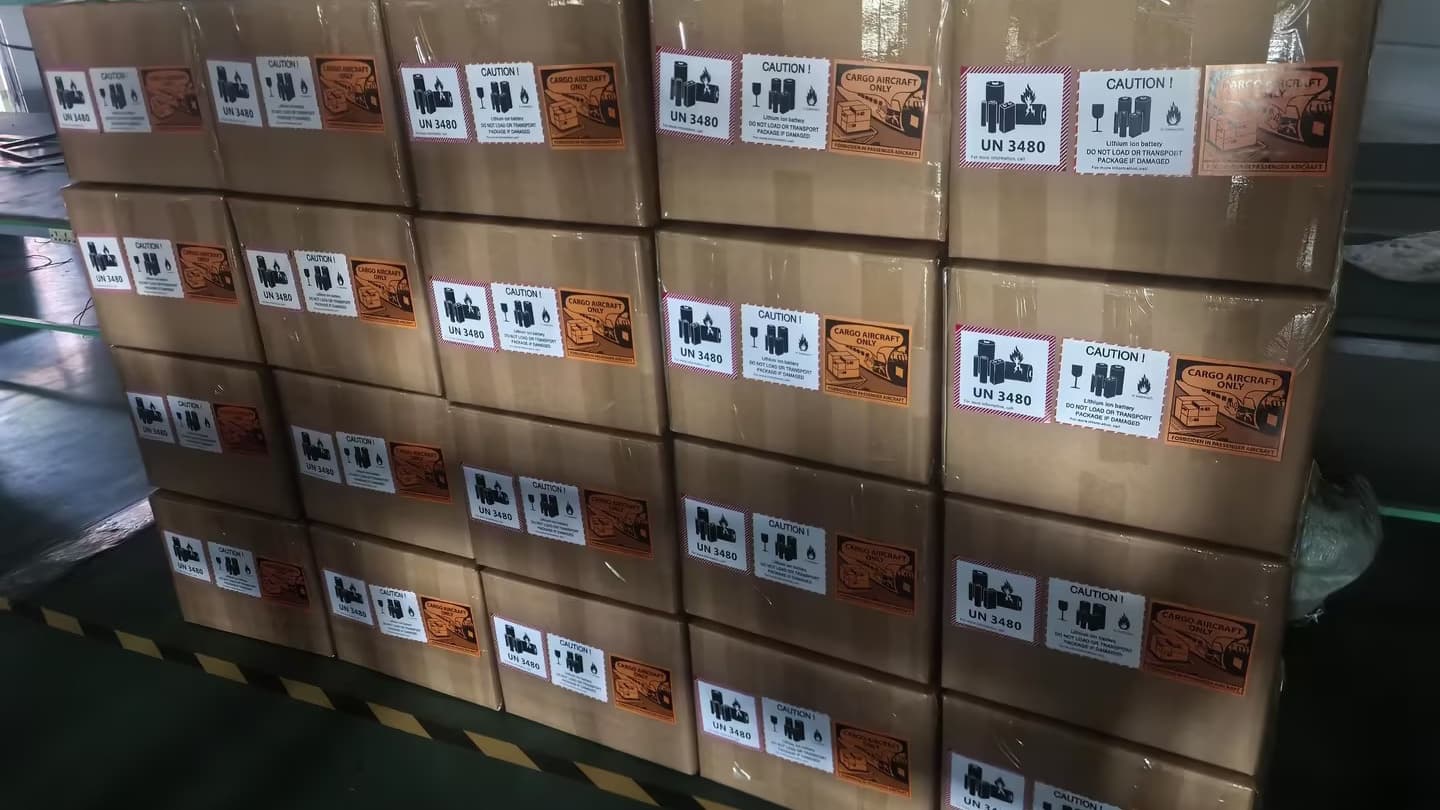
Actual TOPTAI shipment cartons prepared with lithium-battery handling, UN 3480 and Cargo Aircraft Only labels. The final label set and placement must follow the applicable packing instruction and the appointed carrier’s requirements.
Are commercial invoices and packing lists sufficient?
No.
A commercial invoice and packing list are standard trade documents, but they do not replace dangerous-goods documentation when such documentation is required.
Depending on the shipment, air-freight documentation may include:
- Air waybill
- Shipper’s Declaration for Dangerous Goods
- UN38.3 test summary
- SDS
- Air-transport classification or conditions report
- Commercial invoice
- Packing list
- Other documents requested by the airline or forwarder
IATA notes that lithium-battery shipments must comply with applicable testing, packaging, marking, labeling and documentation requirements. It also warns that state and airline variations may be more restrictive than the general rules. See IATA’s lithium-battery shipping guidance.
7. Sea-Freight Requirements for Power Banks
Lithium-battery shipments by sea are governed through the International Maritime Dangerous Goods Code and the carrier’s operational requirements.
A conventional power bank shipped by itself is generally treated as UN 3480, Class 9.
The shipping arrangement must consider:
- Watt-hour rating
- UN38.3 status
- Packaging
- Protection against short circuit
- Prevention of unintended activation
- Package marks and labels
- Container and dangerous-goods declarations
- Carrier and port requirements
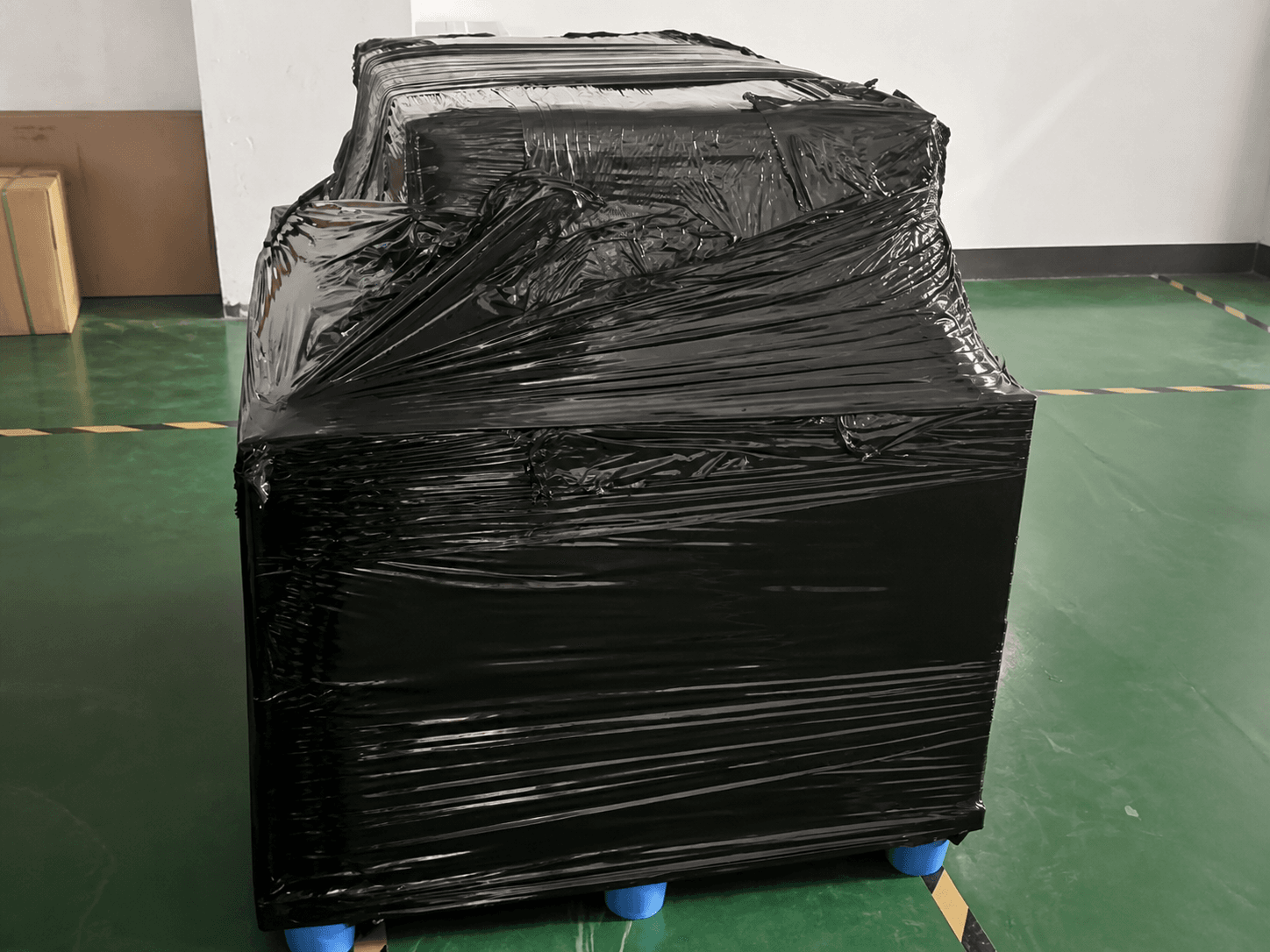
Example of TOPTAI’s waterproof outer wrapping for a sea-freight loose-cargo shipment. The packing method can be coordinated with the buyer’s forwarder according to the shipment size, route and handling requirements.
Can power banks under 100Wh be shipped as non-dangerous goods?
The statement “under 100Wh means non-dangerous goods” is misleading.
Smaller lithium-ion batteries may qualify for certain regulatory exceptions when all applicable conditions are met. However, they remain lithium batteries and are not automatically free from testing, packaging, marking or carrier-review requirements.
The correct question is:
The buyer and supplier should ask the freight forwarder to confirm this in writing before booking.
Documents commonly requested for sea freight
Depending on the route and carrier, the document package may include:
- UN38.3 test report or test summary
- SDS
- Sea-transport conditions or classification report
- Dangerous goods declaration
- Container packing certificate where applicable
- Commercial invoice
- Packing list
- Product specifications
- Emergency contact information
- Carrier-specific declaration forms
The exact list should come from the appointed shipping line or freight forwarder.
8. UN38.3 vs MSDS vs IEC 62133: Key Differences
| Question | UN38.3 | SDS/MSDS | IEC 62133-2 |
|---|---|---|---|
| Is it primarily a transport requirement? | Yes | Supporting hazard communication | No |
| Does it involve laboratory testing? | Yes | Not necessarily | Yes |
| Does it prove market access? | No | No | Not by itself |
| Does it replace a dangerous goods declaration? | No | No | No |
| Does it evaluate normal-use battery safety? | Limited to transport-related conditions | No | Yes |
| Should it match the actual model? | Yes | Yes | Yes |
| Can it replace the other two documents? | No | No | No |
The documents are complementary, not interchangeable.
9. Documents That Do Not Automatically Authorize Shipment
B2B buyers often receive a folder containing CE, FCC, RoHS, UL or IEC reports and assume the shipment is ready.
These documents may be important for product compliance, but they do not automatically complete transport compliance.
For example:
- CE-related documentation concerns applicable EU product legislation.
- RoHS concerns restrictions on certain hazardous substances.
- FCC documentation relates to applicable electromagnetic or radio-frequency requirements in the United States.
- UL reports or certifications address particular safety standards or certification programs.
- IEC 62133-2 addresses rechargeable-cell and battery safety.
- UN38.3 addresses lithium-battery transport testing.
A power bank may have market compliance reports and still be rejected by a carrier because of:
- Incorrect UN classification
- Missing UN38.3 test summary
- Mismatched model information
- Incorrect packaging
- Excessive state of charge
- Missing marks or labels
- Incomplete dangerous-goods documentation
- Airline or shipping-line restrictions
10. What Should Buyers Check Before Paying a Deposit?
Before placing an OEM or private-label order, request documents for the exact model—not just a general factory certificate list. Our guide to choosing a power bank supplier explains how model-specific evidence fits into the wider supplier-evaluation process.
Product and battery identity
Confirm:
- Finished-product model
- Cell manufacturer and model
- Cell chemistry
- Rated cell capacity
- Battery-pack configuration
- Nominal voltage
- Watt-hour rating
- PCBA and protection design
Transport documentation
Request:
- UN38.3 test report
- UN38.3 test summary
- Current SDS
- Relevant air or sea transport report, if required by the planned forwarder
- Clear confirmation of the UN number and proper shipping name
Market documentation
Ask which reports support sale in the destination market, such as:
- EMC documentation
- RoHS documentation
- Product safety reports
- Wireless charging or radio-related documents where applicable
- Battery labeling
- Importer or producer-responsibility obligations
Shipment planning
Confirm:
- Air, sea, rail or road transport
- Departure country
- Destination country
- Carrier
- Whether the goods will be shipped as standalone batteries
- Carton quantity
- Net battery weight per package
- Gross shipment weight
- Required state of charge
- Packaging and labeling responsibilities
This review should take place before mass production. Discovering a document mismatch after the cargo reaches the warehouse can cause rebooking, repacking, storage charges or shipment delays.
11. How to Verify Whether a Report Matches the Product
A report folder is only useful when its contents are traceable to the goods.
Use this verification checklist:
Model consistency
The product model on the report should match the product, specification sheet and commercial documents.
Electrical consistency
Check:
- mAh
- Wh
- Nominal voltage
- Cell quantity
- Series or parallel configuration
Watt-hours can be calculated using:
Wh = Ah × nominal voltage
For example:
20,000mAh = 20Ah
At a nominal cell voltage of 3.7V:
20Ah × 3.7V = 74Wh
The advertised USB output voltage should not be used as the cell’s nominal voltage for this calculation.
Manufacturer consistency
Identify whether the report belongs to:
- The cell manufacturer
- The battery-pack manufacturer
- The finished-product manufacturer
- An unrelated supplier
A cell-level report does not automatically prove that every finished battery-pack configuration is covered.
Report traceability
Check:
- Laboratory name
- Report number
- Issue date
- Standard or regulatory edition
- Applicant and manufacturer
- Product photos
- Technical drawings
- Signatures or authorization
If information has been edited, obscured or presented only as an incomplete screenshot, request the complete document for review.
12. Common Shipping Mistakes in OEM Power Bank Projects
Three document errors that frequently delay shipment review
Before a forwarder reviews the packing method, buyers should check three basic points across the battery report, product specification, label, invoice and packing list:
- The battery model, capacity or watt-hour rating does not match. A report for a different cell, battery pack or advertised power bank capacity may not cover the goods being shipped. Compare the exact model number, nominal voltage, mAh and Wh value rather than relying on a similar product name.
- The document is no longer current. SDS/MSDS files and air- or sea-transport identification reports are commonly reviewed against the current shipment year. Reports issued for the 2026 calendar year normally state an expiry date of December 31, 2026. Buyers should obtain the current-year version before booking instead of submitting a report marked valid only through December 31, 2025.
- The report does not show the expected CNAS accreditation mark or stamp. For shipments handled through China, a forwarder may require a transport report issued within an accepted laboratory and accreditation scope. Check the report cover for the CNAS identification, issuing laboratory, report number and official stamp, then ask the appointed forwarder to confirm acceptance.
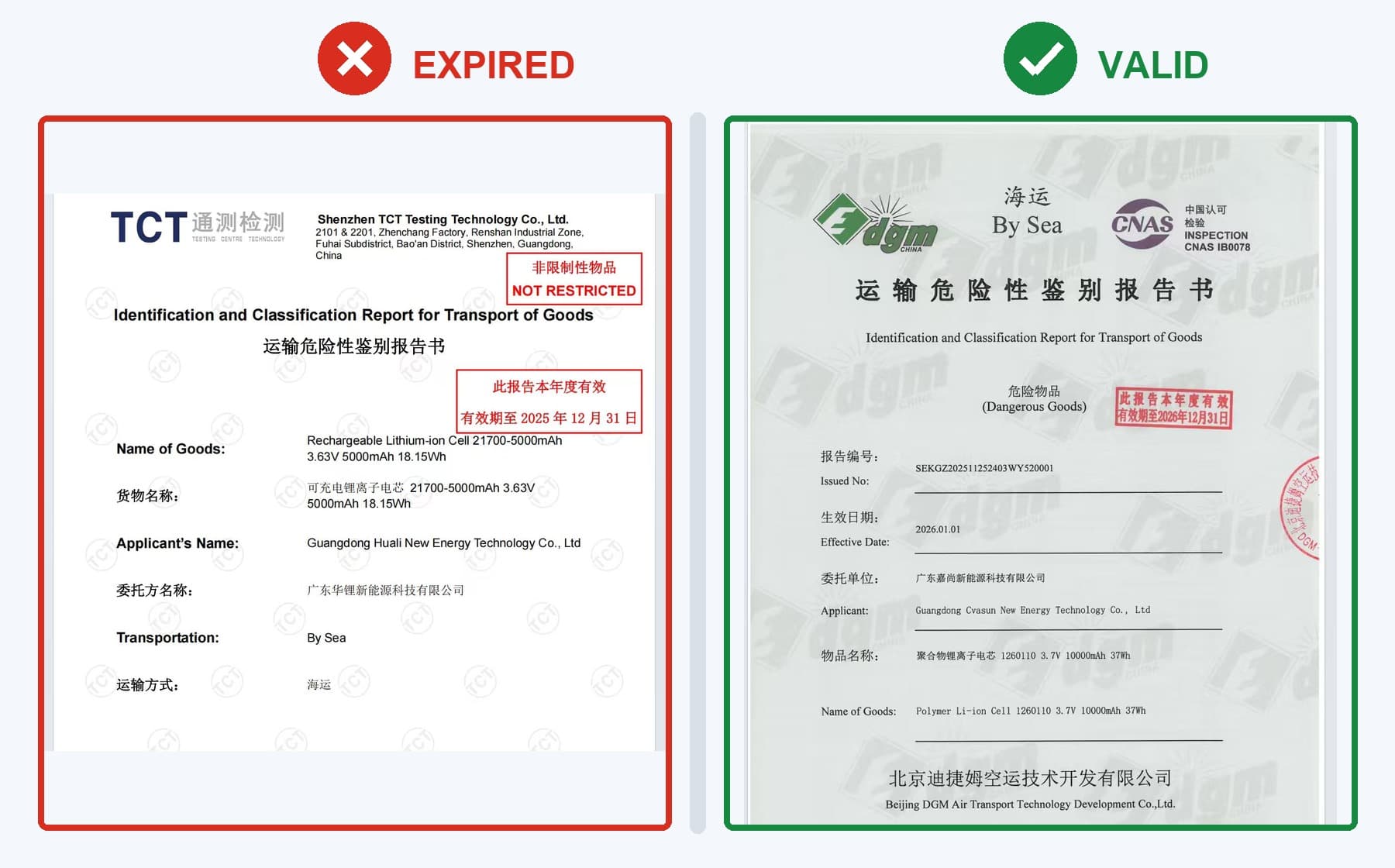
Left: a transport report marked valid only through December 31, 2025. Right: a 2026 report marked valid through December 31, 2026 and displaying CNAS identification. The correct report must also match the actual battery model and electrical specifications.
TOPTAI can check these three points before production and prepare the current model-specific document package for the buyer’s freight forwarder. Final acceptance still depends on the shipment route, carrier and the forwarder’s current requirements.
Mistake 1: Requesting “all certificates” without naming a market
There is no universal certificate package for every country and transport route.
A better request is:
Mistake 2: Checking documents after production
The buyer may discover that the tested cell, capacity or model differs from the finished product.
Document review should occur before the deposit or before materials are finalized.
Mistake 3: Treating an SDS as a battery test report
An SDS does not prove UN38.3 compliance.
Mistake 4: Treating IEC 62133 as a shipping certificate
IEC 62133-2 is a battery safety standard, not a replacement for transport testing and shipping declarations.
Mistake 5: Assuming all products under 100Wh have identical requirements
The 100Wh threshold is important, but classification also depends on packaging, quantity, transport mode and carrier rules.
Mistake 6: Ignoring airline and shipping-line variations
A shipment that is technically classifiable may still require carrier preapproval or additional documentation.
Mistake 7: Using reports from a similar model
A similar appearance or capacity does not prove that the cell, battery pack and protection design are identical.
13. Recommended Document Workflow for Importers
A lower-risk document process can follow five stages.
Stage 1: Define the project
Provide the supplier with:
- Destination country
- Product model
- Capacity and wattage
- Sales channel
- Order quantity
- Planned transport mode
Stage 2: Review existing documents
Check whether the supplier already holds model-specific reports and whether they match the current configuration.
Stage 3: Identify gaps
Separate the gaps into:
- Transport testing
- Shipping documentation
- Product safety
- EMC
- Environmental compliance
- Market labeling
- Customer-specific requirements
Stage 4: Confirm with the freight forwarder
Send the product specifications and available reports to the appointed forwarder before booking.
Ask the forwarder to confirm:
- Classification
- Packing instruction
- Required marks and labels
- Required declarations
- State-of-charge restriction
- Carrier acceptance
- Additional route-specific documents
Stage 5: Recheck before shipment
Verify that the mass-produced goods, packaging and shipping documents remain consistent with the reviewed samples and reports.
TOPTAI can perform this recheck against the approved specification, product label, carton data and model document folder, then provide the package to the buyer’s nominated forwarder for final acceptance.
14. How TOPTAI Supports Power Bank Shipping Documentation
TOPTAI’s power bank supplier and product collection supports B2B buyers from model selection through sampling, production and shipment preparation.
Depending on the model and project, available support may include:
- Model-specific product specifications
- UN38.3 test reports and test summaries
- SDS/MSDS
- Existing compliance reports
- Product and carton labeling information
- Packaging data
- Coordination with the buyer’s freight forwarder
- Support for additional testing when required
Example: one organized document package for one model
The image below is an actual working-file view for TOPTAI’s J11 power bank project. The model folder brings together the UN38.3 test report and summary, signed MSDS, road/air/sea transport identification reports and stacking-related documentation. Keeping these files under one exact product model makes it easier to trace document numbers, compare the battery specification and send the correct package to the buyer or forwarder.
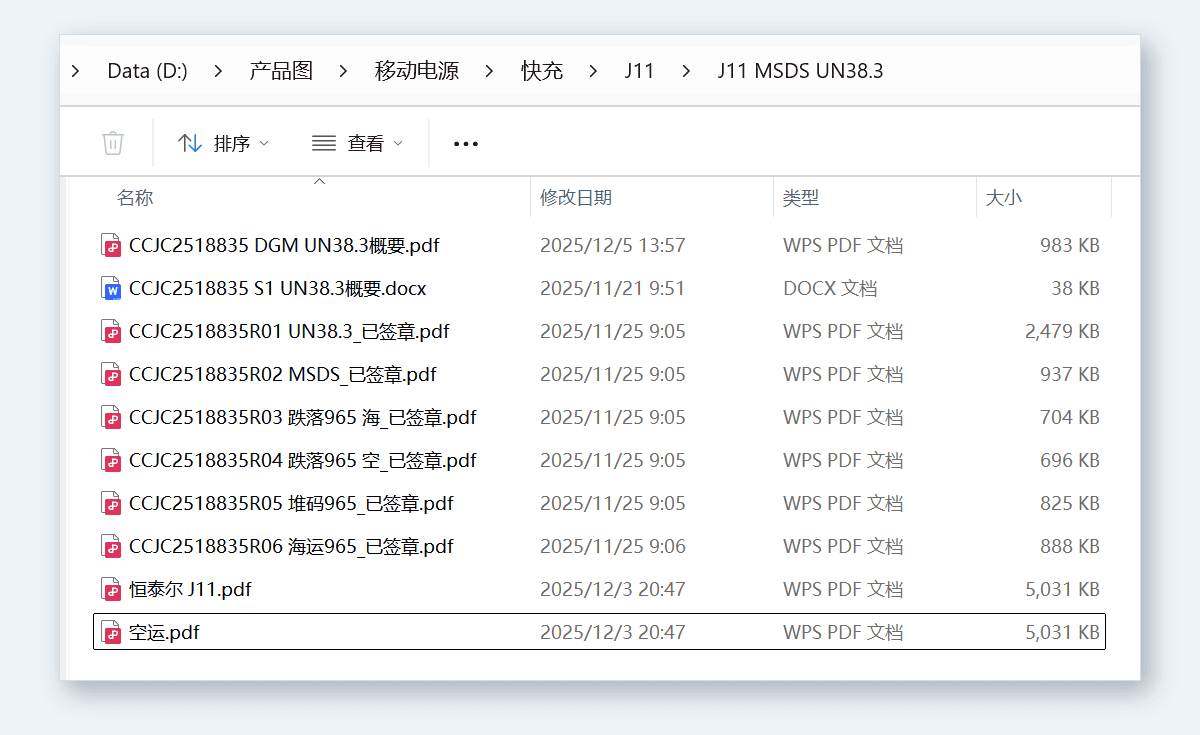
A real TOPTAI J11 transport-document folder, shown as operational evidence rather than a generic certificate list. Full reports can be provided for the relevant model and project, subject to document-disclosure conditions.
This screenshot demonstrates document organization, but it does not replace review of the full files. Before shipment, TOPTAI checks the model, nominal voltage, capacity, watt-hour rating, report validity and available laboratory identification against the goods being produced.
Document availability varies by model, configuration, destination market and customer requirement.
Before quotation, buyers should provide:
- Target country
- Sales channel
- Required capacity and output power
- Customization scope
- Estimated order quantity
- Planned shipping method
- Required certification or retailer standard
This allows the factory to determine whether an existing model and document package are suitable or whether additional testing is required.
Frequently Asked Questions
Is UN38.3 mandatory for shipping power banks?
Lithium cells and batteries offered for transport generally need to be of a type that has passed the applicable UN38.3 tests, subject to specific provisions and exceptions in the governing regulations.
Buyers should request both the relevant report evidence and the UN38.3 test summary for the actual battery type.
Is MSDS the same as UN38.3?
No. An SDS or MSDS communicates hazard and handling information. UN38.3 involves transport-related testing of lithium cells and batteries.
Can IEC 62133 replace UN38.3?
No. IEC 62133-2 evaluates portable rechargeable battery safety. UN38.3 addresses transport testing. Passing one does not replace the other.
Do power banks need a dangerous goods declaration?
It depends on the transport mode, classification, packing instruction and applicable exception. The appointed dangerous-goods forwarder should confirm whether a declaration is required for the shipment.
Can power banks be shipped by passenger aircraft?
Standalone lithium-ion batteries classified as UN 3480 are forbidden as cargo on passenger aircraft under the IATA air-transport requirements. They may be accepted on cargo aircraft when all applicable conditions are met.
This cargo rule is different from the rules governing passengers carrying power banks in cabin baggage.
Why does a forwarder request an air-transport or sea-transport report?
Forwarders and carriers may request a classification or transport-conditions report to support their review of the battery, packaging and applicable shipping provisions. The requested document format may vary by carrier, port and route.
Does a CE report allow a power bank to be shipped internationally?
No. CE-related documentation may support EU product compliance, but it does not replace lithium-battery transport testing, packaging, marking or shipping documentation.
Is a 30000mAh power bank below 100Wh?
It depends on the nominal battery voltage.
At 3.7V:
30Ah × 3.7V = 111Wh
Therefore, a genuine 30000mAh battery rated at a nominal 3.7V would exceed 100Wh. Buyers should check the rated energy printed on the product and supported by the battery specification.
Can one UN38.3 report cover several power bank colors?
A cosmetic color change may not alter the tested battery type, but the report’s applicability must still be confirmed. Changes to the cell, capacity, battery configuration, housing construction or protection circuit require closer review.
Who is responsible for correct shipping documentation?
The shipper is responsible for correctly declaring and preparing the shipment. In an OEM project, the factory, exporter, buyer, freight forwarder and carrier must coordinate their respective responsibilities.
Final Buyer Checklist
Before shipping a power bank order, confirm:
- The actual battery type passed the applicable UN38.3 tests.
- A traceable UN38.3 test summary is available.
- The SDS matches the current product.
- Capacity, voltage and Wh values are consistent.
- The correct UN number and shipping name are used.
- Air or sea requirements have been confirmed separately.
- The packaging protects terminals against short circuit.
- Required marks and labels are applied correctly.
- State-of-charge limits are met for air freight.
- Dangerous-goods declarations are completed when required.
- The carrier has reviewed any route-specific restrictions.
- Market compliance documents have been checked separately.
- Production goods match the tested and documented configuration.
Conclusion
UN38.3, SDS/MSDS and IEC 62133-2 serve different purposes.
UN38.3 provides transport-test evidence. An SDS communicates hazard and handling information. IEC 62133-2 addresses portable rechargeable battery safety. None of these documents, by itself, guarantees that a power bank shipment will be accepted or that the product meets every destination-market requirement.
For B2B buyers, the safest approach is to verify the exact model, cell, capacity, watt-hour rating, transport mode and destination before production. The complete document package should then be reviewed with the appointed freight forwarder or dangerous-goods specialist before booking.
A power bank supplier should provide more than a folder labeled “certificates.” It should be able to explain which document applies to the product, which applies to transportation and which still needs to be confirmed for the target market.
Sources and editorial note
This guide combines current primary-source guidance with TOPTAI’s experience supporting OEM/ODM power bank evaluation. Requirements can change by model, market, carrier and date; confirm the exact product and destination before ordering or traveling.

ABOUT THE REVIEWER