
EMERGENCY POWER · B2B SOURCING GUIDE
How B2B Buyers Should Source Solar and Hand-Crank Power Banks for Emergency Preparedness
A B2B sourcing guide for brands, importers and emergency-supply buyers comparing stored energy, hand-crank generation, four-panel solar charging, lighting, outputs and validation evidence.
 Reviewed by Grace WongCo-Founder | Custom Charging Solutions Lead · Updated September 13, 2026 · 15 min read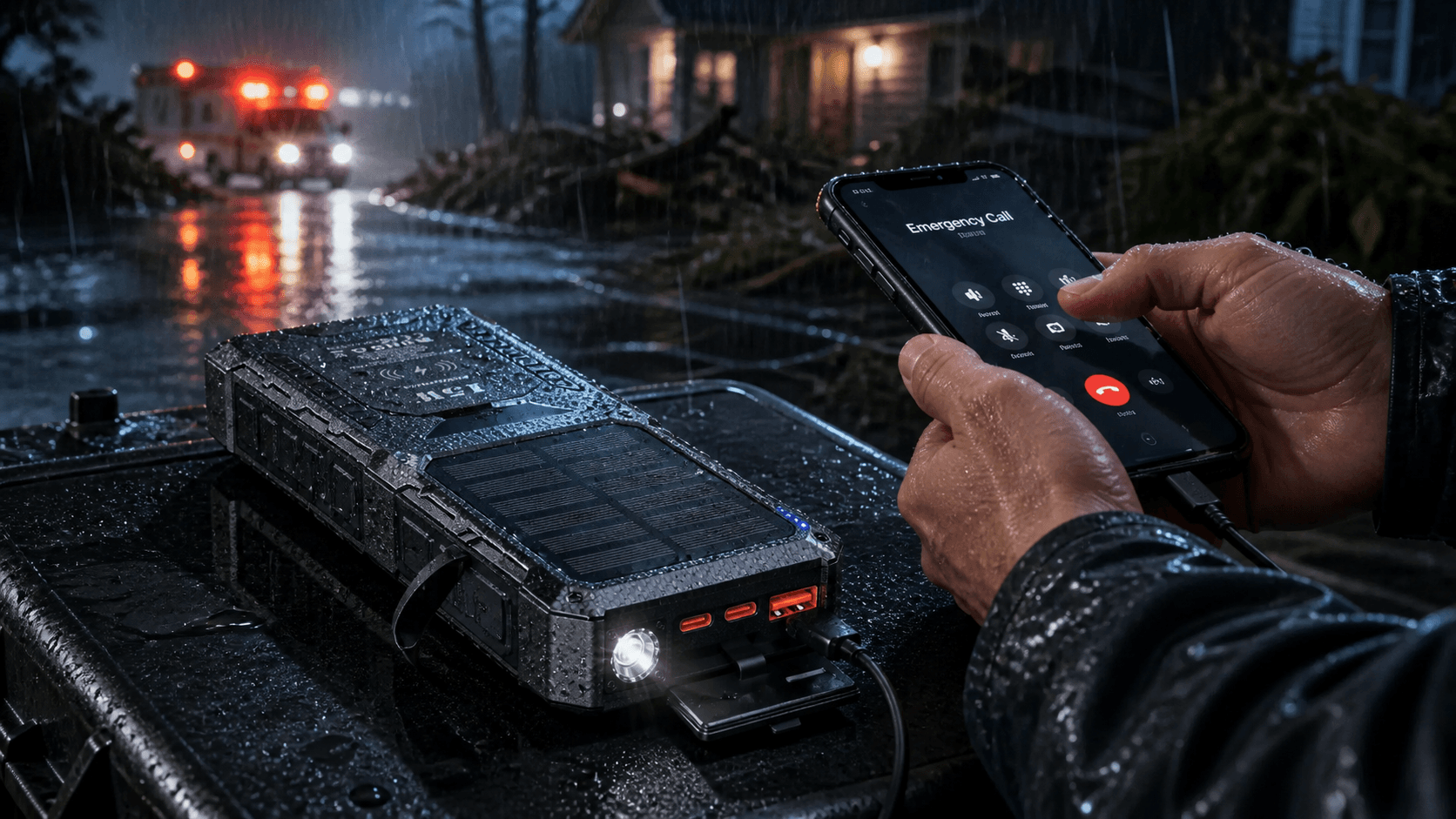
For an emergency-preparedness product line, treat the charged battery as the primary energy reserve. Hand-crank and solar inputs are ways to add limited energy when mains power is unavailable: selected TOPTAI hand-crank models are specified at up to 400mAh per hour of continuous cranking, while a four-panel foldable solar model can add about 3,000mAh during a day of clear, strong sunlight. Solar charging is not suitable for rainy or heavily overcast conditions. B2B buyers should choose the product around the intended emergency task—lighting, essential phone charging or small-device support—then validate the exact model, conditions, output, mechanical durability, documents and user claims before approving a batch order.
Why emergency-power buyers are reviewing their product ranges in 2026
Emergency-supply distributors, outdoor brands, importers and institutional buyers are planning against a stronger climate-risk backdrop. NOAA’s September 10, 2026 discussion says El Niño is strengthening and gives a greater than 90% chance of a very strong event during the Northern Hemisphere fall and winter of 2026–27. The World Meteorological Organization says a very strong event can shift rainfall and temperature patterns and increase the risk of floods, drought and extreme heat.
Those forecasts do not mean that every country will experience the same event or that a portable battery can solve disaster preparedness. Local impacts remain probabilistic and region-specific. For a B2B buyer, the responsible commercial response is to review the target market, likely outage scenarios, distribution channel, required claims and replenishment plan—not to print an El Niño promise on the box.
An emergency power bank has a narrow but important role: it stores portable energy before an outage and can support basic lighting, communication and small-device charging when normal power is unavailable. Compare TOPTAI solar and hand-crank power bank platforms before defining a branded emergency range.
The sourcing principle: stored energy first, backup generation second
The battery should be fully charged before an emergency. Its usable stored energy is the primary resource. Solar panels and a hand crank add limited energy after the grid is unavailable; they do not turn a portable power bank into a large generator.
Hand-crank input is a last-resort energy source
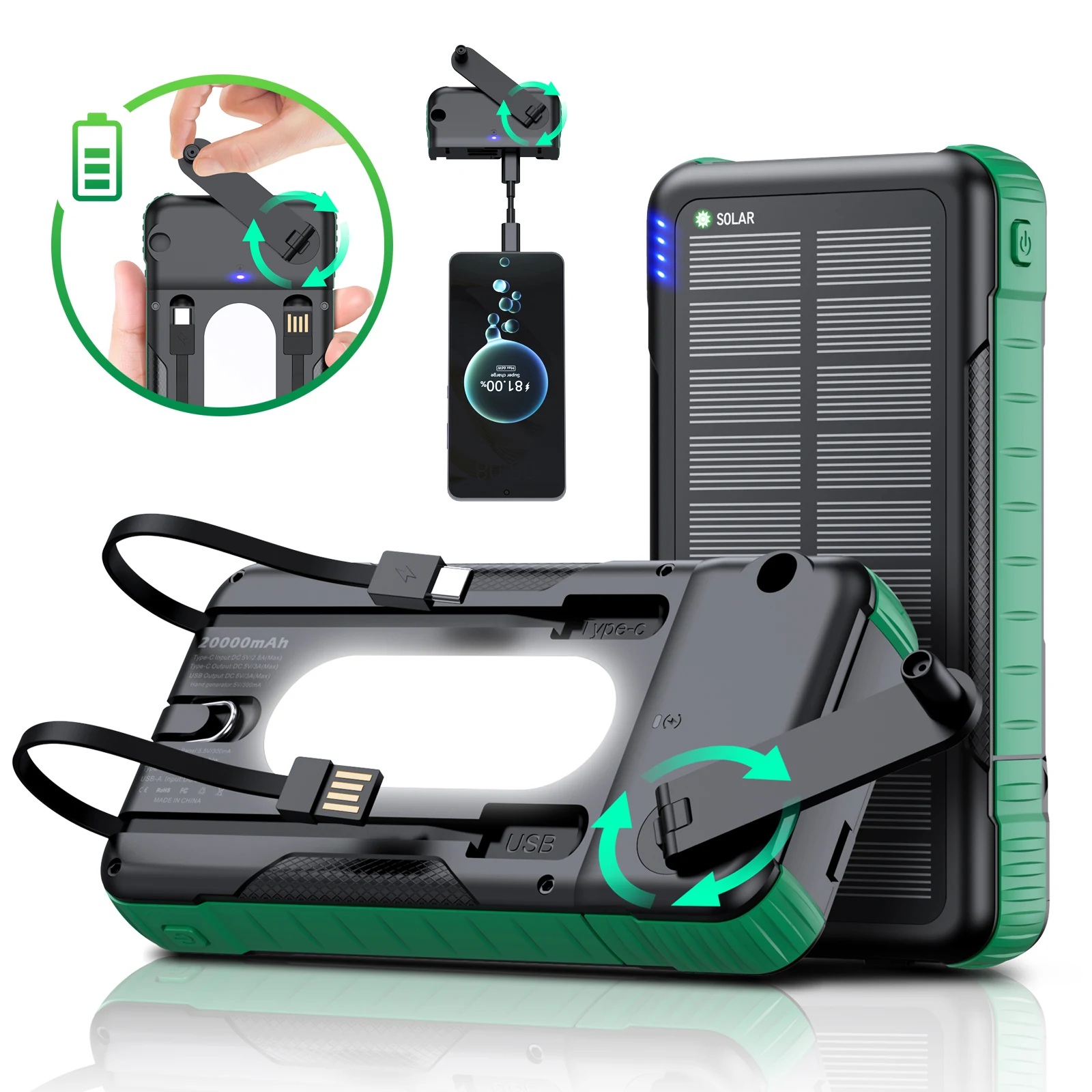
Selected TOPTAI hand-crank models PF209 and PF303 are specified at a maximum of about 400mAh per hour when operated around 120 rpm. PF208 is specified separately at about 260mAh per hour around 110 rpm. These figures describe sustained mechanical input under stated conditions, not an effortless or universal consumer result. Continuous cranking is physically demanding, so buyers should position it for emergency lighting or a limited communication charge—not as a fast way to refill a 20,000mAh or 40,000mAh battery.
Four-panel solar charging needs clear, strong sunlight
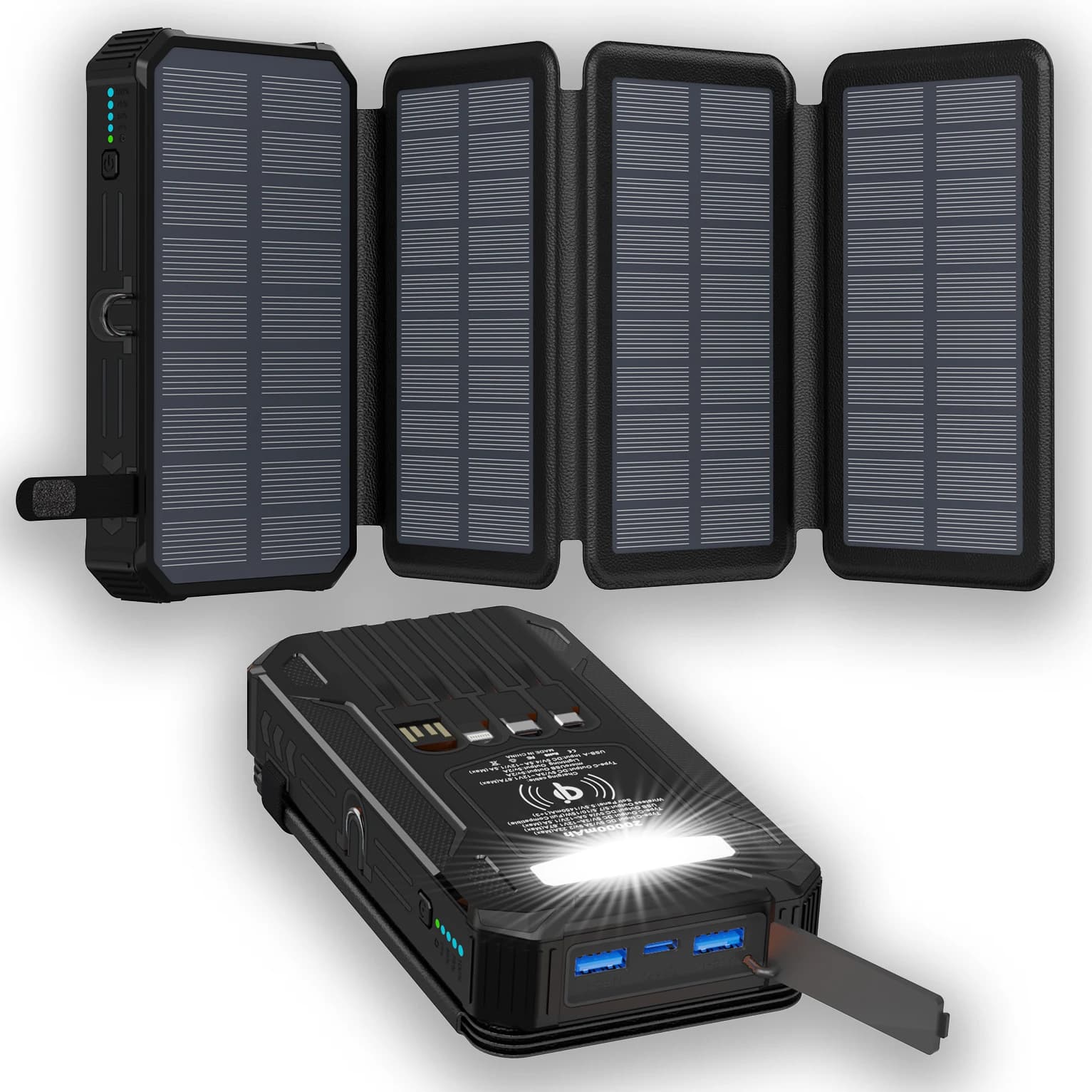
The four-panel foldable PF201 and PF301 use a rated 5.5V/6W solar input. Under clear, strong sunlight, a four-panel unit can add approximately 3,000mAh during a day. Solar charging is not suitable for rainy weather and should not be promised for heavily overcast conditions. Actual collection changes with sunlight strength, angle, shading, temperature, panel cleanliness and exposure time.
Claims must state the condition
A B2B specification should say whether a figure is a rated input, a controlled test result or an estimated daily contribution. The manual and packaging should tell users to pre-charge from mains power, deploy all panels in direct strong sunlight and treat solar or crank input as emergency supplementation.
Define the emergency job before choosing a model
Start the RFQ with the job the end user must complete. A product for a retail preparedness kit, an outdoor assortment, a vehicle kit and an institutional relief program can need different capacity, weight, lighting, ports, packaging and instructions.
| Emergency job | Minimum product requirement | Buyer evidence to request |
|---|---|---|
| Find and move safely after an outage | Accessible torch or area light and simple controls | Brightness modes, measured lighting time and switch test |
| Make essential calls or send messages | Compatible wired output and stored energy | Phone test, output profile and usable-energy result |
| Support several small devices | Enough ports and managed combined output | Multi-output load and temperature test |
| Add energy without mains power | Hand crank or four-panel solar input | Time-, speed- and weather-defined generation test |
| Distribute through retail or aid programs | Clear instructions, traceable model and suitable packaging | Approved manual, labels, carton data and golden sample |
Do not start with the largest printed capacity. Specify the number of users, devices, hours without mains power, storage conditions, carry weight, target country, order quantity and required arrival date. Then compare the closest mature platform.
Hand-crank models for emergency programs
PF208: compact detachable hand-crank format
PF208 is a 10,000mAh platform measuring approximately 164 × 80 × 32mm and listed at 175g. It combines a detachable hand crank, a 2W torch, 1.2W solar input, USB and USB-C outputs, and a built-in USB-C cable. Its crank specification is lower than the larger models at approximately 260mAh per hour under the stated operating condition. It is the more portable reference for branded kits where weight and detachable construction matter.
PF209: 20,000mAh multi-device emergency format
PF209 is a 20,000mAh platform measuring approximately 197 × 96 × 48mm and listed at 615g. It combines a 2W torch, hand-crank input up to approximately 400mAh per hour, 1.5W solar input, wired outputs up to the 20W–22.5W class and wireless charging up to 15W. Built-in connector options can reduce dependence on loose cables. Buyers should approve the exact cable mix and wireless-device compatibility on the sample.
PF303: higher stored energy for larger kits
PF303 is a 40,000mAh hand-crank platform measuring approximately 197 × 96 × 48mm and listed at 960g. It combines a hand crank specified up to approximately 400mAh per hour, 2.5W solar input and multiple wired charging routes. Its higher stored capacity also brings substantially more weight, so it is better evaluated for vehicle, institutional or larger emergency kits than for a lightweight personal pouch.
These specifications are model references from current product materials. Final weight, capacity, output configuration and document scope must be confirmed on the quoted version and production-representative sample.
Need an emergency-power model shortlist?
Share the target country, buyer channel, emergency scenario, required lighting and charging tasks, quantity, branding, packaging and delivery date. TOPTAI can compare mature hand-crank and foldable-solar platforms and define the sample tests needed before ordering.
Request catalog & quotation →Four-panel foldable solar models for outdoor and preparedness ranges
PF201: 20,000mAh four-panel platform
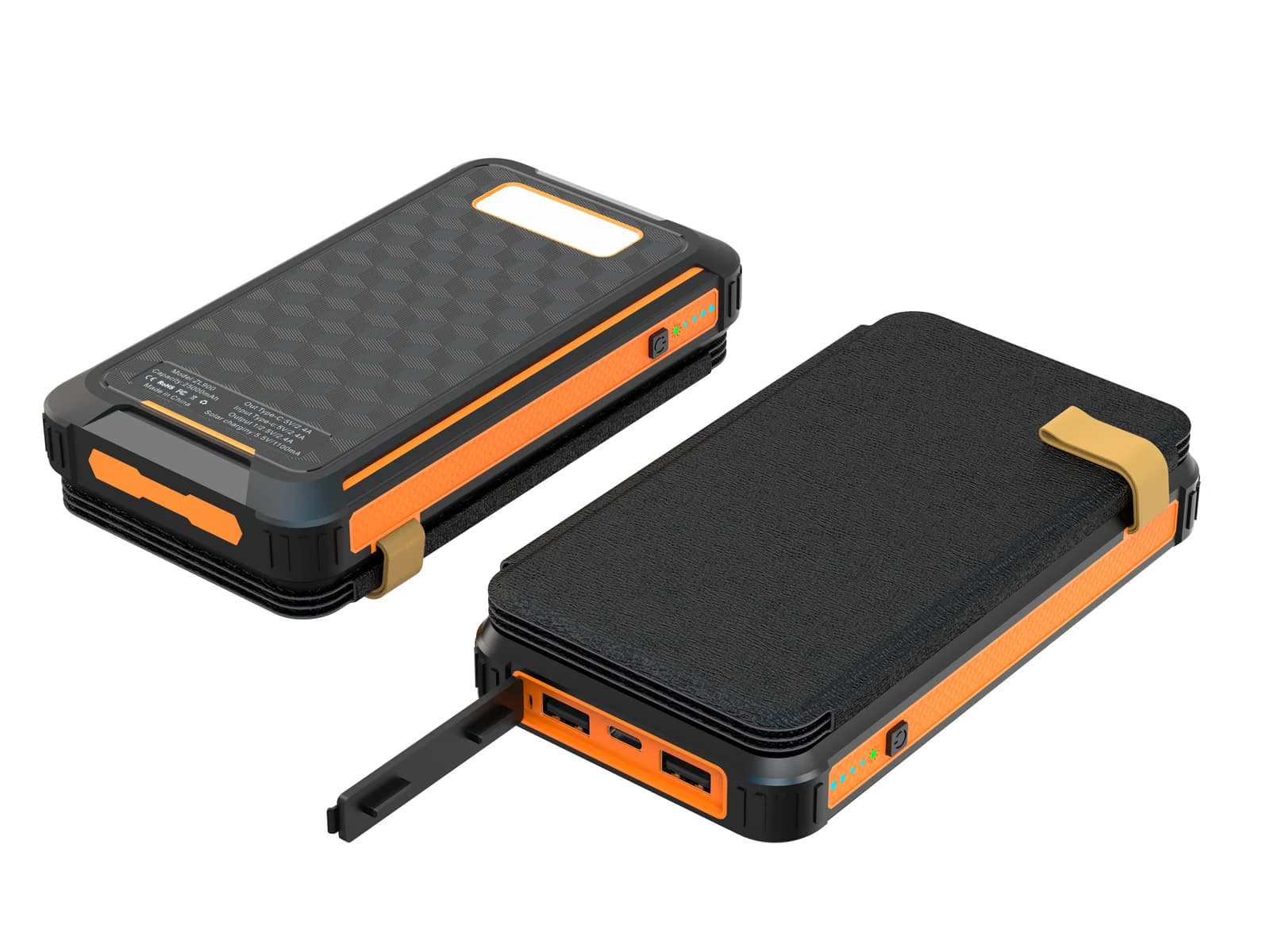
PF201 combines a 20,000mAh battery with four folding panels rated at 5.5V/6W. It measures approximately 161 × 83 × 32mm and is listed at 450g. The basic configuration provides 5V/2A input and wired outputs, with a wireless option available. It also includes a 2W camping light and torch/SOS-light functions.
PF301: higher-output four-panel platform
PF301 is a 20,000mAh four-panel platform measuring approximately 165 × 85 × 38mm and listed at 615g. The enhanced configuration includes wired charging in the 20W–22.5W class, built-in cable options and wireless charging up to 15W. This makes it relevant to outdoor retail ranges that need stronger everyday charging as well as an emergency solar function.
For both four-panel formats, the commercial advantage is the larger solar collection area. Under clear, strong sunlight, the panels can add about 3,000mAh during a day. Buyers should not turn that into a guaranteed daily figure for every market. The sample test should record the location, date, weather, exposure duration, panel angle, starting state of charge and measured energy added.
A foldable model can serve two channel roles: an everyday camping and outdoor-charging product in normal conditions, and a compact personal energy reserve during an outage. That dual role is stronger than marketing it only as a disaster product.
How B2B buyers should compare the available routes
| Buying requirement | PF208 | PF209 | PF303 | PF201 / PF301 |
|---|---|---|---|---|
| Primary role | Compact crank kit | Multi-device emergency kit | Higher-capacity emergency kit | Outdoor plus emergency range |
| Nominal capacity | 10,000mAh | 20,000mAh | 40,000mAh | 20,000mAh |
| Backup generation | Crank + small panel | Crank + small panel | Crank + small panel | Four-panel solar |
| Generation reference | About 260mAh/h crank | Up to about 400mAh/h crank | Up to about 400mAh/h crank | About 3,000mAh/day in clear, strong sunlight |
| Main trade-off | Lower crank contribution | Larger and heavier | 960g listed weight | Solar depends on strong sunlight |
| Best B2B fit | Portable branded kits | Retail and relief kits | Vehicle or institutional kits | Outdoor brands and preparedness retail |
This table is a shortlist, not a final specification. The correct product depends on target devices, local climate, pack weight, user instructions, branding, quantity and required evidence. Discuss logo, packaging and function customization after selecting the closest standard platform.
Do not confuse IP65 with solar charging in the rain
Water-resistance and solar-generation claims answer different questions. A model may have an IP65 document for a defined enclosure and test condition, but that does not mean its solar panel will produce useful charging power in rain. Solar input requires suitable sunlight; the power bank should not be promoted as a rainy-weather generator.
TOPTAI holds a model-specific IP65 test record for sample model PF203 under IEC 60529 and the corresponding EN standard. That evidence supports the tested dust and water-jet conditions for the identified sample; it is not proof of immersion resistance and should not be automatically applied to every housing, cable opening or hardware revision.
Product materials for PF208, PF209, PF303, PF201 and PF301 list certifications or protection claims, but a B2B buyer should request the actual documents for the exact selected model. Check model number, applicant, laboratory, standard, date and configuration before approving packaging. Review TOPTAI factory and quality-control evidence.
Validate the claims before approving a batch order
Stored-energy and output testing
- Measure usable output energy under a defined load.
- Verify wired and wireless output profiles with target devices.
- Test multiple outputs together and record surface temperature.
- Confirm low-current behavior for radios, lights or small USB devices.
Hand-crank testing
- Record crank speed, duration and energy added.
- Test one, three and five-minute emergency contributions as well as longer operation.
- Inspect handle, gears, attachment point and housing after repeated cycles.
- Write a user claim that reflects physical effort and the tested condition.
Solar testing
- Use clear, strong sunlight and record weather and location.
- Deploy all four panels at a controlled angle without shading.
- Measure input throughout the exposure period and total energy added.
- State clearly that rainy and heavily overcast conditions are unsuitable.
Lighting and mechanical testing
- Measure torch and area-light runtime at each mode.
- Verify SOS operation and control logic.
- Test panel hinges, cable exits, port covers, buttons and drop resistance.
- Check the product after storage and temperature exposure relevant to the target market.
Build a responsible retail or relief-program claim set
Climate news can create demand for preparedness products, but the product claim must remain factual. Do not say that a power bank protects users from El Niño, works in every extreme-weather event or fully recharges from solar in one day. Do not show solar charging in rain as if the weather supports generation.
- Say: pre-charge fully before an emergency.
- Say: hand-crank input provides limited, last-resort energy under stated operation.
- Say: four-panel solar can add about 3,000mAh during a day of clear, strong sunlight.
- Say: actual solar performance depends on sunlight, angle, shading and temperature.
- Say: verify exact IP, safety and transport documents for the selected model.
- Avoid: unlimited power, all-weather solar charging, disaster-proof or guaranteed phone-charge counts.
For a private-label project, approve the user manual, claim wording, rating label, model identity, logo, accessories and packaging together. This reduces the risk that a distributor makes a stronger promise than the test evidence supports.
MOQ, samples, documents and factory controls
Emergency-product buyers should treat the standard product, logo, packaging and any modified function as separate approval items. Current TOPTAI information lists many solar platforms from 100 pieces, with selected hand-crank models beginning at 200 or 500 pieces. Confirm the exact MOQ after choosing the model, color, logo process, cable configuration and packaging.
Request a production-representative sample rather than relying only on a visual prototype. The approval record should include capacity, dimensions, weight, inputs, outputs, cables, lighting modes, crank performance, solar-panel configuration, markings and packaging. Standard samples for selected products may be available in approximately two to three days; customized samples and packaging require a separate schedule. Typical mass production is approximately 20–30 days after approval, subject to model, quantity, materials and factory capacity.
The document pack should match the exact product and shipment. Depending on the target market and configuration, buyers may need product compliance evidence, the current UN 38.3 test summary, battery transport documents, safety records, IP documentation, manual, labels and inspection criteria. Review commercial battery shipping documents.
TOPTAI’s manufacturing process should verify incoming materials, charging and output functions, lighting, hand-crank operation, solar input, aging performance, appearance, branding and final packing against the approved sample. Any change to cells, PCB, housing, cables, panels or critical components should be reviewed before substitution.
RFQ checklist for an emergency solar or hand-crank project
- Buyer company, country and sales or distribution channel.
- Emergency scenario and expected outage duration.
- Devices, number of users and minimum charging tasks.
- Required lighting mode and target lighting time.
- Preference for hand crank, four-panel solar or both.
- Capacity, wired outputs, wireless charging and built-in cable requirements.
- Maximum acceptable dimensions and carry weight.
- Environmental and IP-document requirements.
- Order quantity, logo, product color, manual languages and packaging.
- Target sample date, required delivery date and destination.
- Required product, battery and transport documentation.
A complete RFQ allows the supplier to recommend a standard platform and test plan instead of sending an undifferentiated catalogue. Request an emergency-power model and sample recommendation.
Frequently asked buyer questions
Can a hand crank recharge a 20,000mAh power bank quickly?
No. Selected PF209 and PF303 configurations are specified at up to about 400mAh per hour under continuous operation around 120 rpm. Hand cranking is a last-resort contribution for essential lighting or communication, not a fast replacement for mains charging.
Will a solar power bank charge during rain?
It should not be selected or promoted for solar charging in rainy weather. Useful solar input requires clear, strong sunlight. Water-resistance documentation does not change the amount of available sunlight.
How much can a four-panel solar power bank add in one day?
Under clear, strong sunlight, a four-panel model can add approximately 3,000mAh during a day. Actual results depend on sunlight strength, panel angle, shading, temperature, exposure time and the exact sample, so the buyer should verify the claim in the intended market.
Which format is better for an emergency range?
Choose a hand-crank model when a weather-independent last-resort input is important. Choose a four-panel model when the product will normally serve outdoor and camping users and can be deployed in strong daylight. Larger capacity increases stored energy but also increases size and weight.
Can all listed models use the same IP65 or certification claim?
No. Request and review documents for the exact model and configuration. A certificate or report for one sample should not be treated as automatic evidence for every model, housing or revision.
Should an emergency product use a custom mold?
Usually start with a mature standard platform and customize the logo, color, manual, accessories and packaging. Consider new tooling only when the deployment requires a housing, mounting method or function that existing platforms cannot provide.
Choose a product the buyer can explain and verify
A credible emergency power range starts with a charged battery. Hand-crank generation provides limited energy when weather and mains power are unavailable. Four-panel solar charging can add more energy during clear, strong sunlight, while the same product remains useful as an outdoor and camping power bank during normal conditions.
For a B2B buyer, the strongest product is not the one with the longest feature list. It is the model whose stored energy, backup input, lighting, outputs, weight, instructions and evidence fit a defined market. Shortlist the standard platform, test the real sample, approve conservative claims and lock the configuration before mass production.
Sources and editorial note
This guide combines current primary-source guidance with TOPTAI’s experience supporting OEM/ODM power bank evaluation. Requirements can change by model, market, carrier and date; confirm the exact product and destination before ordering or traveling.

ABOUT THE REVIEWER