
SOURCING · SUPPLIER EVALUATION
How to Choose a Power Bank Supplier: 3 Questions That Matter More Than the Lowest Price
Evaluate a power bank supplier beyond price by checking product launch history, model-specific compliance documents and practical OEM customization support.
 Reviewed by Grace WongCo-Founder | Custom Charging Solutions Lead · Updated August 26, 2026 · 11 min read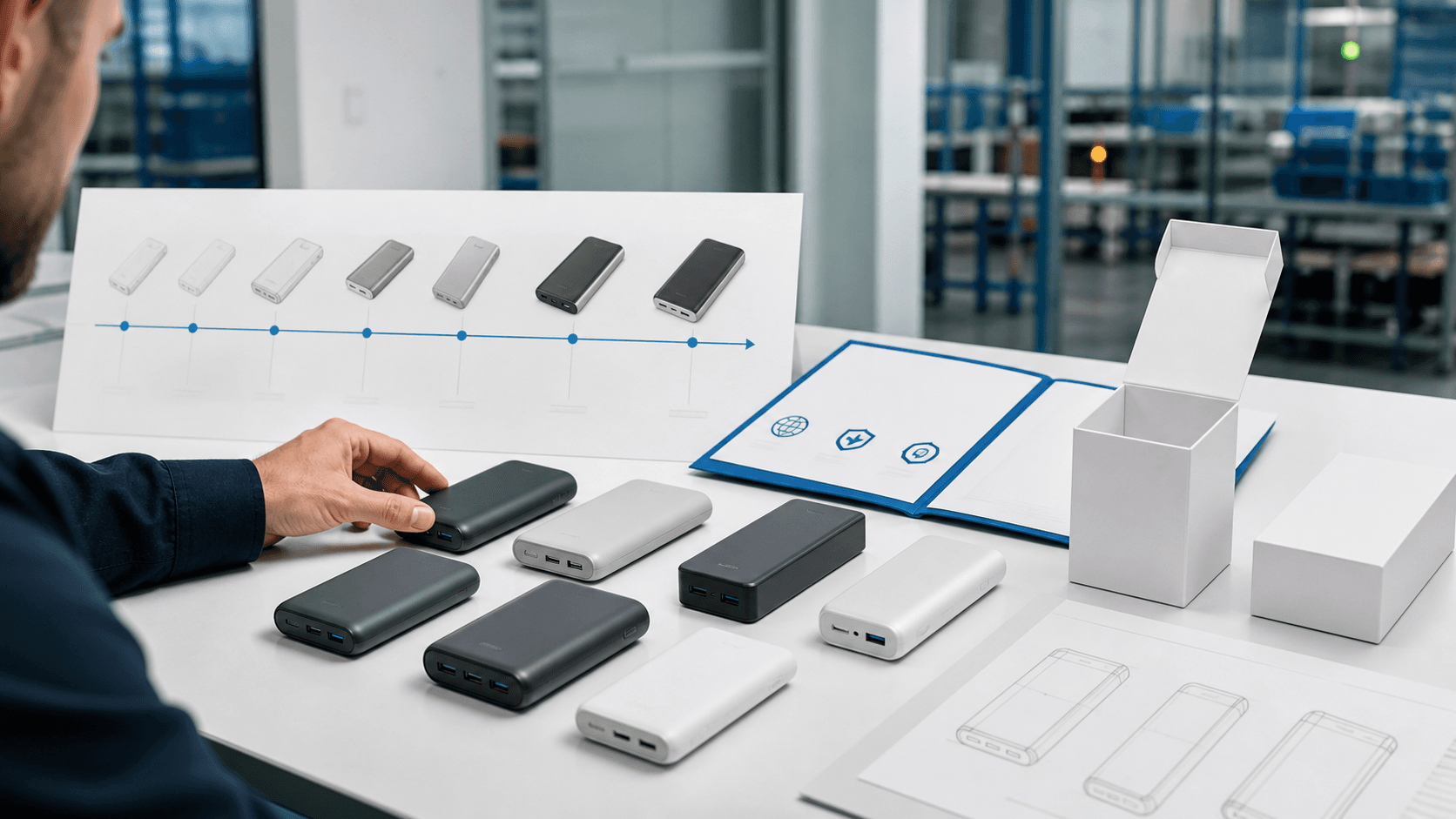
The lowest quotation does not show whether a power bank will remain competitive, clear your target market’s compliance checks or support a differentiated brand. Before comparing price, ask when the current product version launched, which documents apply to that exact configuration and what the supplier can reliably customize and reproduce.
Price matters—but it does not describe the opportunity
When buyers start looking for a power bank supplier, price is often the first thing they ask about: What is your best-selling model? What is your price for 50,000 pieces? What is your lowest price? These are reasonable questions. Price affects margin, retail position and the ability to compete.
However, price alone does not tell you whether a supplier is the right long-term partner. A lower quotation may be based on an older product, a different battery configuration, fewer included services or a different level of compliance support.
After working with B2B buyers since 2009, we have found that three other questions reveal much more about a supplier and a product opportunity: When was this product launched? What certifications and compliance documents does it have? Can you customize it for my own brand? Together, these questions expose market potential, compliance risk and the ability to build a differentiated business.
1. When was this power bank product launched?
The launch date can tell you a great deal about a product. A model launched several years ago may still be reliable and commercially successful, but its appearance, charging technology, size, functions or packaging may no longer match current expectations. A recently launched product may offer newer features and a more modern design, but it may have less sales history, fewer market reviews or limited real-world data.
The question is not simply whether new is better than old. Ask when the current version launched, whether it has been upgraded, whether different hardware or battery versions exist, which markets currently use it, whether the supplier still actively supports it, and whether replacement components and production capacity are stable.
A professional supplier should explain the development history clearly. A magnetic power bank, for example, may have several generations using different housing materials, charging configurations, heat-management solutions, thicknesses or output designs. Your business is selecting a product that may need to stay competitive for months or years.
Why product lifecycle matters
Choosing a product that is too old can make differentiation harder, place you against many similar competitors, feel outdated to retail buyers, lose supplier support or leave slow-moving inventory. Choosing a product that is too new can mean limited market feedback, ongoing technical adjustments, incomplete documentation for some markets or little return and warranty history.
The strongest choice is usually a product with a clear development history, stable production support and a market position that still offers room for growth.
- Ask for the current version’s launch date, not only the original model date.
- Identify every hardware, battery and firmware version in the quotation.
- Check whether components and production support are stable for repeat orders.
- Balance novelty against validation history and market fit.

2. What certifications and compliance documents does it have?
Power banks contain lithium batteries and charging electronics. Compliance can affect customs clearance, transportation, marketplace approval, product liability and customer trust. Before choosing a manufacturer, ask which certifications and documents are available for the specific model you intend to purchase.
Depending on the product and destination, relevant evidence may include CE, RoHS, FCC, UKCA, UL-related documentation, UN 38.3 test documentation, MSDS or SDS, EMC or LVD documentation for applicable products, and other market-specific testing or labeling documents. The exact route depends on product design, battery configuration, wireless functions and destination country.
Product certification is not factory certification
ISO 9001 relates to a company’s quality management system; it does not automatically certify every power bank made by that factory. Likewise, a supplier may have reports for one model that do not apply to another. Ask whether each document covers the exact model and tested configuration, the target market, the same battery cell and protection board, and the final logo, packaging and labeling.
A certificate list on a website is a useful starting point, not a substitute for checking the selected product’s documentation. The supplier should also explain what it can provide and what the buyer must arrange independently.
Why compliance matters commercially
Compliance can influence import clearance, e-commerce listing approval, air or sea transport, retailer acceptance, customer confidence and exposure to product risk. Clear, model-specific answers are a strong signal that a supplier understands international B2B business.
- Match every report to the exact model, configuration and revision.
- Confirm the destination-market scope before mass production.
- Check whether cell, PCB, housing, firmware or artwork changes require review.
- Request updated documents before approving final production and packaging.
3. Can you customize the product for my own brand?
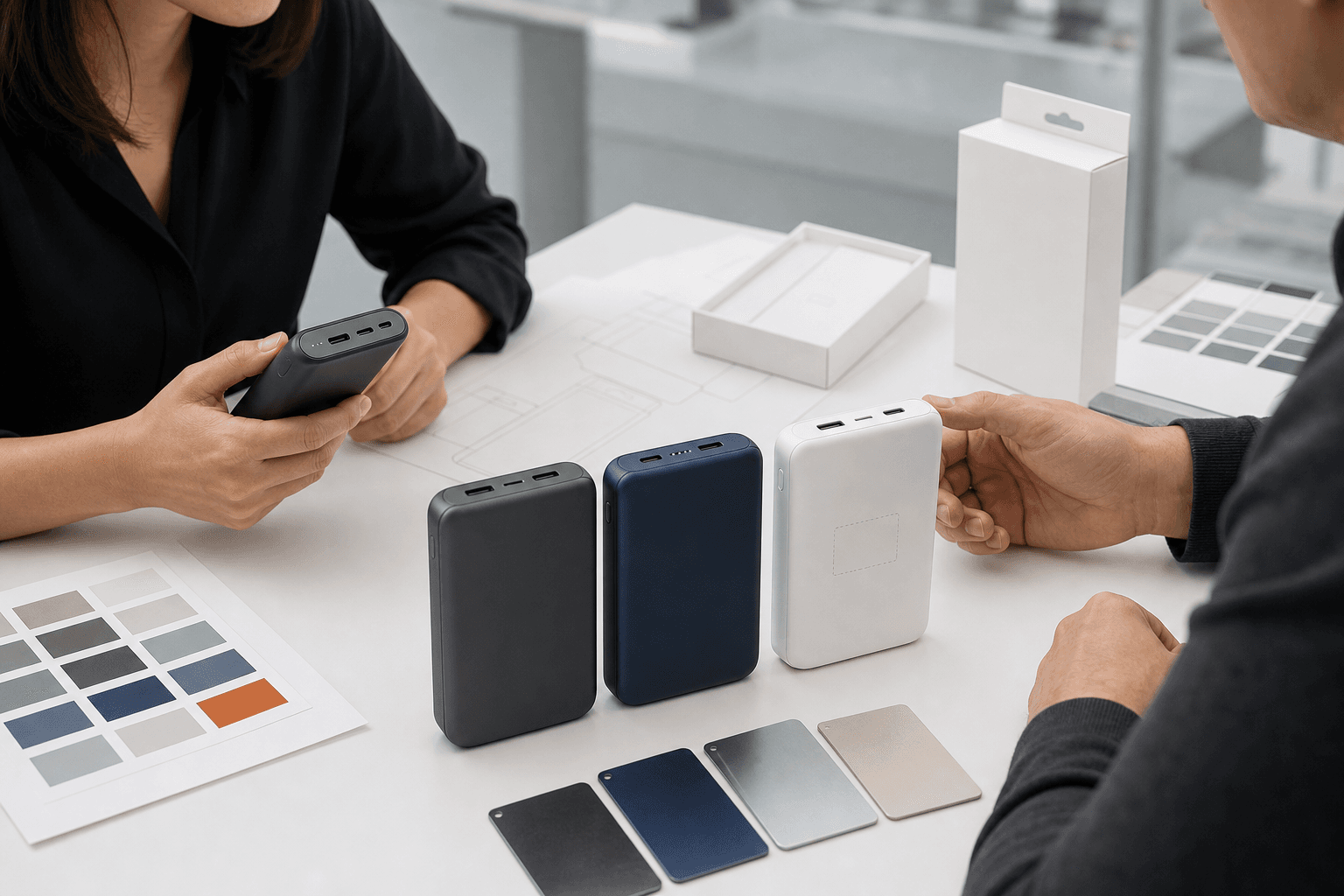
Adding a logo is only one part of private-label power bank customization. Basic options may include logo printing or laser engraving, product color, Pantone matching, retail box design, manuals, labels, gift packaging, cable configuration and logo placement.
More advanced work may cover product appearance, housing material and finish, display or indicator design, ports and cable structure, output power and capacity, wireless charging, protection features, dimensions, special applications or custom product development.
Not every factory offering OEM provides the same support. Some only print a logo on an existing product; others can help with selection, engineering adaptation, sampling, packaging and mass production. Before ordering, clarify customization levels, MOQ, tooling, sample timing, artwork ownership, certification impact, lead time and repeat-order consistency.
At TOPTAI, customization can include logo branding, packaging, Pantone color matching and selected functional adaptations. For suitable projects, we also support free mockups and samples in approximately 3–7 days, depending on the product and customization scope.
Why private labeling matters
Private labeling can build a recognizable identity, improve differentiation, give you more control over packaging and customer experience, fit the product to a target market and create a foundation for repeat orders. It does not always require a completely new product: often the practical route is a proven platform with targeted changes to appearance, packaging, color, cable configuration or selected functions.
- Define logo, color and packaging changes separately from functional changes.
- Confirm MOQ and whether new tooling is required.
- Ask how customization changes the test and certification scope.
- Approve a reproducible golden sample before mass production.
Need a supplier and model shortlist?
Share your target market, estimated quantity, product requirements and customization needs. TOPTAI can recommend suitable models and outline a practical sample and production path.
Request catalog & quotation →Questions to ask about customization
| Decision area | Question to ask | Commercial reason |
|---|---|---|
| Scope | What levels of customization are available? | Separates simple private label from real OEM/ODM support |
| MOQ | What is the MOQ for logo, color and packaging? | Prevents surprises after artwork begins |
| Tooling | Is a new mold required, and who owns it? | Clarifies cost, control and future orders |
| Sampling | How long will mockups and physical samples take? | Protects the launch schedule |
| Compliance | Will the change affect certification or testing? | Avoids unsupported claims |
| Repeatability | Can the same design be reproduced later? | Supports a stable product program |
Also confirm production lead time after sample approval, ownership of artwork and tooling, the effect of cable or battery changes, and how the supplier will control the approved configuration across future orders.
A practical power bank supplier checklist
Product
- Is the current version clearly identified?
- Do you understand when it launched and what has changed?
- Does it fit your target customers and channel?
- Is there enough differentiation in your market?
Compliance
- Are documents available for the exact model?
- Do they match the destination market?
- Are battery and transportation documents available?
- Can the supplier explain each document’s limits?
Customization
- Can the supplier customize logo, color and packaging?
- Can it support functional or structural changes if needed?
- Are MOQ, sampling and tooling requirements clear?
- Can the approved design be reproduced consistently?
Production and support
- Is production capacity stable?
- Are quality-control checkpoints explained clearly?
- Can the supplier support repeat orders?
- Is communication responsive after the quotation?
- Can it coordinate documentation, inspection and delivery?
How to compare suppliers without letting price hide risk
Normalize quotations before comparing them. Make sure each supplier is quoting the same product version, battery configuration, included accessories, customization scope, packaging, compliance support, inspection plan and commercial terms. Otherwise, a lower number may simply represent a different product.
Use samples and documents to test the supplier’s answers. Ask for the current-version history, match reports to the sample model and map every requested customization to cost, lead time and validation work. Record open questions in the purchase specification rather than relying on sales messages.
The goal is not to ignore price. It is to understand what the price includes and whether the product can reach market, perform consistently and support repeat business.
Final thoughts
The lowest price can help you compare suppliers, but it should not be the only basis for choosing one. Before committing to a product, ask when it launched, which certifications and compliance documents apply, and whether it can be customized for your own brand.
A suitable supplier should provide a competitive quotation while helping you select a product with a viable lifecycle, satisfy the necessary compliance requirements and develop a product program that can grow with your business.
If you are evaluating power banks for wholesale, retail, corporate gifts or a private-label brand, share your target market, estimated quantity, product requirements and customization needs with TOPTAI. Our team can recommend suitable models and outline a practical sample and production path.
Sources and editorial note
This guide combines current primary-source guidance with TOPTAI’s experience supporting OEM/ODM power bank evaluation. Requirements can change by model, market, carrier and date; confirm the exact product and destination before ordering or traveling.

ABOUT THE REVIEWER