
COMPLIANCE · IMPORTER CHECKLIST
Power Bank Certifications for the US and EU: 2026 Importer Checklist
A buyer-focused map of power bank safety, transport, EMC, wireless charging, labeling and documentation—plus the questions to resolve before paying for tooling or inventory.
 Reviewed by Grace WongCo-Founder | Custom Charging Solutions Lead · Updated August 4, 2026 · 15 min read
There is no single worldwide “power bank certificate.” A compliant program is a stack of product, battery, radio/EMC, chemical, transport, labeling and producer-responsibility obligations determined by the exact model and destination. UN 38.3 supports lithium-battery transport; it is not a market-access certificate. In the US, wireless power transfer and digital circuitry may trigger FCC authorization, while UL 2056 is a dedicated power-bank safety standard and may be requested by channels or risk policies. In the EU, importers must map applicable legislation, complete conformity assessment and technical documentation, issue the declaration of conformity where required and apply markings correctly.
Why there is no universal certificate
Importers often ask whether a factory has “CE, FCC and UN38.3.” That shorthand is useful for an opening conversation but unsafe as an approval method. CE is a marking backed by conformity work under the applicable European Union legislation; FCC requirements depend on the radio-frequency behavior of the device; UN 38.3 addresses transport testing of lithium cells and batteries. Each answers a different question. A logo page or a report for a similar model cannot replace a product-specific compliance map.
Start by freezing what the product is. Capacity, cell supplier, USB-C power profiles, wireless charging, Bluetooth or location features, display, built-in cables, supplied adapter, materials and packaging can change the applicable rules or test plan. Then identify every country, the party placing the product on the market, retail-channel policies and shipment modes. The responsible importer should confirm the final route with a qualified laboratory or compliance professional.
A good supplier helps collect evidence, controls the build and flags design changes. It should not tell a buyer that one certificate makes every configuration legal everywhere. The importer’s strongest protection is traceability: exact model numbers, report numbers, samples, component lists, label versions and declarations that agree with one another.
The evidence stack: product, battery and transport
Battery and product safety
Power banks combine rechargeable cells, charging electronics, output ports and an enclosure intended to be carried close to users. Safety evaluation therefore looks beyond the cell certificate. Protection against overcharge, over-discharge, short circuit, abnormal operation, mechanical impact and thermal hazards matters at product level. UL describes UL 2056 as its dedicated standard for phone-charging power banks, covering products supplied and delivering low-voltage DC within its scope.
IEC 62133-2 is widely used for portable sealed secondary lithium cells and batteries, but an individual cell report is not evidence that the finished power bank has been evaluated for every product hazard. Ask which standard covers the cell, which covers the pack or product, whether the test sample matches the final construction, and which changes invalidate the result.
UN 38.3 transport testing
The UN Manual of Tests and Criteria, subsection 38.3, addresses lithium battery transport tests such as altitude simulation, thermal, vibration, shock, external short circuit, impact or crush, overcharge and forced discharge as applicable. The manufacturer and subsequent distributors must be able to make a test summary available. The summary includes manufacturer and laboratory details, a report identifier and date, battery description and model numbers, watt-hour rating, tests and results, the manual edition and a signatory.
Treat the summary as a verification tool. Compare the cell or battery designation, mass, Wh rating and model family with the product and shipping documents. If the factory changes the cell, pack configuration or protection circuit, ask whether new testing or an updated summary is required. Your freight forwarder may also require a safety data sheet, classification, packaging, marks, labels and documents based on route and mode.

United States: FCC and safety expectations
A standard wired power bank can contain digital circuitry that falls under FCC rules for unintentional radiators. Wireless power transfer adds another layer. FCC Knowledge Database publication 680106 states that WPT devices above 9 kHz must be authorized and are subject to Part 15 and/or Part 18 requirements. A unit that communicates between the transmitter and powered device may fall under Part 15 rules for intentional radiators; charging and communication modes can involve different authorization paths.
Do not choose the authorization procedure from a marketing name. Give the laboratory the full schematic, operating frequencies, modulation or communication behavior, antenna or coil details, firmware modes and intended use. Ask whether certification or a Supplier’s Declaration of Conformity is required, which party is the responsible party and what labeling and user-information statements apply. The tested configuration must match imported production.
UL 2056 is not simply another FCC document. It is safety-focused. UL says the program covers overcharge and discharge protection, short circuit and overload, mechanical impact and thermal safety. Whether a particular law, retailer, marketplace, insurer or customer contract requires a certification must be determined for the project, but independent safety evaluation can materially reduce recall and reputation risk. California or other state chemical warnings, recycling and product-specific rules may add obligations.
European Union: conformity is a process
The EU Batteries Regulation 2023/1542 establishes sustainability, safety, labeling, conformity and end-of-life requirements for batteries. It includes CE-marking provisions for batteries and a staged timetable. As of August 2026, buyers need particular care with effective dates: Article 13 links several label requirements to 18 August 2026 or 18 months after the relevant implementing act, whichever is later. Do not convert a headline date into packaging without checking the current implementing measures and product category.
A power bank may also sit within other EU frameworks depending on its functions. EMC, restriction of hazardous substances, radio-equipment rules for communication features, waste electrical and electronic equipment, general product safety and national producer-responsibility registration can all matter. Wireless charging without general-purpose radio communication still needs an expert classification. A supplied mains adapter or cable adds its own product and ecodesign considerations.
CE marking is the manufacturer’s declaration that the product complied with applicable EU requirements when placed on the market; it is not a generic certificate purchased from a laboratory. The European Commission’s Your Europe guidance says supporting technical documentation and the EU declaration of conformity must be kept current and retained for at least ten years after market placement. Importer identity, manufacturer details, traceability markings, warnings and language requirements should be resolved before packaging sign-off.
| Evidence area | What to verify | Typical owner |
|---|---|---|
| Applicable legislation | Written model-and-market scope, standards and conformity route | Manufacturer + importer/compliance adviser |
| Test reports | Exact model, revision, lab, methods, results and photos | Manufacturer/test lab |
| Technical file | Design, BOM, risk assessment, reports, instructions and labels | Manufacturer; importer access obligations |
| Declaration | Correct legal entity, model and cited legislation/standards | Responsible manufacturer |
| Market registrations | Battery/WEEE/packaging EPR and local representation where applicable | Economic operator/importer |
| Production control | Controlled components, change notices and inspections | Manufacturer + buyer |
Build the compliance plan before the purchase order
Send TOPTAI your destination, sales channel, exact function set and packaging concept. We will help organize model-specific evidence and identify items for your compliance adviser or test laboratory to confirm.
Request catalog & quotation →Labeling, claims and producer responsibility
Make a master artwork checklist for the product, retail box, master carton, manual and online listing. It should cover legal entities and addresses, product and batch identification, electrical ratings, battery energy in Wh, capacity claims, warnings, disposal symbols, required conformity marks, country of origin and channel-specific barcodes. Minimum font size, permanence and placement can differ. A tiny product may allow some information on packaging or documents, but that exception should be confirmed, not assumed.
Avoid decorating packaging with compliance marks. Each mark has rules governing form, minimum size, authorization and proximity to other information. Never copy a CE, FCC, recycling or Qi mark from a competitor. The report scope, declaration and artwork must agree. “FDA approved,” “airline approved” and “globally certified” are especially risky claims for ordinary power banks because they imply an authority or universal scope that may not exist.
Extended producer responsibility often surprises exporters. The company placing batteries, electrical equipment or packaging on a national market may need registration, reporting and financing arrangements. These duties can vary by member state and sales model. They are not completed by attaching a recycling symbol at the factory. Assign responsibility contractually and obtain registration advice for each target country before inventory enters the market.
How to audit a supplier's documents
Step 1: request an indexed data room
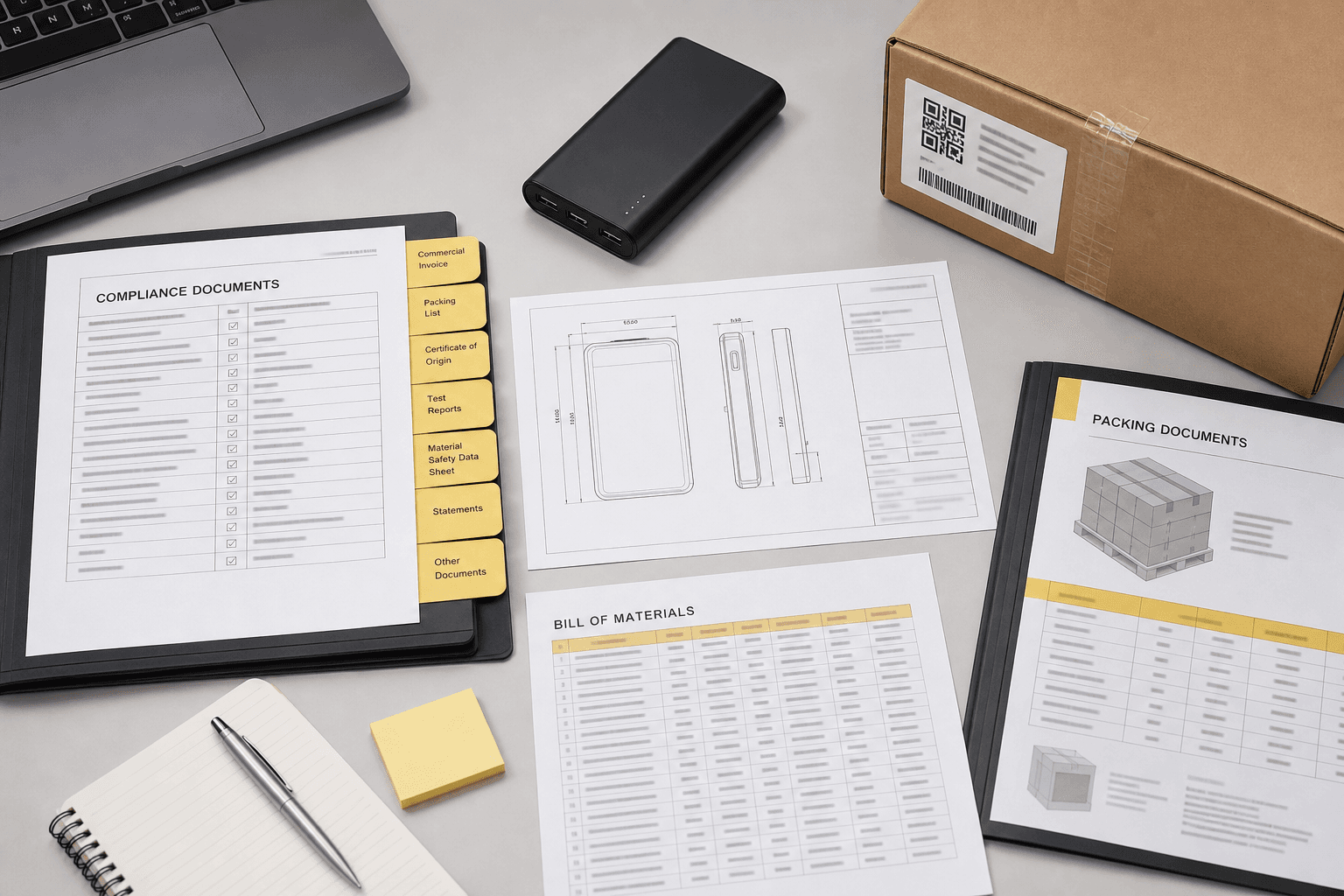
Ask for a model-specific folder with test reports, test summaries, declarations, label drawings, instruction manual, product specification, cell specification, safety data, circuit and critical-component list as appropriate. Use a tracker with document title, issuing body, model, issue date, expiry or review trigger and owner.
Step 2: authenticate and cross-check
Check the laboratory’s accreditation scope where relevant, the report number with the issuing body when a database exists, and the product photographs inside the report. Compare model spelling, PCB or firmware revision, capacity, cell, ports and enclosure. A real report can still be irrelevant if it covers a different construction.
Step 3: manage changes
Require written notice before changes to cells, protection ICs, charging coils, magnets, thermal materials, PCB layout, firmware, enclosure resin, cables or suppliers. The laboratory or compliance owner should decide whether the change needs engineering review, partial testing, a report amendment or full retest.
Step 4: verify production
Use golden samples, incoming inspection and functional limits. Include rated capacity or energy checks, port protocols, protection behavior, surface temperatures, appearance, labeling and packaging. Randomly compare components against the controlled BOM. Compliance is maintained batch by batch; it is not permanently conferred by a PDF.
- Reject reports with mismatched models or missing product photos.
- Confirm the certificate holder and manufacturing site relationship.
- Keep editable artwork under version control.
- Record who approved deviations and why.
- Retain samples and batch traceability for complaints or recalls.
A pre-order compliance workflow
At concept stage, define the countries, channel, user, functions and claims. Ask a qualified laboratory for a written preliminary assessment. During supplier selection, review existing platform evidence and gaps. Before tooling, confirm the cell, electrical architecture, wireless functions, materials and labeling space. Before certification, freeze the build and prepare pre-compliance samples.
Before the purchase order, agree who pays for initial tests, failures, retests and changes; who owns reports and certificates; how the buyer may use them; which entity signs declarations; and how long records and samples will be retained. Add a change-control clause and right to audit. Before shipment, receive final documents, approved artwork, batch inspection, transport package evidence and any market registrations controlled by the importer.
The practical goal is not the largest certificate list. It is a small, complete and defensible evidence set for the exact product you sell. TOPTAI can help buyers organize specifications, samples and available reports, but the final market-access decision should remain with the importer and its chosen competent adviser. That division of responsibility creates clarity instead of false assurance.
Testing failures and corrective action
A failed pre-compliance test is information, not a reason to shop for a friendlier report. Ask the laboratory to identify the condition, mode, frequency, sample and limit. Preserve the failed unit. The engineering team should reproduce the result, identify the root cause and document the change. Common actions may involve layout, shielding, filtering, firmware, thermal materials, protection thresholds, cell selection or mechanical reinforcement.
Corrective action can create secondary risk. Adding a metal shield may change wireless performance or heat. Reducing charge current may affect the advertised time. Changing enclosure resin may affect drop performance or restricted-substance documentation. Re-test the affected requirement and run a regression plan across coupled functions. Update the BOM, drawing, firmware identifier, risk assessment and sample status.
The commercial agreement should allocate failed-test cost without encouraging concealment. Define the included pre-compliance rounds, laboratory quotation approval, responsibility for design-caused retests and the buyer’s responsibility when it requests a late customization. No shipment should substitute an unreviewed component because the approved item is unavailable. An authorized deviation needs technical and compliance sign-off before production.
Marketplace, retailer and recall readiness
Legal market access is the floor. Retailers and online marketplaces may request additional laboratory reports, battery documentation, insurance, responsible-party details, factory audits or restricted-substance declarations. Their policies can change and may be stricter than legislation. Collect channel requirements at the brief stage; otherwise a technically compliant product can still miss its listing date.
Create a complaint taxonomy before launch. Track overheating, swelling, odor, charging interruption, port damage, capacity dissatisfaction and compatibility separately. Preserve returned units when safe, record batch and serial or date codes, and investigate trends. Define escalation thresholds and contacts. Fast access to the approved BOM, production records and shipment destinations is critical if a field action becomes necessary.
A recall plan should identify who can stop sales, notify authorities and channels, contact customers, retrieve units and report corrective action. The plan is not an admission that a recall will happen; it is evidence that the importer takes product safety seriously. Test the contact tree and record system before launch. Supplier traceability should connect finished goods to critical components and production dates.
Compliance questions to put in the RFQ
What exact model and revision do the reports cover?
Request model mapping and internal photographs. If multiple commercial names share a platform, obtain the documented relationship. Ask which color, cell or accessory variants were included and which changes need laboratory review.
Who is the legal certificate or report holder?
Record the company name, address and relationship to the factory. Confirm that your brand may lawfully reference the evidence and marks. A report owned by an unrelated trader can become unusable when that relationship ends.
Which requirements remain the importer’s responsibility?
Ask specifically about EU economic-operator details, declarations, EPR registrations, national languages, marketplace submissions and US responsible-party obligations. Put the answer in a responsibility matrix with dates and named owners.
How is conformity protected in mass production?
Request the control plan for cells, protection devices, PCB and firmware, plus incoming and final inspection. Define notification and approval rules for substitutions. Compliance evidence loses value if production can drift from the tested construction without detection.
Sources and editorial note
This guide combines current primary-source guidance with TOPTAI’s experience supporting OEM/ODM power bank evaluation. Requirements can change by model, market, carrier and date; confirm the exact product and destination before ordering or traveling.

ABOUT THE REVIEWER