
TRAVEL SAFETY · 2026 GUIDE
Airline Power Bank Rules in 2026: Wh Limits, Carry-On Safety and Buyer Design
A current guide to the 100Wh limit, carry-on-only treatment, changing airline use restrictions and the product details travel-accessory buyers should specify.
 Reviewed by Grace WongCo-Founder | Custom Charging Solutions Lead · Updated August 4, 2026 · 14 min read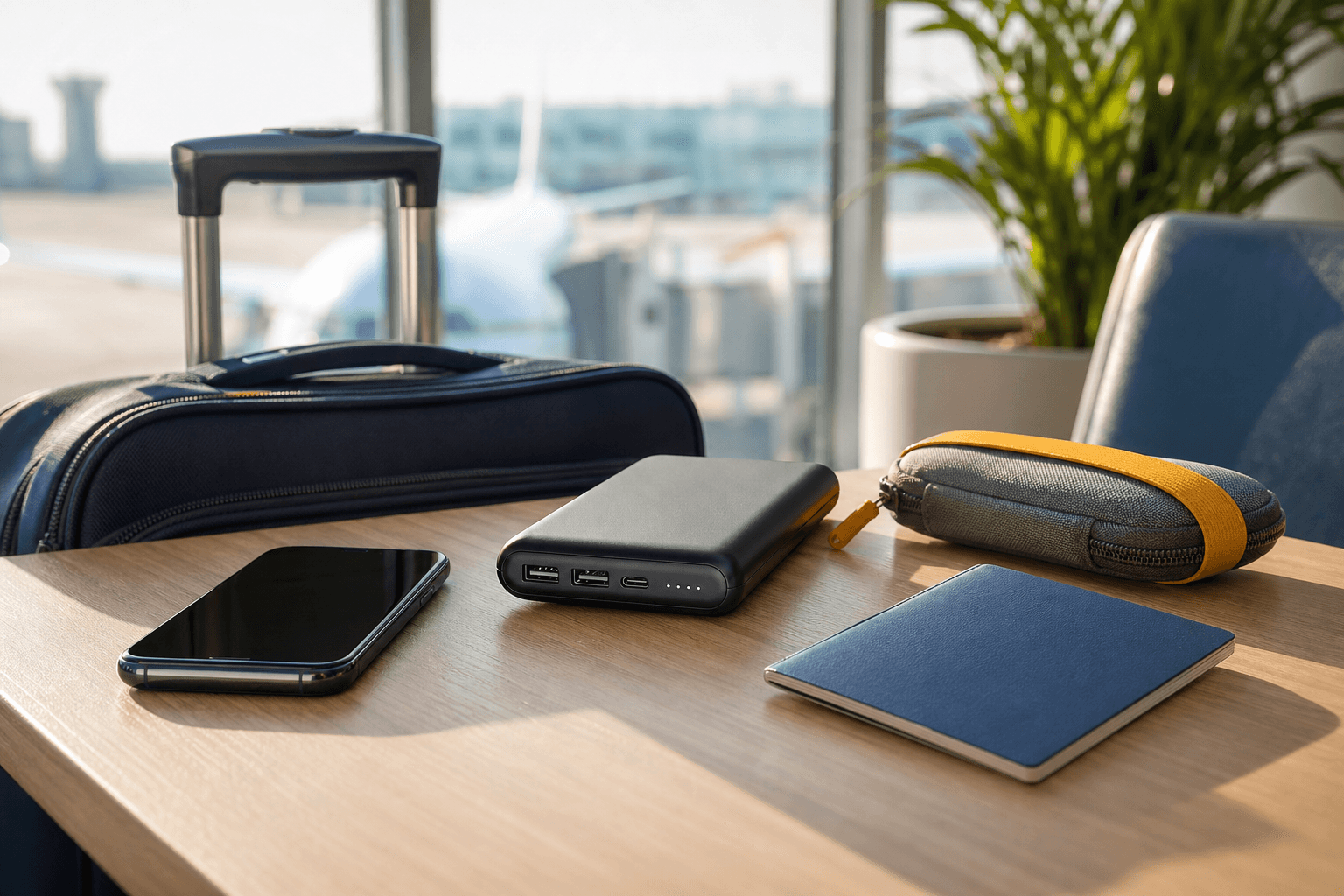
Power banks are treated as spare lithium batteries and belong in carry-on baggage, not checked baggage. Under current FAA guidance, lithium-ion power banks are limited to 100Wh per battery; the FAA allows up to two 101–160Wh spare batteries with airline approval, but IATA’s 2026 operator guidance shows power banks above 100Wh as forbidden, so the stricter airline and route rule controls. Many airlines now also restrict using or charging a power bank on board. Check the operating carrier immediately before travel, keep terminals protected and keep the unit accessible—not in an overhead bag during use.
The core rule: carry-on, not checked baggage
A power bank is a spare lithium battery because its main purpose is to provide energy to another device. That classification matters more than the marketing name. IATA’s passenger guidance and the US Federal Aviation Administration both direct travelers to keep spare batteries and power banks in the cabin. They must not be placed in checked baggage. If a carry-on bag is gate-checked, remove the power bank before handing over the bag.
The safety logic is straightforward. A damaged or defective lithium battery can overheat and enter thermal runaway. Cabin crew can see smoke or heat in the passenger cabin and respond using established procedures. A battery hidden in a cargo hold is harder to detect and access. Passengers should therefore keep the unit reachable, protect it from crushing and avoid placing it where seat mechanisms can trap it.
Rules are not perfectly uniform. Aviation bodies set a baseline, national authorities implement rules and airlines can impose stricter operational limits. A code-share itinerary can involve more than one operating carrier. Airport security staff also apply local procedures. The reliable advice is to check every operating carrier’s dangerous-goods or baggage page close to departure and comply with the strictest rule across the trip.
Understand the 100Wh threshold
The common limit is expressed in watt-hours, not milliampere-hours. FAA guidance limits ordinary lithium-ion spare batteries and power banks to 100Wh per battery. The label should state Wh directly. When only nominal capacity and voltage are available, energy is calculated as Wh = Ah × V, or Wh = (mAh ÷ 1000) × nominal voltage.
For example, a 10,000mAh lithium pack rated at 3.7V is 37Wh; a 20,000mAh pack at 3.7V is 74Wh. A nominal 27,000mAh pack at 3.7V is 99.9Wh, very close to the boundary. Do not use USB output voltage such as 5V, 9V or 20V in this cell-energy calculation unless that is genuinely the battery’s rated nominal voltage. The manufacturer’s declared Wh rating should be based on the battery configuration and be printed legibly.
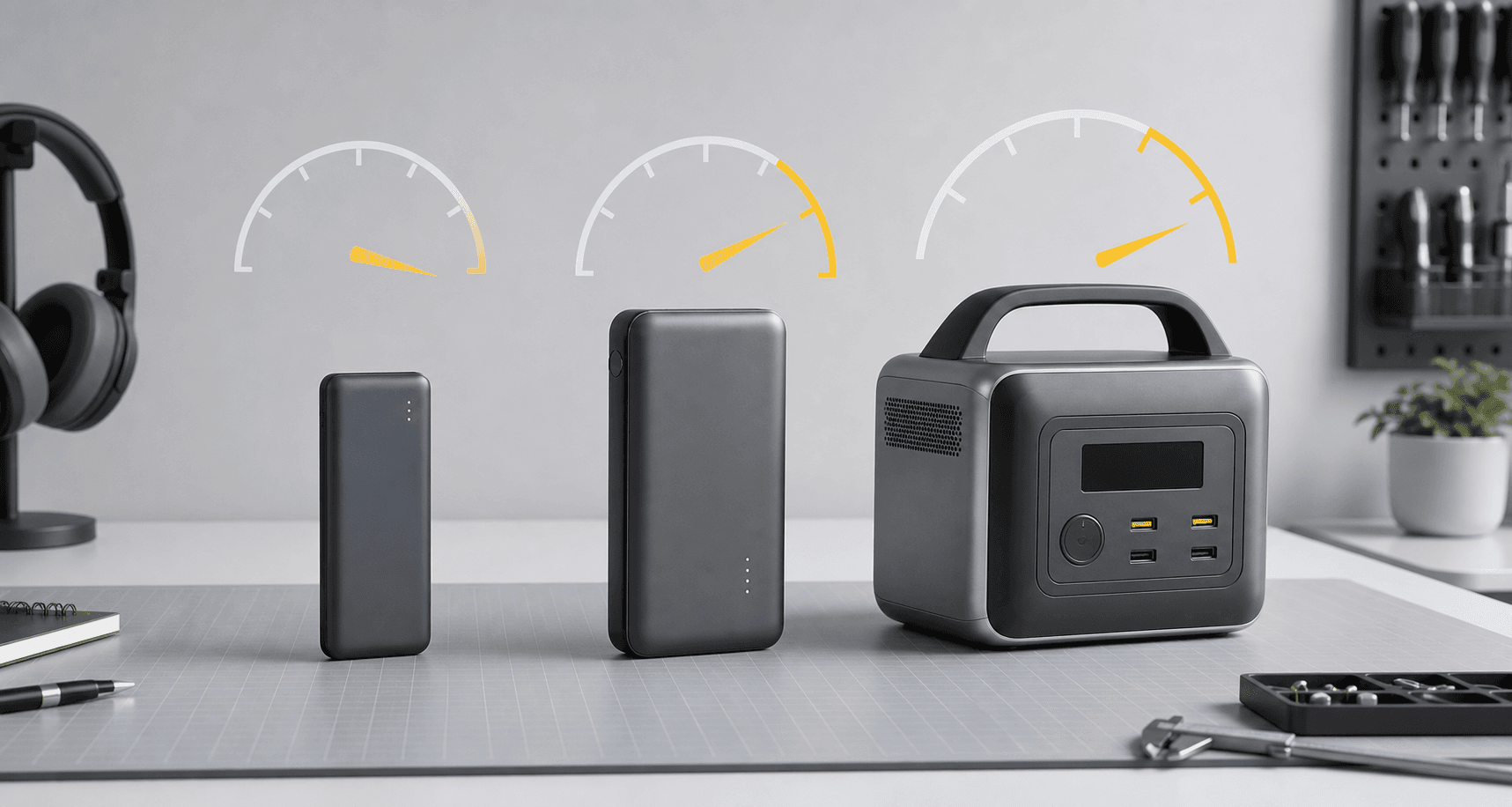
Above 100Wh, policy diverges in ways that matter in 2026. The FAA says passengers may carry up to two larger spare lithium-ion batteries of 101–160Wh with airline approval. However, IATA’s 2026 guidance to operators distinguishes power banks from some other spare batteries and lists power banks over 100Wh and up to 160Wh as forbidden. Airlines are also adding their own limits. A travel brand should not market a power bank above 100Wh as routinely passenger-airline friendly.
| Typical label example | Energy | General travel position | Buyer note |
|---|---|---|---|
| 5,000mAh at 3.7V | 18.5Wh | Well below 100Wh | Pocket-friendly; verify full label |
| 10,000mAh at 3.7V | 37Wh | Below 100Wh | Common travel and gift capacity |
| 20,000mAh at 3.7V | 74Wh | Below 100Wh | Heavier; still check carrier quantity/use rules |
| 27,000mAh at 3.7V | 99.9Wh | At the practical boundary | Allow tolerance and make Wh highly visible |
| 30,000mAh at 3.7V | 111Wh | Over 100Wh | Do not promise normal passenger acceptance |
What changed for travelers in 2026
The capacity baseline is only part of the story. Airlines have responded to battery incidents with restrictions on where power banks may be stored and whether they may be used in flight. Some carriers prohibit charging a phone from a power bank, prohibit charging the power bank from a seat outlet, limit each passenger to a specified number, or require the unit to remain visible or in a seat pocket rather than in the overhead bin.
IATA published updated operator guidance for power banks, and its consumer campaign emphasizes checking capacity, carrying batteries correctly, protecting loose batteries, watching for damage and following crew instructions. FAA’s PackSafe page was updated in April 2026 and continues to direct power banks to carry-on baggage. Individual airline policies can change faster than a printed product manual, so packaging should direct customers to current carrier guidance rather than make a universal promise.
Travel content also needs date discipline. A blog that says “all airlines allow two power banks” may be wrong for a specific operator or special itinerary. State what the authority says, distinguish general guidance from carrier rules and show the update date. This is why TOPTAI recommends a QR code or web link to a maintained travel-safety page in addition to durable warnings and ratings on the product.
How passengers should pack a power bank
Inspect before packing
Do not travel with a swollen, cracked, punctured, leaking, unusually hot or recalled power bank. Check that the housing is closed, the ports are clean and the rating label is readable. If the unit has been dropped hard, exposed to water or behaves unpredictably, stop using it and follow local battery-disposal guidance.
Prevent short circuits and accidental activation
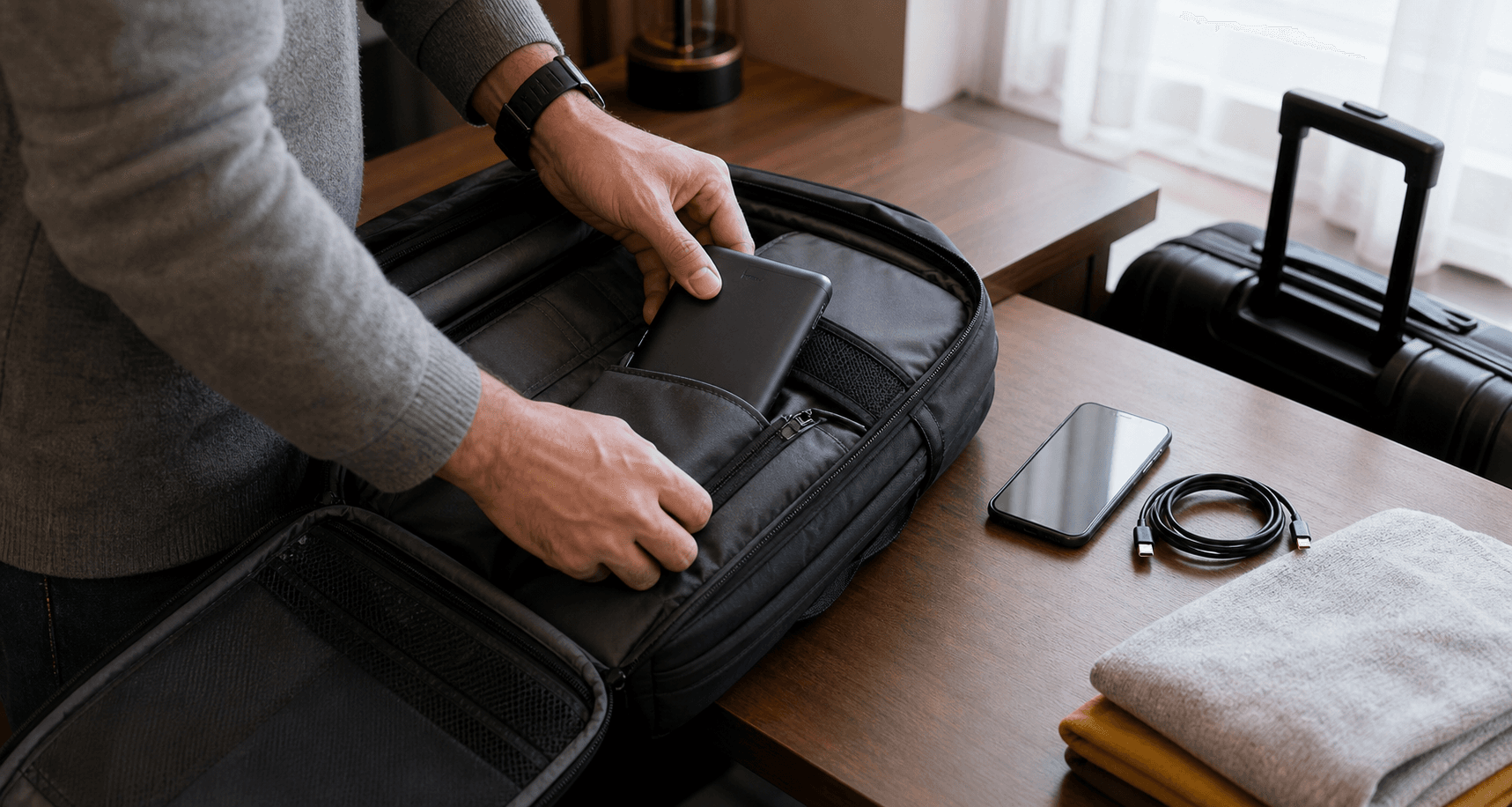
Keep the power bank in its own pouch or retail protective sleeve, or otherwise cover exposed terminals. Do not let loose coins, keys or metal tools bridge contacts. Turn off outputs when possible and avoid packing the activation button under pressure. Store cables separately or neatly so connectors do not damage ports.
Keep it accessible in the cabin
Place the unit in a personal item or accessible carry-on compartment. Follow the airline if it requires storage in a seat pocket during flight. Do not wedge it into a seat, leave it under bedding or use it inside a closed bag where heat cannot dissipate. Never retrieve or use it against crew instructions.
Respond to warning signs
If a battery becomes hot, deforms, hisses, smells unusual, leaks or smokes, stop using it and alert cabin crew immediately. Do not handle a smoking unit casually or try an improvised disposal method. Crew members are trained for onboard battery events and need to know at once.
Design a travel-ready power bank range
TOPTAI can help shortlist compact models, define visible Wh labeling, select USB-C and magnetic features and prepare OEM samples for your target travel or gift channel.
Request catalog & quotation →Travel-ready product design requirements
For a buyer, travel suitability begins with a conservative energy target and an honest, durable label. Put rated capacity, nominal voltage and Wh where they can be read without opening a sealed enclosure. Include model, manufacturer traceability and required electrical information. Laser marking or a durable, abrasion-resistant label is preferable to ink that disappears after months in a bag.
Mechanical design should protect the cell and ports from normal impacts. Rounded corners, a robust enclosure, cell spacing, controlled fasteners, insulation, strain relief and a stable PCB all contribute. Built-in cables should recess securely. Stands and magnetic rings should not create sharp points or expose the cell when dropped. The power button should resist accidental activation without becoming frustrating.
Electrical protection should address overcharge, over-discharge, overcurrent, short circuit and temperature in the context of the full product. Fast-charging profiles and simultaneous outputs must stay inside the cell and thermal design limits. A display can help users understand remaining energy, but it must not replace the required rating label. Production firmware and protection components must be controlled after testing.
Travel brands should validate temperature during pocket use, wired fast charging, magnetic charging, pass-through scenarios and warm ambient conditions. Drop and vibration tests should reflect luggage handling. The finished battery must have the appropriate UN 38.3 transport evidence and test summary, while shipping preparation follows the applicable air, sea or road dangerous-goods rules.
A sourcing checklist for travel brands
- Target capacity and Wh with design margin below 100Wh
- Legible permanent Wh, voltage, capacity, model and traceability label
- Cell and finished battery model linked to UN 38.3 evidence
- Product-level electrical, mechanical and thermal safety evaluation
- USB-C Power Delivery profiles confirmed with target devices
- Clear rules for simultaneous wired/wireless outputs and pass-through
- Protected ports, robust enclosure and low accidental-activation risk
- Warnings and instructions reviewed for target-market languages
- Packaging that protects terminals during shipment and consumer travel
- Change control for cells, PCB, protection IC, firmware and enclosure
Ask for multiple production-representative samples, not only an engineering prototype. Measure rated energy and usable output under a defined load. Run charge and discharge cycles, thermal mapping, port durability, drop, vibration and functional protection checks. Inspect the label after abrasion and common cleaning exposure. Keep an approved golden sample and comparison photos.
For a corporate-gift program, consider how logo methods affect heat and label visibility. Do not cover the Wh rating with a client logo or sleeve. For retail, avoid airplane graphics paired with “airline approved.” Prefer accurate language such as “37Wh rated battery; check your airline’s current rules.” For e-commerce, show the rating label in listing images so buyers and airport staff can identify it easily.
Frequently asked buyer questions
Can I take a 20,000mAh power bank on a plane?
Often yes if its correctly declared energy is below 100Wh, it is in carry-on baggage and the operating airline permits it. A typical 20,000mAh pack at 3.7V is 74Wh, but use the product’s actual label and check the carrier. Capacity alone does not override damage, recall, quantity or use restrictions.
Can I use a power bank during the flight?
Do not assume so. A growing number of airlines prohibit using or charging power banks on board, or restrict where they may be kept. Follow the operating carrier and crew instructions even when the unit is below 100Wh.
Is a CE or UN38.3 mark enough for airport acceptance?
No. UN 38.3 is transport-test evidence, not passenger approval; CE relates to applicable EU product conformity. Airport and airline decisions rely on dangerous-goods rules, a legible Wh rating, condition and carrier policy. A vague symbol cannot replace this information.
What capacity is easiest for a travel retail line?
Five-thousand and 10,000mAh classes are compact and comfortably below 100Wh when correctly engineered and rated. Twenty-thousand mAh offers more energy but adds weight and heat-management demands. Select from the traveler’s trip length, device mix and channel price point, then validate the exact design.
Air shipment is different from passenger baggage
A carton of power banks moving from a factory to a distributor is cargo, not passenger baggage. It follows dangerous-goods classification, state-of-charge, packaging, quantity, marking, labeling, declaration and carrier-acceptance rules that depend on battery configuration and transport mode. Passenger permission to carry one 37Wh unit says nothing about whether a commercial air shipment has been prepared correctly.
Power banks are generally shipped as lithium-ion batteries rather than batteries contained in equipment because their purpose is to provide power externally. The shipper should work with trained dangerous-goods personnel and the current ICAO/IATA, maritime or road requirements. Airlines and forwarders may impose operator variations or refuse certain routes. Never describe commercial cartons as ordinary electronics to avoid a battery surcharge.
Buyers should ask who is the shipper of record, which packing instruction and UN number the forwarder applies, what state of charge is required, and which documents accompany the lot. Confirm that the UN 38.3 test summary matches the shipped battery. Freight quotes should state whether dangerous-goods handling, inspection, terminal fees and last-mile restrictions are included.
Merchandising without misleading travelers
Travel imagery is persuasive, but it must not imply blanket permission. Avoid an aircraft icon beside “approved,” because no single manufacturer can approve a product for every carrier, country and date. Better copy states the rated Wh, carry-on-only principle and a clear instruction to verify the operating airline. Date the online guidance and maintain it.
Make the capacity calculation understandable on the product page. Show nominal cell voltage and Wh, then separately explain USB-C output power. Do not calculate 10,000mAh × 5V and call the result battery energy if 5V is only a converted output. Clear technical information helps consumers, retail staff and airport screeners while reducing support tickets.
A travel bundle can add value without changing the battery: a terminal-protective pouch, short certified cable, concise safety card and accessible digital manual. Packaging should let the buyer inspect the rating without destroying the box where practical. Corporate-gift artwork must leave warnings and identity information unobstructed.
Quality control for repeat travel orders
Approve a golden sample after electrical and mechanical validation. The inspection specification should identify weight, dimensions, ports, USB-C profiles, usable energy method, LED or display behavior, protection responses, label adhesion and packaging. Set tolerances and an acceptance sampling plan appropriate to the order and risk. Verify a selection at low and high state of charge.
Battery cells deserve lot-level traceability. Record supplier, model, date or lot code, incoming voltage and relevant inspection results. Control protection ICs, temperature sensors, firmware and enclosure materials. A substitute cell with the same printed capacity can have a different discharge capability, thickness or safety behavior. Require approval before any critical substitution.
Monitor field data by production batch and travel channel. Complaints about airport refusal may reveal an unreadable label even when the energy is acceptable. Reports of heat may cluster around a specific fast-charging mode or accessory. Feed those observations into the next order’s design and manual. A travel product stays credible when evidence continues after the first shipment.
Sources and editorial note
This guide combines current primary-source guidance with TOPTAI’s experience supporting OEM/ODM power bank evaluation. Requirements can change by model, market, carrier and date; confirm the exact product and destination before ordering or traveling.

ABOUT THE REVIEWER