
WIRELESS CHARGING · B2B PRODUCT SELECTION
Does Your Brand Really Need Qi2.2 25W Certification?
Compare Qi2.2 25W certification, channel requirements, sustained charging performance, cost, lead time and launch risk before selecting a wireless charger.
 Reviewed by Grace WongCo-Founder | Custom Charging Solutions Lead · Updated August 31, 2026 · 14 min read
Qi2.2 25W certification is valuable when a retailer, distributor or long-term brand program requires standards-based interoperability or use of the Qi2 mark. For a small market test or a price-sensitive channel, a carefully tested performance-focused 25W solution may offer a better balance of cost and launch speed. Confirm the channel requirement first, then validate sustained power, temperature and device compatibility.
Why do so many B2B buyers ask for Qi2.2 25W?
Qi2.2 25W has become a popular sourcing term because buyers associate it with faster wireless charging, better magnetic alignment, support for newer smartphones and a stronger upgrade from the crowded 15W category.
According to the Wireless Power Consortium, the 25W profile raises available charging power substantially compared with the original 15W Qi2 profile. Official certification also verifies the exact product against WPC requirements for safety, interoperability and backward compatibility.
These benefits are meaningful, but not every buyer searching for a Qi2.2 25W wireless charger needs the same commercial solution. A major retailer may require an officially certified product and licensed mark. An online seller may care more about real charging time, temperature control, design and speed to market.
Certification is a channel decision, not only a technical decision
Certification is more likely to create value when a retailer or distributor explicitly requires it, the brand needs to display the Qi2 mark, standardized interoperability supports the brand promise, or the product is expected to remain in the range for several years.
- Major retail or controlled distribution programs
- Established brands selling across several markets
- Products that need licensed certification marks on packaging
- Programs with enough planned volume and margin to support certification
Certification may be less urgent when the product is a small category test, the channel does not require it, the target customer prioritizes charging speed and price, or a seasonal launch has a fixed delivery window.
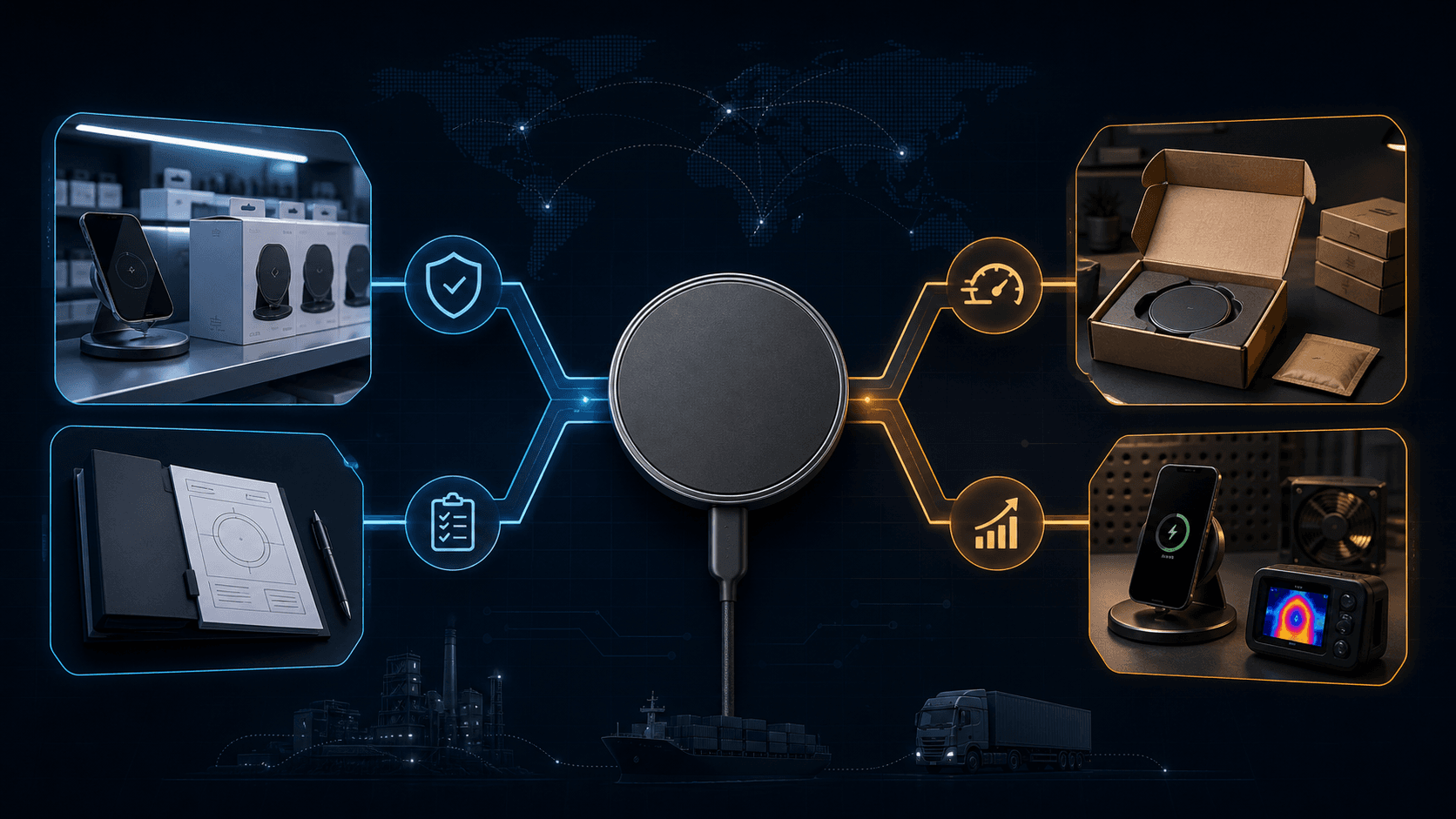
Which B2B buyers are more likely to need certification?
| Buyer type | Typical recommendation | Main decision factor |
|---|---|---|
| Apple-related supply-chain customer | Certification is usually important | Supply-chain and compliance requirements |
| Established consumer electronics brand | Evaluate certification seriously | Brand credibility, global sales and long product life |
| Supplier to a major retail chain | Often required | Retailer onboarding and compliance rules |
| Mature Amazon or independent-site brand | Depends on positioning | Selling price, customer trust and competitive strategy |
| Social-commerce seller | Not always necessary | Launch speed, differentiation and price sensitivity |
| Promotional gift supplier | Usually performance and budget led | Project cost, customization and delivery date |
| New brand testing wireless charging | Consider testing first | Initial risk, sales validation and cash flow |
| Wholesaler serving several channels | Consider offering both options | Different downstream requirements |
Confirm the requirement with the target channel before finalizing samples, packaging and marketing materials. Discovering a mandatory certification rule after artwork or tooling has been approved creates avoidable cost and delay.
When does a performance-focused 25W solution make more sense?
A performance-focused 25W solution can suit buyers whose main objective is faster practical charging without the development commitment of an officially certified product. Typical users include e-commerce brands testing a higher-power offer, sellers upgrading from 15W, niche brands, gift programs and buyers starting with a controlled first order.
However, 25W on a specification sheet is not enough. A charger that briefly reaches a high peak may deliver a poor experience if heat causes rapid power reduction. Ask for evidence of sustained output, real charging time and thermal behavior.
An uncertified product must be represented accurately. It must not be described as Qi2.2 Certified, and the official certification mark must not appear on the product, packaging or listing unless the exact configuration is certified and licensed.
Need the right 25W route for your channel?
Share your market, channel, target price, quantity and certification requirements. TOPTAI can compare suitable platforms and prepare a practical sample plan.
Request catalog & quotation →Certified vs. performance-focused: what changes for the buyer?
| Decision area | Qi2.2 25W certified solution | Performance-focused 25W solution |
|---|---|---|
| Primary value | Standardized compliance and interoperability | Practical performance and commercial flexibility |
| Best suited to | Compliance-led brands and controlled retail channels | E-commerce, niche brands, gifts and market testing |
| Product claim | Approved certification claims and marks when licensed | Accurate performance descriptions without certification claims |
| Development investment | Higher | Lower in most projects |
| Project preparation | More testing and certification coordination | Faster with a mature existing platform |
| First-order flexibility | Better suited to planned-volume programs | More suitable for controlled trial orders |
| Brand benefit | Stronger standards-based trust signal | Balance of performance, cost and launch speed |
| Main risk | Paying for certification without channel value | Overstating compliance or selecting an unstable design |
The lowest unit price is not automatically the best choice. Nor is the certified product automatically the most profitable. Select the route that supports the actual route to market.
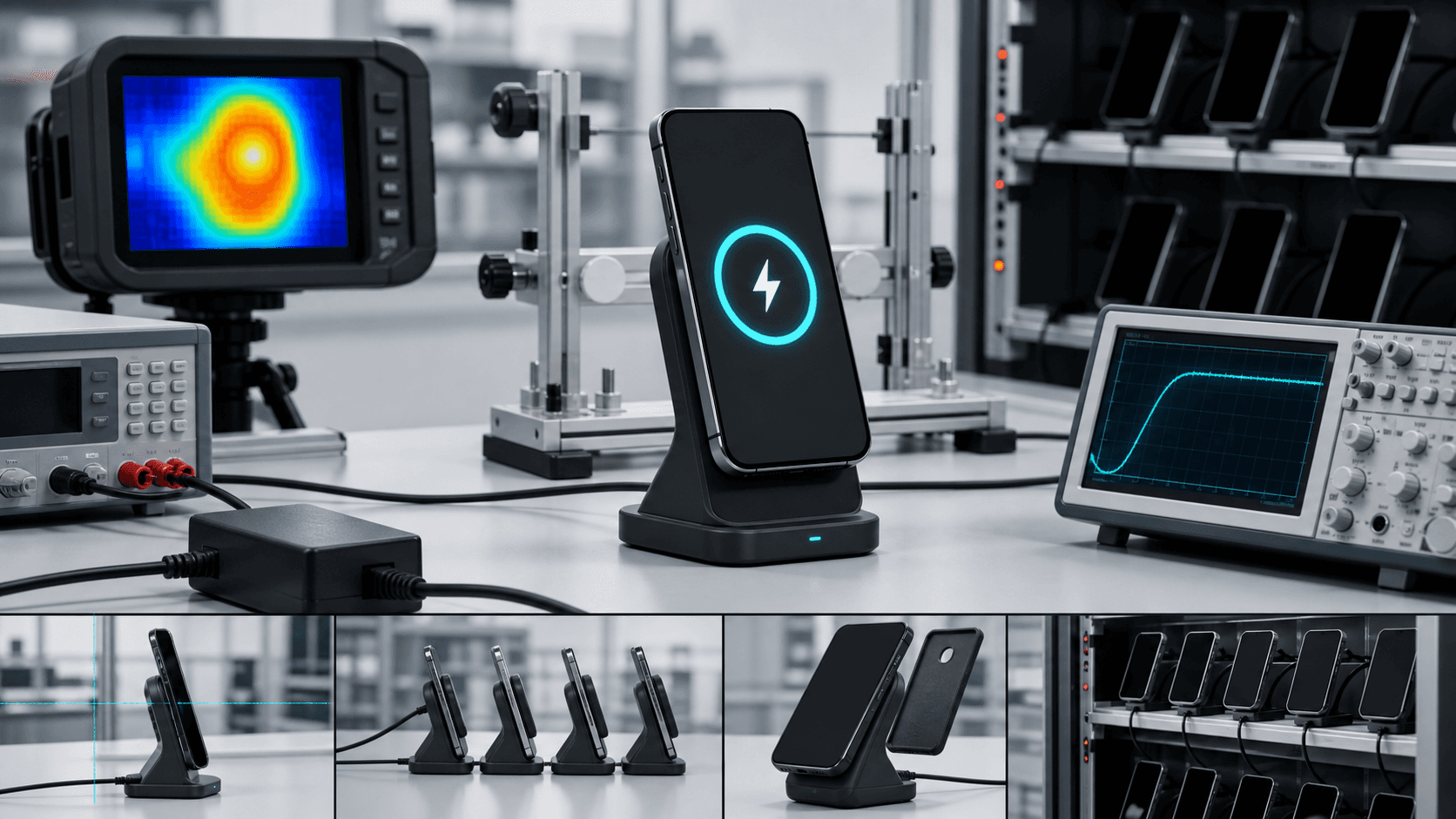
What should buyers verify beyond the 25W claim?
Compatible phone models and charging curve
Confirm the exact phones tested and request a charging curve that shows how power changes as battery level and product temperature rise. Do not rely on one peak-power screenshot.
Real charging time and temperature control
Measure practical milestones such as 0–50% and 0–100%. Review surface temperature, internal protection, power-reduction thresholds and shutdown behavior.
Adapter, cable and mechanical alignment
The charger, cable and adapter operate as one system. Confirm the required input protocol, coil position, magnet strength, housing material and product thickness.
Aging, repeated use and claims
Validate extended operation and repeated cycles. Review performance claims, compatibility statements and certification language separately before approving packaging.
Three product-launch strategies for B2B buyers
Strategy 1: Certification first
Choose this route when certification is part of the channel requirement or long-term brand strategy. Confirm markets, product configuration, annual volume, packaging claims and schedule at the start.
Strategy 2: Performance first
Choose this route when practical speed, thermal control, purchase price and launch timing matter more than an official mark. Use disciplined testing and accurate marketing.
Strategy 3: Test first, certify after validation
Select a mature 25W solution for a controlled trial, test the main customer devices, launch in a limited channel and measure conversion, feedback and returns. If demand reaches the planned level, move to a certified long-term program.
The third route is not suitable when the initial channel already requires certification. Channel requirements must always be confirmed first.

A practical project evaluation checklist
- Which countries and sales channels will carry the product?
- Does a retailer, distributor or platform require Qi2.2 certification?
- Does the brand need the Qi2 mark on the product or packaging?
- Which phone models represent most target users?
- What retail price and gross margin are required?
- What are the expected first order and annual volume?
- Is this a market test or a long-term core product?
- What is the required launch date?
- Which matters most: certification, charging performance, unit cost or speed to market?
How TOPTAI helps buyers choose the right 25W solution
TOPTAI works with brands, wholesalers, e-commerce sellers and gift distributors on wireless charging wholesale and customization programs. The review begins with the market and channel rather than assuming every buyer needs the same certification route.
We evaluate the device profile, target retail price, order quantity, launch schedule, logo and packaging scope, performance expectations and compliance requirements. The project can then move through feasibility review, sampling, testing and controlled production.
Frequently asked questions
Is a 25W wireless charger automatically Qi2.2 certified?
No. Charging power and official certification are separate. Only an exact product that completed the required certification process may be described as certified.
Can a non-certified 25W charger use the Qi2 logo?
No. WPC certification marks are restricted to properly certified and licensed products.
Is a certified version always the better business choice?
Not necessarily. It is the better choice when certification supports channel access, brand positioning or long-term sales. A verified performance-focused solution may suit a small market test or price-sensitive channel.
What is a practical route for a new brand?
If the channel does not require certification, consider a controlled trial with a mature performance-focused solution. If demand is proven, evaluate certification for a larger and longer-term program.
Choose the solution your market actually needs
Qi2.2 25W certification can provide real value, but only when that value is recognized by the buyer's channel and customers. Faster performance, official certification, lower cost and faster launch are different benefits.
The best sourcing decision begins with the business model, not with the specification name. Share your market, channel, expected quantity, target price and launch date so the available routes can be compared before sampling.
Sources and editorial note
This guide combines current primary-source guidance with TOPTAI’s experience supporting OEM/ODM power bank evaluation. Requirements can change by model, market, carrier and date; confirm the exact product and destination before ordering or traveling.

ABOUT THE REVIEWER