
PRODUCT SELECTION · MARKET PLANNING
How to Choose the Right Wattage Power Bank for Your Market
A practical B2B guide to selecting 22.5W, 35W, 65W and 100W power banks by customer, sales channel and product-portfolio role.
 Reviewed by Grace WongCo-Founder | Custom Charging Solutions Lead · Updated August 28, 2026 · 12 min read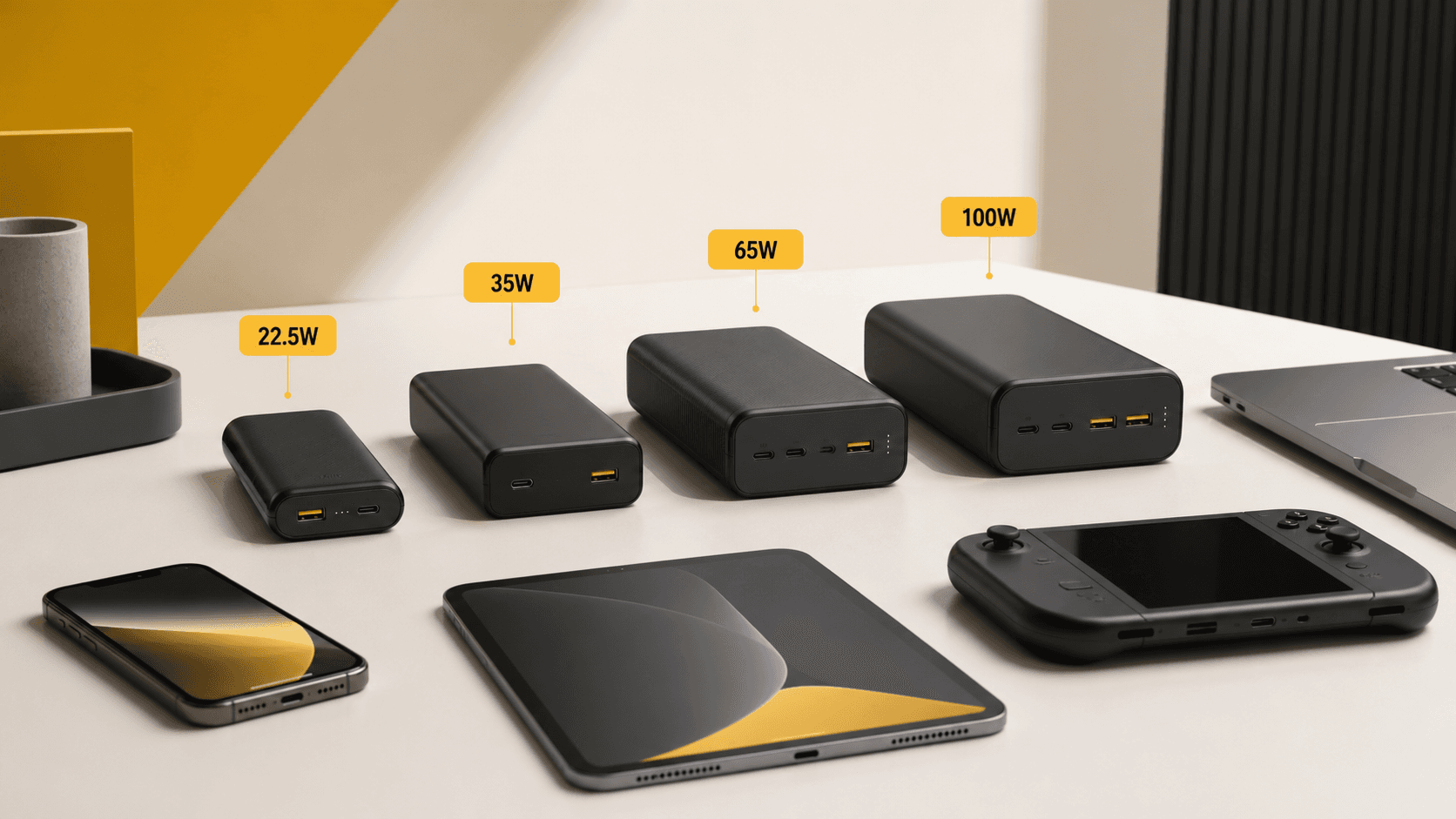
Do not default to the highest output. Choose a primary wattage that fits most target users, then add a small number of higher-power models. For many wholesale ranges, 22.5W is the mainstream tier, while 65W and 100W extend the offer to tablet, laptop and professional users.
Higher Wattage Does Not Always Mean a Better Product
Power output is only one part of power bank performance. A higher-wattage model can support a wider range of devices, but the connected device determines how much power it draws.
A 65W power bank can charge a phone that supports 20W, but the phone normally draws around 20W. The power bank provides a maximum output ceiling; it does not force the device to accept more power.
Actual performance also depends on device compatibility, USB-C PD, PPS or QC protocols, voltage and current profiles, cable quality, battery temperature and whether several ports are used at the same time.
A clear, well-matched specification can therefore be more commercially useful than a higher but unnecessary wattage.
Start With Mainstream Demand
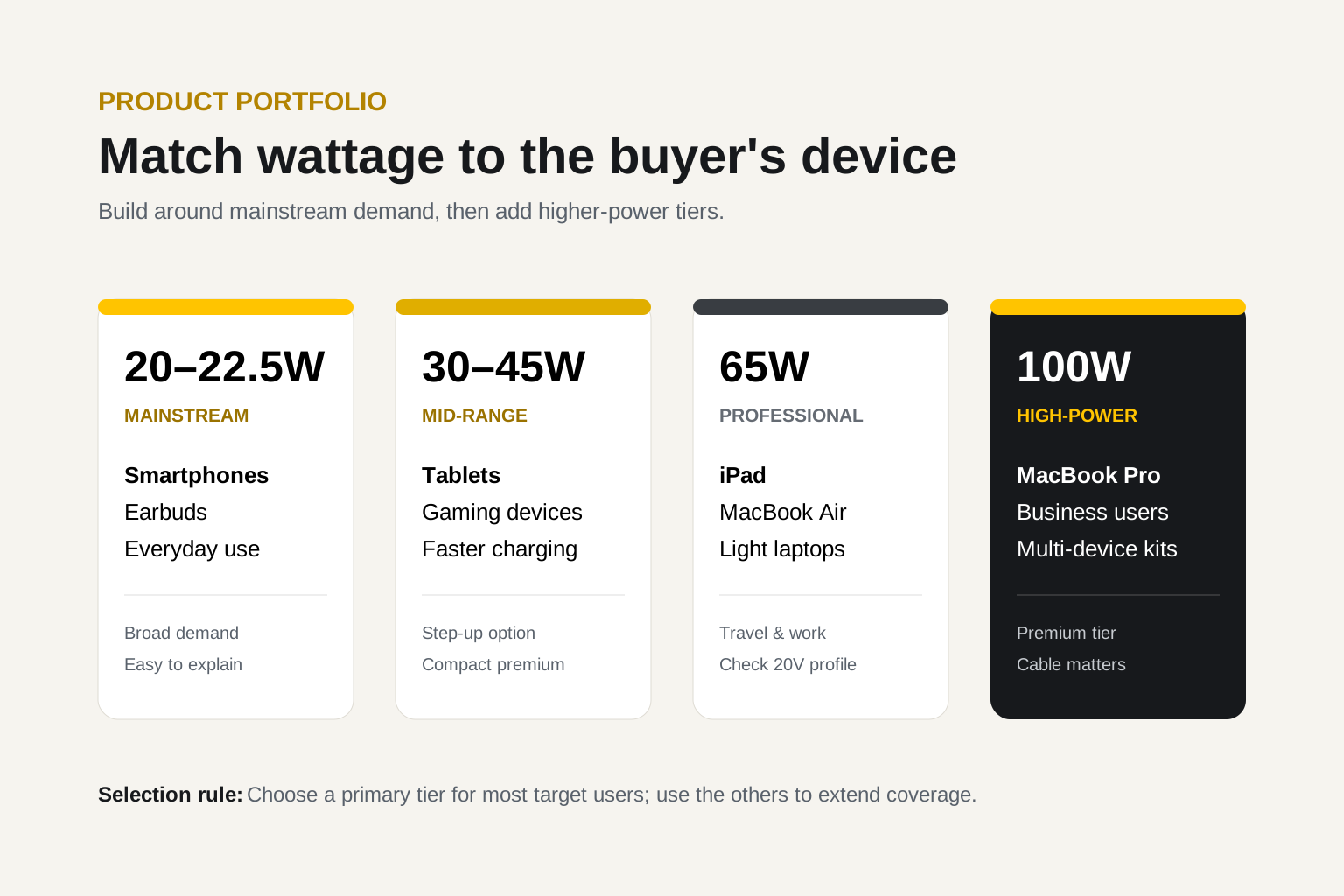
Select one main wattage for most customers and use other models to complete the range. For many general-purpose markets, 20W and 22.5W remain practical choices for smartphones, earbuds and everyday electronics.
- 20W or 22.5W as the main volume product
- 30W or 45W for a stronger fast-charging step
- 65W for tablets, handheld consoles and lightweight laptops
- 100W for business users and higher-performance laptops
The final mix should reflect the customer profile, sales channel, price position and expected order volume.
Recommendation for Wholesalers
Wholesalers usually need broad demand, competitive positioning and inventory turnover. A useful structure is a 22.5W core offer with selected 65W and 100W products as higher-performance options.
Main product: 22.5W
- Smartphones and earbuds
- Everyday travel and general retail
- Promotional and corporate gift projects
Supporting products: 65W and 100W
- Tablets and compatible USB-C laptops
- Handheld gaming devices
- Business travelers and professional users
- Multi-device charging requirements
High-power models should add a premium tier rather than replace the mainstream product.
Recommendation for Brand Owners
Business and professional users
For frequent travelers, remote workers and laptop users, 65W and 100W models can serve as flagship products. Review capacity, laptop compatibility, PD and PPS support, display, housing, packaging and any pass-through function on the exact sample.
Younger lifestyle users
For students, lifestyle customers and social-media shoppers, compact design and everyday convenience may matter more than maximum output.
- 20W or 22.5W output
- 5,000mAh or 10,000mAh formats
- Compact weight and built-in cables
- Magnetic charging where suitable
- Distinct colors, display or exterior design
The decision should follow the audience and use case, not a competitor's headline wattage.
Need a wattage mix for your channel?
Share your market, customer profile, sales channel, device mix and expected quantity. TOPTAI can shortlist relevant models for sample review.
Request catalog & quotation →Match the Wattage to the Sales Channel
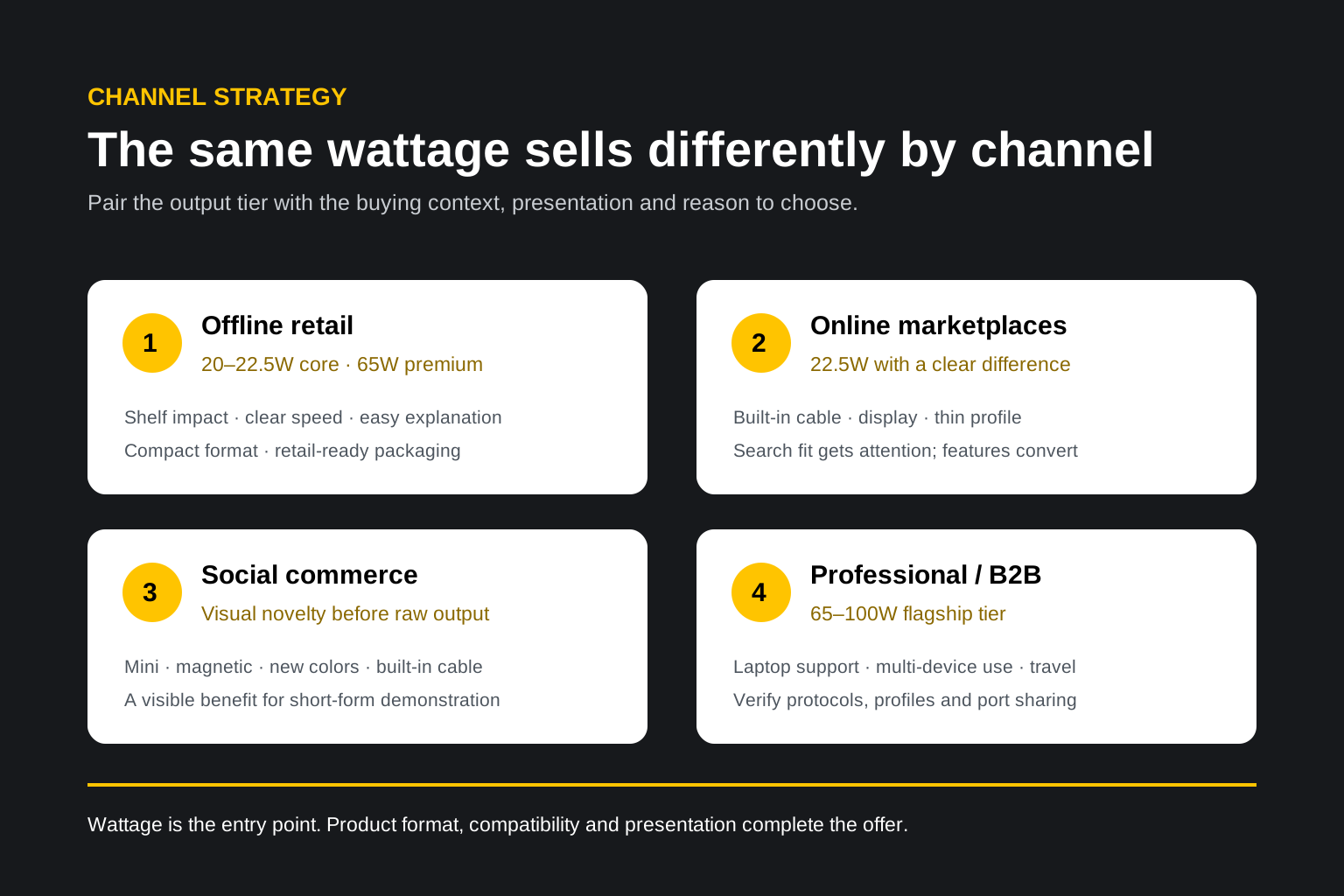
Offline retail and shopping malls
Focus on easy-to-understand 20W and 22.5W products, strong packaging and compact display. A selected 65W model can create a premium tier.
Online marketplaces
A standard 22.5W listing needs a visible difference such as a built-in cable, battery display, magnetic function, thin profile, faster input or a useful bundle.
Social commerce
Mini, magnetic and built-in-cable formats with new colors or a clear on-camera function are easier to demonstrate in short video. New 65W or 100W models work when their benefit is immediately visible.
The wattage may attract the search, but product format and presentation often determine conversion.
Build a Balanced Product Portfolio
For most B2B buyers, a tiered portfolio is more practical than a single output level.
| Product tier | Suggested wattage | Main target users |
|---|---|---|
| Mainstream | 20W–22.5W | Smartphone and everyday users |
| Mid-range | 30W–45W | Tablets, gaming devices and faster charging |
| Professional | 65W | iPad, MacBook Air and lightweight laptops |
| High-power | 100W | MacBook Pro, business users and higher-performance devices |
Use sales data to adjust the exact mix. The main product should serve most target users; other tiers extend the range to additional segments.
What B2B Buyers Should Confirm Before Ordering
Check more than the headline output before approving a model.
- Target devices and main sales channel
- Whether the wattage is maximum or continuous output
- Supported PD, PPS and QC protocols
- Required voltage profiles, including 20V for laptop use
- Power division when several ports are active
- Input wattage and recharge conditions
- Whether the included or built-in cable supports the rated output
- Safety and temperature protections
- Exact-model test reports and market-specific compliance documents
Request a production-representative sample and confirm real application limits before final artwork or mass production.
Choose the Wattage That Fits Your Market
The best power bank is not necessarily the one with the highest wattage. Wholesalers can use 22.5W as a mainstream tier with selected 65W and 100W models for tablet and laptop users.
- Business and professional users: review 65W or 100W models
- Younger lifestyle users: review compact 20W or 22.5W formats
- Online marketplaces: pair mainstream output with a clear difference
- Social commerce: prioritize visible novelty and demonstrability
- Offline retail: prioritize clarity, packaging and broad compatibility
A planned portfolio can reduce inventory concentration and make the range easier to position. TOPTAI supports model selection and customization review for wattage, capacity, protocols, appearance, logo, color and packaging.
Sources and editorial note
This guide combines current primary-source guidance with TOPTAI’s experience supporting OEM/ODM power bank evaluation. Requirements can change by model, market, carrier and date; confirm the exact product and destination before ordering or traveling.

ABOUT THE REVIEWER